QUESTION IMAGE
Question
rebekah gomez
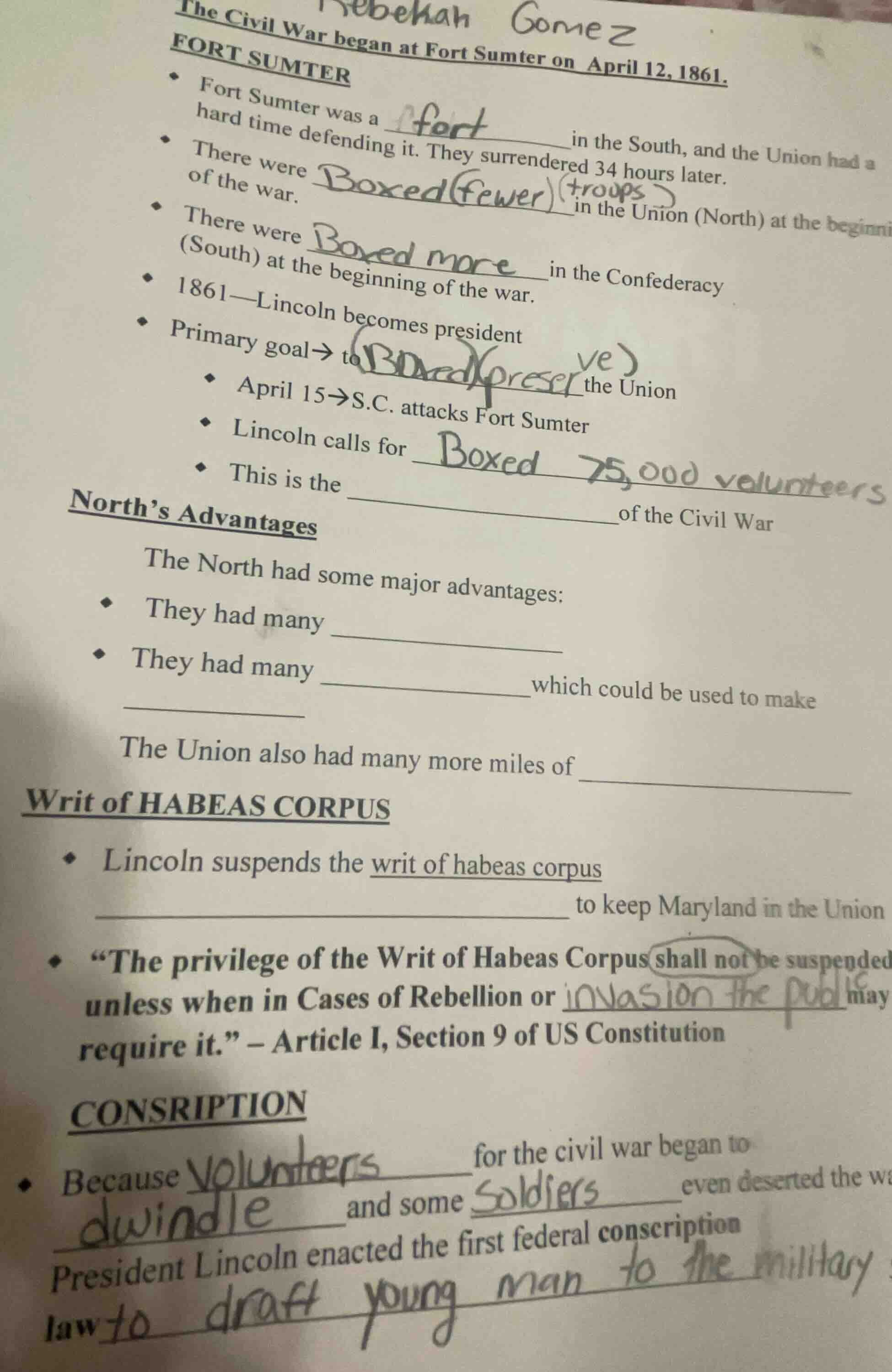
the civil war began at fort sumter on april 12, 1861.
fort sumter
- fort sumter was a ______ in the south, and the union had a hard time defending it. they surrendered 34 hours later.
- there were ______ in the union (north) at the beginning of the war.
- there were ______ in the confederacy (south) at the beginning of the war.
- 1861—lincoln becomes president
- primary goal→ to ______ the union
- april 15→s.c. attacks fort sumter
- lincoln calls for ______
- this is the ______ of the civil war
north’s advantages
the north had some major advantages:
- they had many ______
- they had many ____ which could be used to make ____
the union also had many more miles of ______
writ of habeas corpus
- lincoln suspends the writ of habeas corpus ______ to keep maryland in the union
- “the privilege of the writ of habeas corpus shall not be suspended unless when in cases of rebellion or ______ may require it.” – article i, section 9 of us constitution
consription
- because ____ for the civil war began to __ and some ____ even deserted the wa
president lincoln enacted the first federal conscription law ______
To answer the fill - in - the - blank questions related to the American Civil War, we analyze each blank based on historical facts:
1. Fort Sumter was a ______ in the South
Fort Sumter was a fort (military fortification) in the South. So the answer here is "fort".
2. There were ______ in the Union (North) at the beginning of the war (for troops)
At the start of the Civil War, the Union (North) had fewer troops compared to what the Confederacy (South) had in terms of the initial troop levels (though the North had other advantages like industrial capacity). So the answer is "fewer troops".
3. There were ______ in the Confederacy (South) at the beginning of the war (for troops)
At the beginning of the Civil War, the Confederacy (South) had more troops available initially for the fight. So the answer is "more troops".
4. Lincoln's primary goal was to ______ the Union
Lincoln's main aim as president during the Civil War was to preserve the Union. So the answer is "preserve".
5. Lincoln calls for ______
After the attack on Fort Sumter, Lincoln called for 75,000 volunteers to fight for the Union. So the answer is "75,000 volunteers".
6. This is the ______ of the Civil War
The attack on Fort Sumter and the subsequent call for volunteers marked the beginning of the Civil War. So the answer is "beginning".
7. The North had many ______
The North had many factories. The Northern states were more industrialized, and these factories were used to produce war materials like weapons, ammunition, and supplies. So the answer is "factories".
8. They had many ____ which could be used to make ____
The North had many raw materials (like iron, coal, etc.) which could be used to make war supplies (weapons, uniforms, etc.). So the first blank is "raw materials" and the second blank is "war supplies".
9. The Union also had many more miles of ______
The Union (North) had many more miles of railroad. Railroads were crucial for transporting troops, supplies, and equipment during the war, and the North had a more extensive railroad network. So the answer is "railroad".
10. Lincoln suspends the writ of habeas corpus ______ to keep Maryland in the Union
Lincoln suspended the writ of habeas corpus in Maryland (a border state) to keep it in the Union. So the answer is "in Maryland".
11. "The privilege of the Writ of Habeas Corpus shall not be suspended unless when in Cases of Rebellion or ______ the public may require it."
According to Article I, Section 9 of the US Constitution, the relevant word is "invasion". So the answer is "invasion".
12. Because ____ for the civil war began to __ and some ____ even deserted the war
Because volunteers for the civil war began to dwindle (decrease in number) and some soldiers even deserted the war, the conscription law was enacted. So the first blank is "volunteers", the second blank is "dwindle", and the third blank is "soldiers".
13. President Lincoln enacted the first federal conscription law ______
President Lincoln enacted the first federal conscription law to draft young men into the military. The conscription law was meant to get more soldiers for the Union army as volunteer numbers were not sufficient. So the answer is "to draft young men into the military".
Final Answers
- fort
- fewer troops
- more troops
- preserve
- 75,000 volunteers
- beginning
- factories
- raw materials; war supplies
- railroad
- in Maryland
- invasion
- volunteers; dwindle; soldiers
- to draft young men into the military

Snap & solve any problem in the app
Get step-by-step solutions on Sovi AI
Photo-based solutions with guided steps
Explore more problems and detailed explanations
To answer the fill - in - the - blank questions related to the American Civil War, we analyze each blank based on historical facts:
1. Fort Sumter was a ______ in the South
Fort Sumter was a fort (military fortification) in the South. So the answer here is "fort".
2. There were ______ in the Union (North) at the beginning of the war (for troops)
At the start of the Civil War, the Union (North) had fewer troops compared to what the Confederacy (South) had in terms of the initial troop levels (though the North had other advantages like industrial capacity). So the answer is "fewer troops".
3. There were ______ in the Confederacy (South) at the beginning of the war (for troops)
At the beginning of the Civil War, the Confederacy (South) had more troops available initially for the fight. So the answer is "more troops".
4. Lincoln's primary goal was to ______ the Union
Lincoln's main aim as president during the Civil War was to preserve the Union. So the answer is "preserve".
5. Lincoln calls for ______
After the attack on Fort Sumter, Lincoln called for 75,000 volunteers to fight for the Union. So the answer is "75,000 volunteers".
6. This is the ______ of the Civil War
The attack on Fort Sumter and the subsequent call for volunteers marked the beginning of the Civil War. So the answer is "beginning".
7. The North had many ______
The North had many factories. The Northern states were more industrialized, and these factories were used to produce war materials like weapons, ammunition, and supplies. So the answer is "factories".
8. They had many ____ which could be used to make ____
The North had many raw materials (like iron, coal, etc.) which could be used to make war supplies (weapons, uniforms, etc.). So the first blank is "raw materials" and the second blank is "war supplies".
9. The Union also had many more miles of ______
The Union (North) had many more miles of railroad. Railroads were crucial for transporting troops, supplies, and equipment during the war, and the North had a more extensive railroad network. So the answer is "railroad".
10. Lincoln suspends the writ of habeas corpus ______ to keep Maryland in the Union
Lincoln suspended the writ of habeas corpus in Maryland (a border state) to keep it in the Union. So the answer is "in Maryland".
11. "The privilege of the Writ of Habeas Corpus shall not be suspended unless when in Cases of Rebellion or ______ the public may require it."
According to Article I, Section 9 of the US Constitution, the relevant word is "invasion". So the answer is "invasion".
12. Because ____ for the civil war began to __ and some ____ even deserted the war
Because volunteers for the civil war began to dwindle (decrease in number) and some soldiers even deserted the war, the conscription law was enacted. So the first blank is "volunteers", the second blank is "dwindle", and the third blank is "soldiers".
13. President Lincoln enacted the first federal conscription law ______
President Lincoln enacted the first federal conscription law to draft young men into the military. The conscription law was meant to get more soldiers for the Union army as volunteer numbers were not sufficient. So the answer is "to draft young men into the military".
Final Answers
- fort
- fewer troops
- more troops
- preserve
- 75,000 volunteers
- beginning
- factories
- raw materials; war supplies
- railroad
- in Maryland
- invasion
- volunteers; dwindle; soldiers
- to draft young men into the military