QUESTION IMAGE
Question
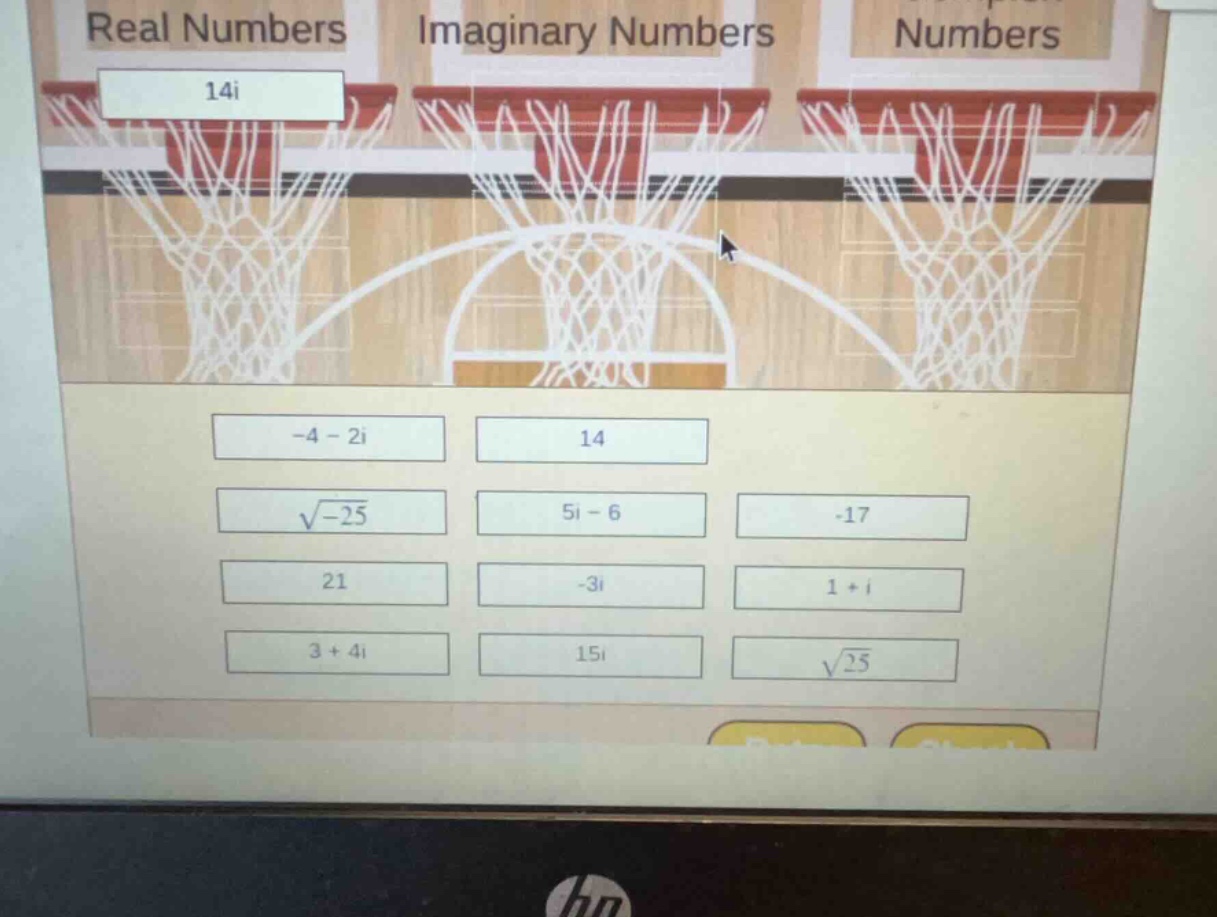
real numbers, imaginary numbers, complex numbers
14i
-4 - 2i
14
\sqrt{-25}
5i - 6
-17
21
-3i
1 + i
3 + 4i
15i
\sqrt{25}
<pre_analysis>
{
"quality": "clear",
"question_count": 1,
"skills_matched": [
"step_cot",
"explain_then_answer",
"tutor"
],
"needs_drawing": false,
"concepts_used": [],
"new_concepts": [
"Complex Numbers",
"Imaginary Numbers",
"Real Numbers"
],
"current_concepts": [
"Real Numbers",
"Imaginary Numbers",
"Complex Numbers"
]
}
</pre_analysis>
<reasoning>
Identify number categories
We classify numbers into three categories:
- Real Numbers: Numbers without an imaginary unit \(i\), such as integers, fractions, and real roots of positive numbers.
- Imaginary Numbers: Numbers of the form \(bi\), where \(b
eq 0\) is a real number and \(i = \sqrt{-1}\).
- Complex Numbers: Numbers of the form \(a + bi\), where both \(a
eq 0\) and \(b
eq 0\). Note that while all real and imaginary numbers are technically complex numbers, in sorting activities like this, "Complex Numbers" specifically refers to those with both non-zero real and imaginary parts.
Simplify given expressions
We simplify any expressions containing radicals to identify their standard form:
- \(\sqrt{-25} = \sqrt{25} \cdot \sqrt{-1} = 5i\) (Imaginary)
- \(\sqrt{25} = 5\) (Real)
Sort each number
We classify each of the remaining numbers:
- \(-4 - 2i\): Contains both real and imaginary parts. (Complex)
- \(14\): Real integer. (Real)
- \(\sqrt{-25} = 5i\): Pure imaginary. (Imaginary)
- \(5i - 6 = -6 + 5i\): Contains both parts. (Complex)
- \(-17\): Real integer. (Real)
- \(21\): Real integer. (Real)
- \(-3i\): Pure imaginary. (Imaginary)
- \(1 + i\): Contains both parts. (Complex)
- \(3 + 4i\): Contains both parts. (Complex)
- \(15i\): Pure imaginary. (Imaginary)
- \(\sqrt{25} = 5\): Real integer. (Real)
- \(14i\) (already placed in the image under Real Numbers, which is incorrect; it should be sorted correctly): Pure imaginary. (Imaginary)
Group sorted results
We group the sorted values into their respective baskets:
- Real Numbers: \(14\), \(-17\), \(21\), \(\sqrt{25}\)
- Imaginary Numbers: \(14i\), \(\sqrt{-25}\), \(-3i\), \(15i\)
- Complex Numbers: \(-4 - 2i\), \(5i - 6\), \(1 + i\), \(3 + 4i\)
</reasoning>
<answer>
The correct sorting of the numbers into their respective baskets is:
- Real Numbers:
- \(14\)
- \(-17\)
- \(21\)
- \(\sqrt{25}\)
- Imaginary Numbers:
- \(14i\)
- \(-3i\)
- \(15i\)
- \(\sqrt{-25}\)
- Complex Numbers:
- \(-4 - 2i\)
- \(5i - 6\)
- \(1 + i\)
- \(3 + 4i\)
</answer>
<post_analysis>
{
"subject": "Mathematics",
"question_type": "Free Response",
"knowledge_point": [
"Mathematics",
"Algebra",
"Complex Numbers"
]
}
</post_analysis>
Snap & solve any problem in the app
Get step-by-step solutions on Sovi AI
Photo-based solutions with guided steps
Explore more problems and detailed explanations
<pre_analysis>
{
"quality": "clear",
"question_count": 1,
"skills_matched": [
"step_cot",
"explain_then_answer",
"tutor"
],
"needs_drawing": false,
"concepts_used": [],
"new_concepts": [
"Complex Numbers",
"Imaginary Numbers",
"Real Numbers"
],
"current_concepts": [
"Real Numbers",
"Imaginary Numbers",
"Complex Numbers"
]
}
</pre_analysis>
<reasoning>
Identify number categories
We classify numbers into three categories:
- Real Numbers: Numbers without an imaginary unit \(i\), such as integers, fractions, and real roots of positive numbers.
- Imaginary Numbers: Numbers of the form \(bi\), where \(b
eq 0\) is a real number and \(i = \sqrt{-1}\).
- Complex Numbers: Numbers of the form \(a + bi\), where both \(a
eq 0\) and \(b
eq 0\). Note that while all real and imaginary numbers are technically complex numbers, in sorting activities like this, "Complex Numbers" specifically refers to those with both non-zero real and imaginary parts.
Simplify given expressions
We simplify any expressions containing radicals to identify their standard form:
- \(\sqrt{-25} = \sqrt{25} \cdot \sqrt{-1} = 5i\) (Imaginary)
- \(\sqrt{25} = 5\) (Real)
Sort each number
We classify each of the remaining numbers:
- \(-4 - 2i\): Contains both real and imaginary parts. (Complex)
- \(14\): Real integer. (Real)
- \(\sqrt{-25} = 5i\): Pure imaginary. (Imaginary)
- \(5i - 6 = -6 + 5i\): Contains both parts. (Complex)
- \(-17\): Real integer. (Real)
- \(21\): Real integer. (Real)
- \(-3i\): Pure imaginary. (Imaginary)
- \(1 + i\): Contains both parts. (Complex)
- \(3 + 4i\): Contains both parts. (Complex)
- \(15i\): Pure imaginary. (Imaginary)
- \(\sqrt{25} = 5\): Real integer. (Real)
- \(14i\) (already placed in the image under Real Numbers, which is incorrect; it should be sorted correctly): Pure imaginary. (Imaginary)
Group sorted results
We group the sorted values into their respective baskets:
- Real Numbers: \(14\), \(-17\), \(21\), \(\sqrt{25}\)
- Imaginary Numbers: \(14i\), \(\sqrt{-25}\), \(-3i\), \(15i\)
- Complex Numbers: \(-4 - 2i\), \(5i - 6\), \(1 + i\), \(3 + 4i\)
</reasoning>
<answer>
The correct sorting of the numbers into their respective baskets is:
- Real Numbers:
- \(14\)
- \(-17\)
- \(21\)
- \(\sqrt{25}\)
- Imaginary Numbers:
- \(14i\)
- \(-3i\)
- \(15i\)
- \(\sqrt{-25}\)
- Complex Numbers:
- \(-4 - 2i\)
- \(5i - 6\)
- \(1 + i\)
- \(3 + 4i\)
</answer>
<post_analysis>
{
"subject": "Mathematics",
"question_type": "Free Response",
"knowledge_point": [
"Mathematics",
"Algebra",
"Complex Numbers"
]
}
</post_analysis>