QUESTION IMAGE
Question
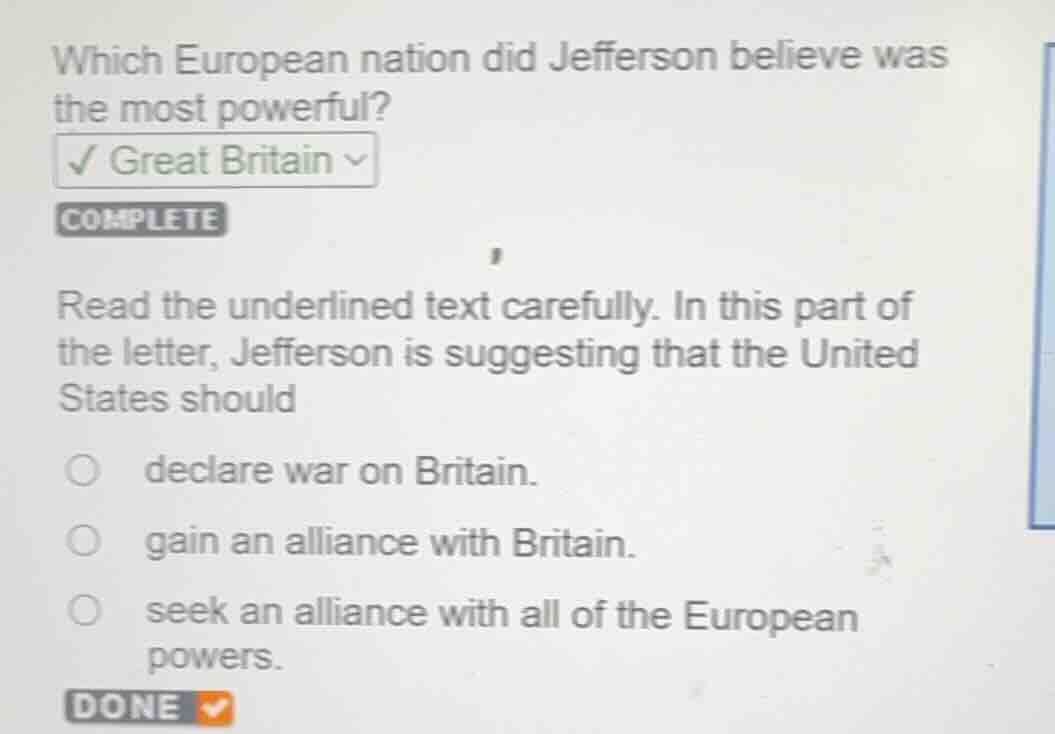
read the underlined text carefully. in this part of the letter, jefferson is suggesting that the united states should
declare war on britain.
gain an alliance with britain.
seek an alliance with all of the european powers.
<pre_analysis>
{
"quality": "clear",
"question_count": 1,
"skills_matched": [
"direct_cot",
"multiple_choice_formatter",
"explain_then_answer",
"quick"
],
"needs_drawing": false,
"concepts_used": [
"Jeffersonian Foreign Policy"
],
"new_concepts": [
"Monroe Doctrine Context"
],
"current_concepts": [
"Jeffersonian Foreign Policy",
"Monroe Doctrine Context"
]
}
</pre_analysis>
<reasoning>
Analyze the historical context
Thomas Jefferson's foreign policy views, especially in his later correspondence regarding the Monroe Doctrine, recognized Great Britain as the most powerful European nation. He believed that having Great Britain on the side of the United States would prevent other European powers from interfering in the Western Hemisphere.
Interpret Jefferson's suggestion
Because Jefferson viewed Great Britain as the dominant naval and global power, he suggested that the United States should align with Britain to secure its own interests and protect the Americas from other European colonizers. This makes an alliance with Britain the logical strategic recommendation.
Evaluate the options
- "declare war on Britain": Incorrect, as Jefferson sought to avoid conflict with the dominant power.
- "gain an alliance with Britain": Correct, aligning with the most powerful nation would protect American security.
- "seek an alliance with all of the European powers": Incorrect, as Jefferson famously warned against "entangling alliances" with continental Europe.
</reasoning>
<answer>
<mcq-option>declare war on Britain.</mcq-option>
<mcq-correct>gain an alliance with Britain.</mcq-correct>
<mcq-option>seek an alliance with all of the European powers.</mcq-option>
</answer>
<post_analysis>
{
"subject": "Social Science",
"question_type": "Multiple Choice",
"knowledge_point": [
"Social Science",
"U.S. History",
"Jeffersonian Foreign Policy"
]
}
</post_analysis>
Snap & solve any problem in the app
Get step-by-step solutions on Sovi AI
Photo-based solutions with guided steps
Explore more problems and detailed explanations
<pre_analysis>
{
"quality": "clear",
"question_count": 1,
"skills_matched": [
"direct_cot",
"multiple_choice_formatter",
"explain_then_answer",
"quick"
],
"needs_drawing": false,
"concepts_used": [
"Jeffersonian Foreign Policy"
],
"new_concepts": [
"Monroe Doctrine Context"
],
"current_concepts": [
"Jeffersonian Foreign Policy",
"Monroe Doctrine Context"
]
}
</pre_analysis>
<reasoning>
Analyze the historical context
Thomas Jefferson's foreign policy views, especially in his later correspondence regarding the Monroe Doctrine, recognized Great Britain as the most powerful European nation. He believed that having Great Britain on the side of the United States would prevent other European powers from interfering in the Western Hemisphere.
Interpret Jefferson's suggestion
Because Jefferson viewed Great Britain as the dominant naval and global power, he suggested that the United States should align with Britain to secure its own interests and protect the Americas from other European colonizers. This makes an alliance with Britain the logical strategic recommendation.
Evaluate the options
- "declare war on Britain": Incorrect, as Jefferson sought to avoid conflict with the dominant power.
- "gain an alliance with Britain": Correct, aligning with the most powerful nation would protect American security.
- "seek an alliance with all of the European powers": Incorrect, as Jefferson famously warned against "entangling alliances" with continental Europe.
</reasoning>
<answer>
<mcq-option>declare war on Britain.</mcq-option>
<mcq-correct>gain an alliance with Britain.</mcq-correct>
<mcq-option>seek an alliance with all of the European powers.</mcq-option>
</answer>
<post_analysis>
{
"subject": "Social Science",
"question_type": "Multiple Choice",
"knowledge_point": [
"Social Science",
"U.S. History",
"Jeffersonian Foreign Policy"
]
}
</post_analysis>