QUESTION IMAGE
Question
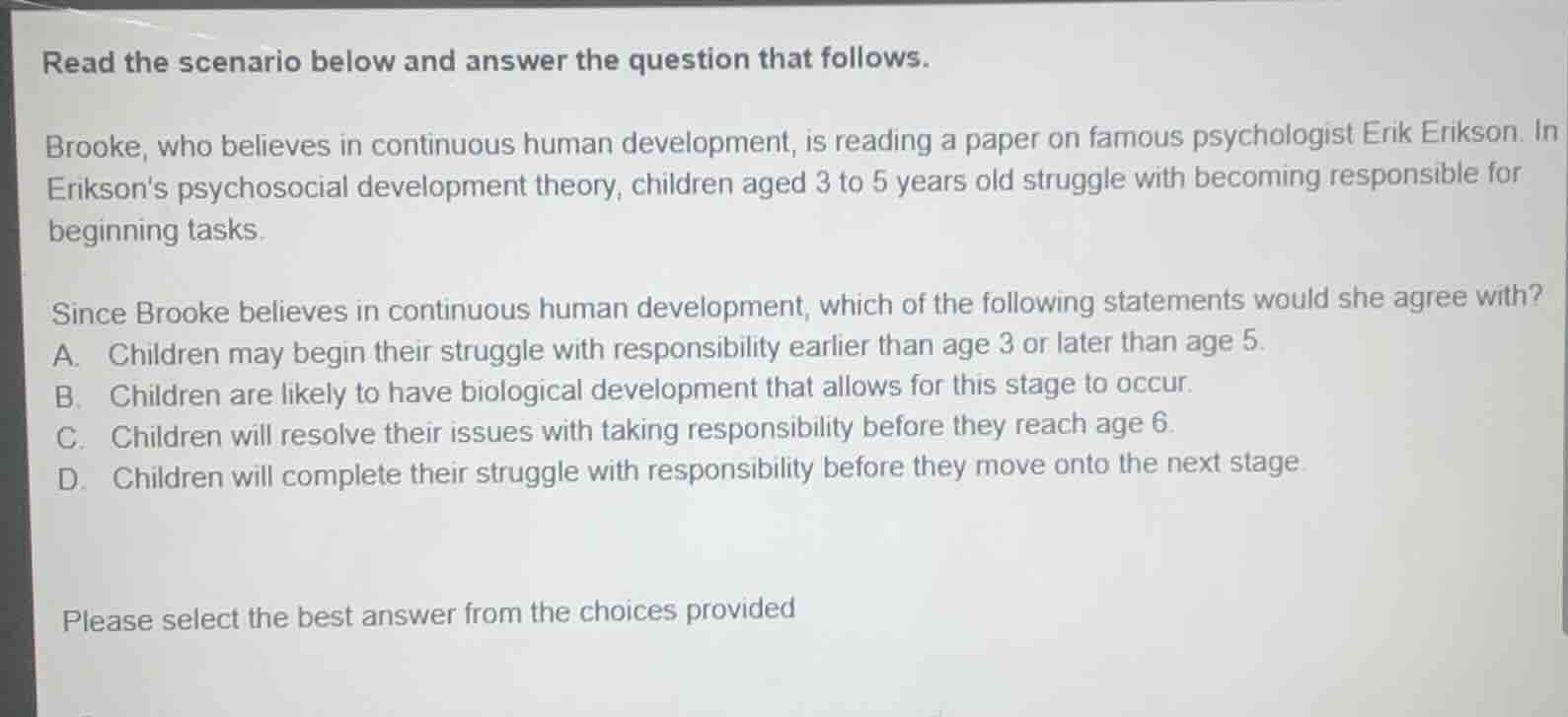
read the scenario below and answer the question that follows.
brooke, who believes in continuous human development, is reading a paper on famous psychologist erik erikson. in eriksons psychosocial development theory, children aged 3 to 5 years old struggle with becoming responsible for beginning tasks.
since brooke believes in continuous human development, which of the following statements would she agree with?
a. children may begin their struggle with responsibility earlier than age 3 or later than age 5.
b. children are likely to have biological development that allows for this stage to occur.
c. children will resolve their issues with taking responsibility before they reach age 6.
d. children will complete their struggle with responsibility before they move onto the next stage.
please select the best answer from the choices provided
<pre_analysis>
{
"quality": "clear",
"question_count": 1,
"skills_matched": [
"direct_cot",
"multiple_choice_formatter",
"explain_then_answer",
"quick"
],
"needs_drawing": false,
"concepts_used": [
"Continuity vs Discontinuity",
"Developmental Psychology"
],
"new_concepts": [
"Erikson's Psychosocial Theory"
],
"current_concepts": [
"Continuity vs Discontinuity",
"Developmental Psychology",
"Erikson's Psychosocial Theory"
]
}
</pre_analysis>
<reasoning>
Analyze the core concepts of continuous vs. discontinuous development
Continuous development views human growth as a gradual, cumulative process without abrupt shifts or rigid age boundaries. Discontinuous development (such as Erikson's stage theory) views development as occurring in distinct, sequential stages with specific age ranges (e.g., ages 3 to 5).
Evaluate the options based on Brooke's belief in continuous development
- Option A: Suggests that the struggle with responsibility is not strictly bound to the rigid age range of 3 to 5, which aligns with a continuous, gradual view of development.
- Option B: Focuses on biological readiness for a specific stage, which is more aligned with discontinuous stage theories.
- Option C: Asserts a rigid age limit (before age 6) for resolving the issue, which is characteristic of discontinuous stage-based thinking.
- Option D: Asserts a strict sequential progression through distinct stages, which directly reflects a discontinuous stage model.
Select the best option
Option A is the only statement that rejects the rigid age boundaries of Erikson's stage theory, reflecting Brooke's belief in continuous development.
</reasoning>
<answer>
<mcq-correct>(A) Children may begin their struggle with responsibility earlier than age 3 or later than age 5.</mcq-correct>
<mcq-option>(B) Children are likely to have biological development that allows for this stage to occur.</mcq-option>
<mcq-option>(C) Children will resolve their issues with taking responsibility before they reach age 6.</mcq-option>
<mcq-option>(D) Children will complete their struggle with responsibility before they move onto the next stage.</mcq-option>
</answer>
<post_analysis>
{
"subject": "Social Science",
"question_type": "Multiple Choice",
"knowledge_point": [
"Social Science",
"Psychology",
"Developmental Psychology"
]
}
</post_analysis>
Snap & solve any problem in the app
Get step-by-step solutions on Sovi AI
Photo-based solutions with guided steps
Explore more problems and detailed explanations
<pre_analysis>
{
"quality": "clear",
"question_count": 1,
"skills_matched": [
"direct_cot",
"multiple_choice_formatter",
"explain_then_answer",
"quick"
],
"needs_drawing": false,
"concepts_used": [
"Continuity vs Discontinuity",
"Developmental Psychology"
],
"new_concepts": [
"Erikson's Psychosocial Theory"
],
"current_concepts": [
"Continuity vs Discontinuity",
"Developmental Psychology",
"Erikson's Psychosocial Theory"
]
}
</pre_analysis>
<reasoning>
Analyze the core concepts of continuous vs. discontinuous development
Continuous development views human growth as a gradual, cumulative process without abrupt shifts or rigid age boundaries. Discontinuous development (such as Erikson's stage theory) views development as occurring in distinct, sequential stages with specific age ranges (e.g., ages 3 to 5).
Evaluate the options based on Brooke's belief in continuous development
- Option A: Suggests that the struggle with responsibility is not strictly bound to the rigid age range of 3 to 5, which aligns with a continuous, gradual view of development.
- Option B: Focuses on biological readiness for a specific stage, which is more aligned with discontinuous stage theories.
- Option C: Asserts a rigid age limit (before age 6) for resolving the issue, which is characteristic of discontinuous stage-based thinking.
- Option D: Asserts a strict sequential progression through distinct stages, which directly reflects a discontinuous stage model.
Select the best option
Option A is the only statement that rejects the rigid age boundaries of Erikson's stage theory, reflecting Brooke's belief in continuous development.
</reasoning>
<answer>
<mcq-correct>(A) Children may begin their struggle with responsibility earlier than age 3 or later than age 5.</mcq-correct>
<mcq-option>(B) Children are likely to have biological development that allows for this stage to occur.</mcq-option>
<mcq-option>(C) Children will resolve their issues with taking responsibility before they reach age 6.</mcq-option>
<mcq-option>(D) Children will complete their struggle with responsibility before they move onto the next stage.</mcq-option>
</answer>
<post_analysis>
{
"subject": "Social Science",
"question_type": "Multiple Choice",
"knowledge_point": [
"Social Science",
"Psychology",
"Developmental Psychology"
]
}
</post_analysis>