QUESTION IMAGE
Question
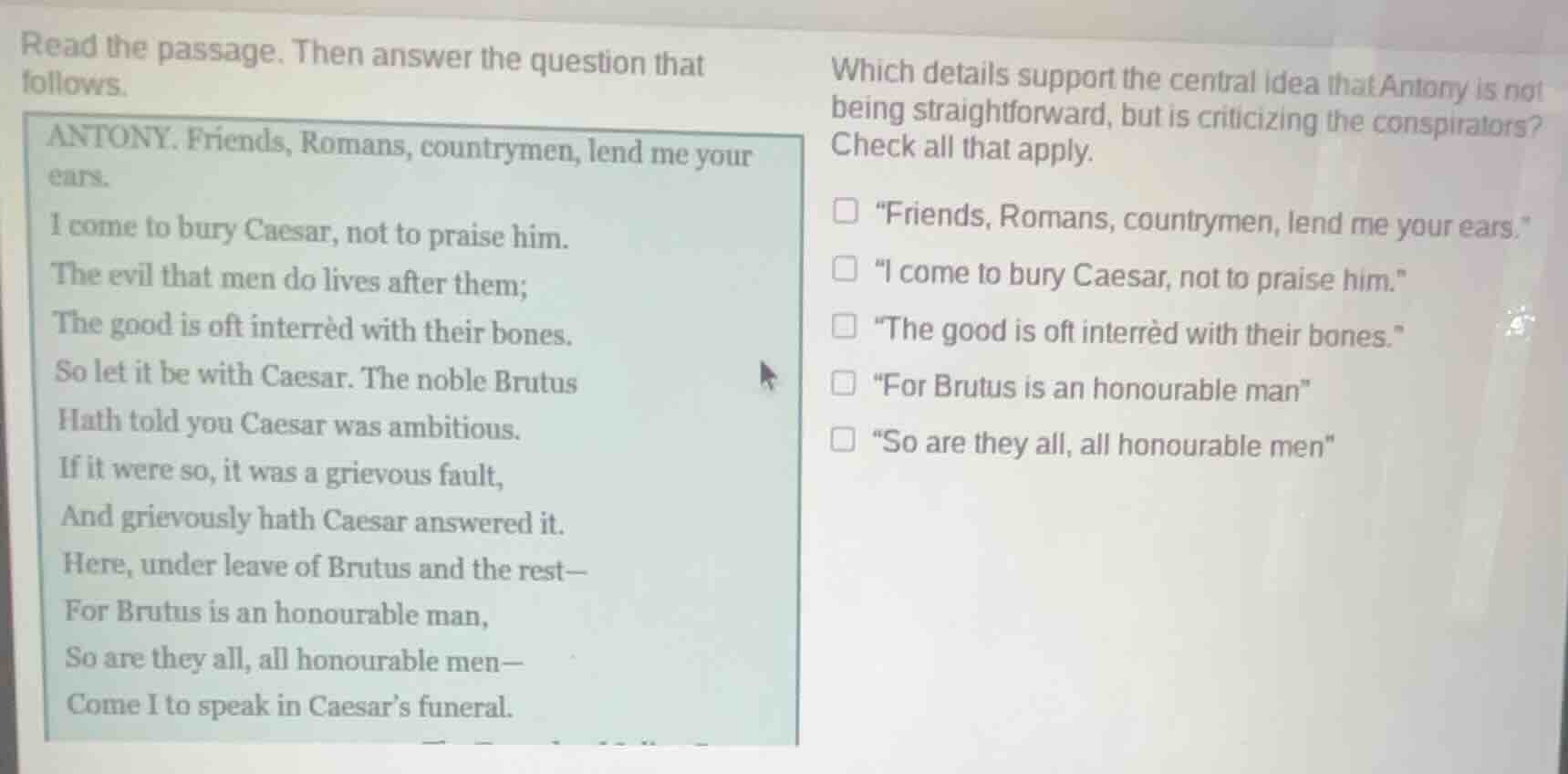
read the passage. then answer the question that follows.
antony. friends, romans, countrymen, lend me your ears.
i come to bury caesar, not to praise him.
the evil that men do lives after them;
the good is oft interrèd with their bones.
so let it be with caesar. the noble brutus
hath told you caesar was ambitious.
if it were so, it was a grievous fault,
and grievously hath caesar answered it.
here, under leave of brutus and the rest-
for brutus is an honourable man,
so are they all, all honourable men-
come i to speak in caesars funeral.
which details support the central idea that antony is not being straightforward, but is criticizing the conspirators? check all that apply.
- \friends, romans, countrymen, lend me your ears.\
- \i come to bury caesar, not to praise him.\
- \the good is oft interrèd with their bones.\
- \for brutus is an honourable man\
- \so are they all, all honourable men\
Analyze the rhetorical context of Antony's speech
Using the Julius Caesar Plot and Rhetorical Analysis knowledge points, we examine Mark Antony's funeral oration. Under the terms of the conspirators, Antony is permitted to speak at Caesar's funeral only if he does not blame them. To bypass this restriction, Antony employs verbal irony. He repeatedly calls Brutus and the conspirators "honourable men" while presenting facts that subtly undermine their claims, thereby criticizing them indirectly.
Evaluate each textual detail for irony
Using the Textual Evidence Analysis knowledge point, we evaluate the given options to see which ones demonstrate Antony's indirect criticism:
- "Friends, Romans, countrymen, lend me your ears.": This is a straightforward, traditional call to attention to begin his speech. It contains no criticism or irony.
- "I come to bury Caesar, not to praise him.": This is a literal statement meant to disarm the crowd and appease the conspirators initially. It is not an indirect criticism of them.
- "The good is oft interrèd with their bones.": This is a general philosophical observation about human nature and memory, not a direct or indirect critique of the conspirators.
- "For Brutus is an honourable man": This is a key example of verbal irony. By repeatedly calling Brutus "honourable" while presenting evidence of Caesar's generosity and lack of ambition, Antony leads the crowd to conclude that Brutus is actually dishonourable.
- "So are they all, all honourable men": Similar to the previous line, this collective labeling of the conspirators as "honourable" is highly sarcastic and designed to make the crowd question their integrity.

Snap & solve any problem in the app
Get step-by-step solutions on Sovi AI
Photo-based solutions with guided steps
Explore more problems and detailed explanations
- "Friends, Romans, countrymen, lend me your ears."
- "I come to bury Caesar, not to praise him."
- "The good is oft interrèd with their bones."
- "For Brutus is an honourable man" (Correct answer)
- "So are they all, all honourable men" (Correct answer)