QUESTION IMAGE
Question
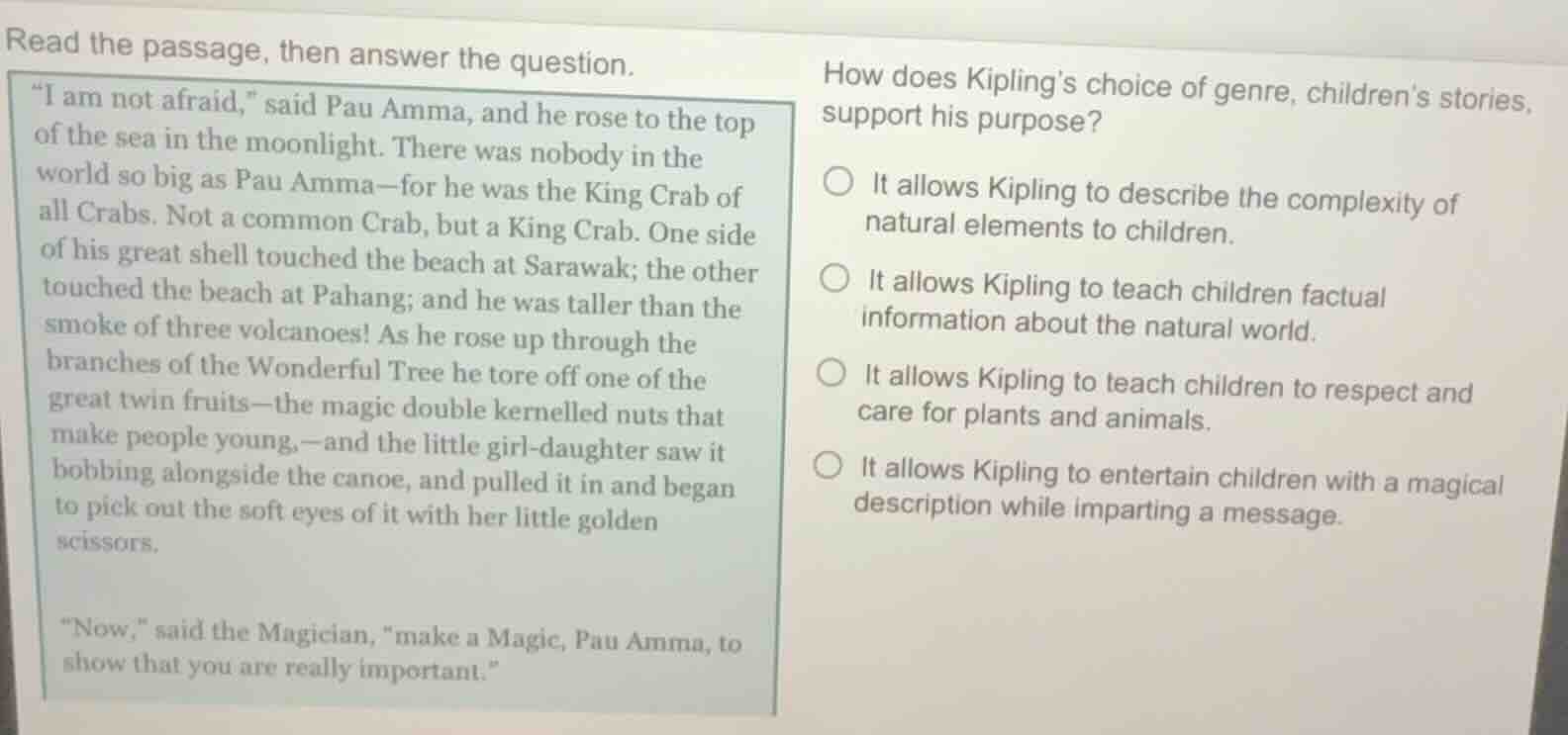
read the passage, then answer the question.
\i am not afraid,\ said pau amma, and he rose to the top of the sea in the moonlight. there was nobody in the world so big as pau amma-for he was the king crab of all crabs. not a common crab, but a king crab. one side of his great shell touched the beach at sarawak; the other touched the beach at pahang; and he was taller than the smoke of three volcanoes! as he rose up through the branches of the wonderful tree he tore off one of the great twin fruits-the magic double kernelled nuts that make people young,-and the little girl-daughter saw it bobbing alongside the canoe, and pulled it in and began to pick out the soft eyes of it with her little golden scissors.
ow,\ said the magician, \make a magic, pau amma, to show that you are really important.\
how does kiplings choice of genre, childrens stories, support his purpose?
it allows kipling to describe the complexity of natural elements to children.
it allows kipling to teach children factual information about the natural world.
it allows kipling to teach children to respect and care for plants and animals.
it allows kipling to entertain children with a magical description while imparting a message.
Analyze the genre and text elements
Using the Just So Stories Analysis knowledge point
The passage features Pau Amma, a giant crab, magic twin fruits, and a Magician. These elements are highly imaginative, fantastical, and characteristic of children's literature, specifically origin myths or folktales.
Determine the author's purpose
Using the Authors Purpose Analysis knowledge point
Rudyard Kipling's purpose in writing these stories is to engage young readers through imaginative storytelling while subtly delivering moral lessons or explanations of natural phenomena. The magical description of Pau Amma serves to captivate and entertain children, making the underlying message more accessible and memorable.
Evaluate the given options
- Option 1: The passage focuses on magical elements (giant crab, magic fruits) rather than explaining complex scientific or natural systems.
- Option 2: The story is fantastical and mythological, not a source of factual, scientific information about the natural world.
- Option 3: While the story features animals, the primary narrative drive in this excerpt is magical and mythological rather than an explicit lesson on conservation or caring for plants and animals.
- Option 4: This option correctly identifies that the children's story genre allows Kipling to use magical, engaging descriptions to entertain young readers while delivering a broader narrative message.

Snap & solve any problem in the app
Get step-by-step solutions on Sovi AI
Photo-based solutions with guided steps
Explore more problems and detailed explanations
- It allows Kipling to describe the complexity of natural elements to children.
- It allows Kipling to teach children factual information about the natural world.
- It allows Kipling to teach children to respect and care for plants and animals.
- It allows Kipling to entertain children with a magical description while imparting a message. (Correct answer)