QUESTION IMAGE
Question
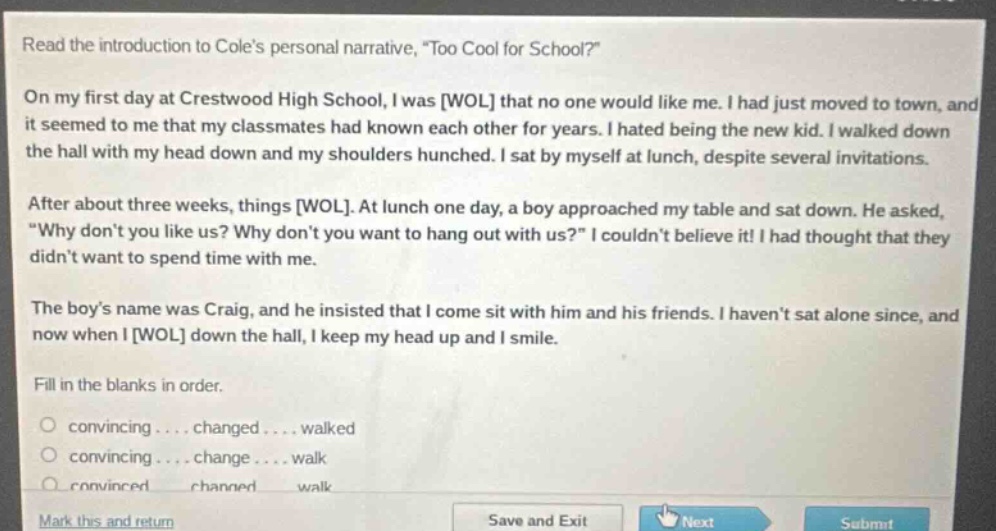
read the introduction to coles personal narrative, \too cool for school?\
on my first day at crestwood high school, i was wol that no one would like me. i had just moved to town, and it seemed to me that my classmates had known each other for years. i hated being the new kid. i walked down the hall with my head down and my shoulders hunched. i sat by myself at lunch, despite several invitations.
after about three weeks, things wol. at lunch one day, a boy approached my table and sat down. he asked, \why dont you like us? why dont you want to hang out with us?\ i couldnt believe it! i had thought that they didnt want to spend time with me.
the boys name was craig, and he insisted that i come sit with him and his friends. i havent sat alone since, and now when i wol down the hall, i keep my head up and i smile.
fill in the blanks in order.
( ) convincing .... changed .... walked
( ) convincing .... change .... walk
( ) convinced .... changed .... walk
🆕 New Concept Discovered: Verb Tense and Aspect Consistency
Using the correct verb form and tense based on the surrounding context.
Step 1: Analyze the first blank
The first sentence reads: "On my first day at Crestwood High School, I was [WOL] that no one would like me."
- The sentence uses the passive construction "I was [verb/adjective]".
- "Convinced" is a past participle acting as an adjective meaning completely certain. "Convincing" is an active participle meaning persuasive to others.
- Since the narrator is the one who felt certain, the correct word is convinced.
Step 2: Analyze the second blank
The sentence reads: "After about three weeks, things [WOL]."
- The narrative is describing events that occurred in the past ("On my first day...", "I hated...", "I walked...").
- To maintain consistent past tense for this completed action in the past, we need the past tense verb changed.
Step 3: Analyze the third blank
The sentence reads: "I haven't sat alone since, and now when I [WOL] down the hall, I keep my head up and I smile."
- The word "now" shifts the timeframe of the narrative to the present day.
- The verbs that follow in the clause are in the simple present tense ("keep", "smile").
- To maintain consistency with this present-day habit, we need the present tense verb walk.

Snap & solve any problem in the app
Get step-by-step solutions on Sovi AI
Photo-based solutions with guided steps
Explore more problems and detailed explanations
convinced . . . changed . . . walk