QUESTION IMAGE
Question
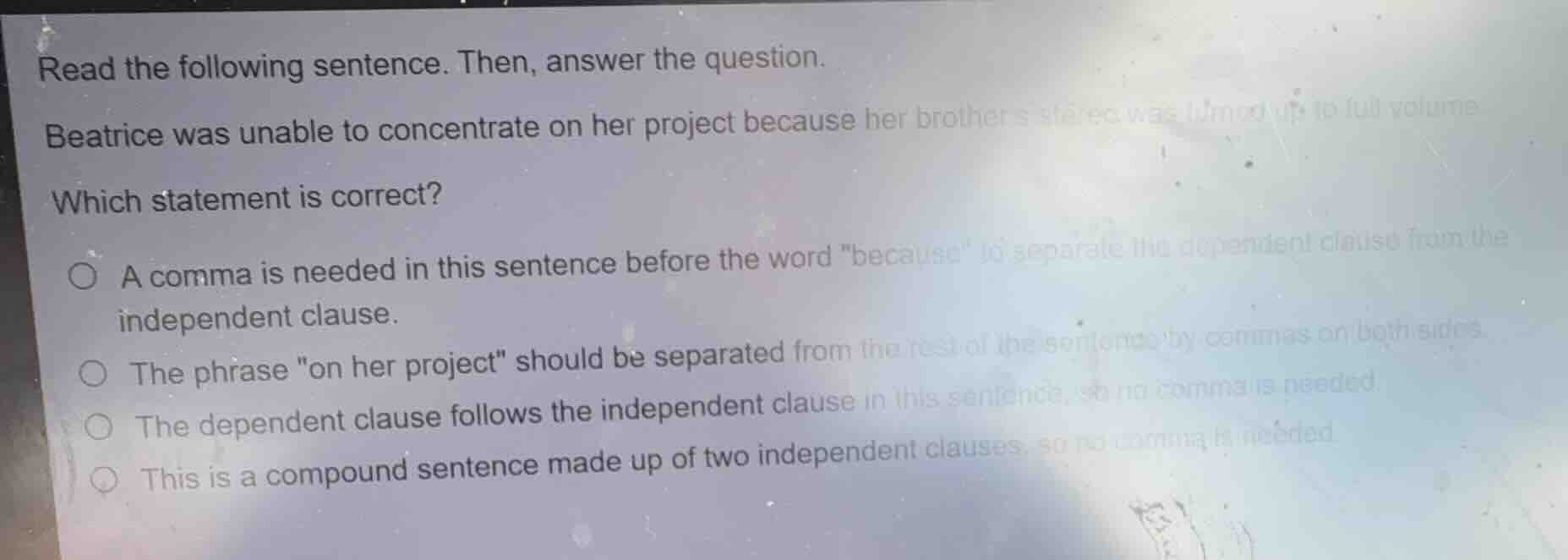
read the following sentence. then, answer the question.
beatrice was unable to concentrate on her project because her brothers stereo was turned up to full volume.
which statement is correct?
- a comma is needed in this sentence before the word \because\ to separate the dependent clause from the independent clause.
- the phrase \on her project\ should be separated from the rest of the sentence by commas on both sides.
- the dependent clause follows the independent clause in this sentence, so no comma is needed.
- this is a compound sentence made up of two independent clauses, so no comma is needed.
Analyze sentence structure
Using the Complex Sentences and Dependent Clauses knowledge points
- Independent clause: "Beatrice was unable to concentrate on her project"
- Dependent clause: "because her brother's stereo was turned up to full volume"
- The dependent clause starts with the subordinating conjunction "because".
Apply punctuation rules
Using the Punctuation Rules knowledge point
- When an independent clause is followed by a dependent clause, no comma is used to separate them.
- Therefore, the sentence is punctuated correctly as written, and no comma is needed.
Evaluate the options
- Option 1: Incorrect. A comma is not needed before "because" when the dependent clause follows the independent clause.
- Option 2: Incorrect. The prepositional phrase "on her project" is essential and should not be set off by commas.
- Option 3: Correct. The dependent clause follows the independent clause, so no comma is needed.
- Option 4: Incorrect. This is a complex sentence, not a compound sentence.

Snap & solve any problem in the app
Get step-by-step solutions on Sovi AI
Photo-based solutions with guided steps
Explore more problems and detailed explanations
- (A) A comma is needed in this sentence before the word "because" to separate the dependent clause from the independent clause.
- (B) The phrase "on her project" should be separated from the rest of the sentence by commas on both sides.
- (C) The dependent clause follows the independent clause in this sentence, so no comma is needed. (Correct answer)
- (D) This is a compound sentence made up of two independent clauses, so no comma is needed.