QUESTION IMAGE
Question
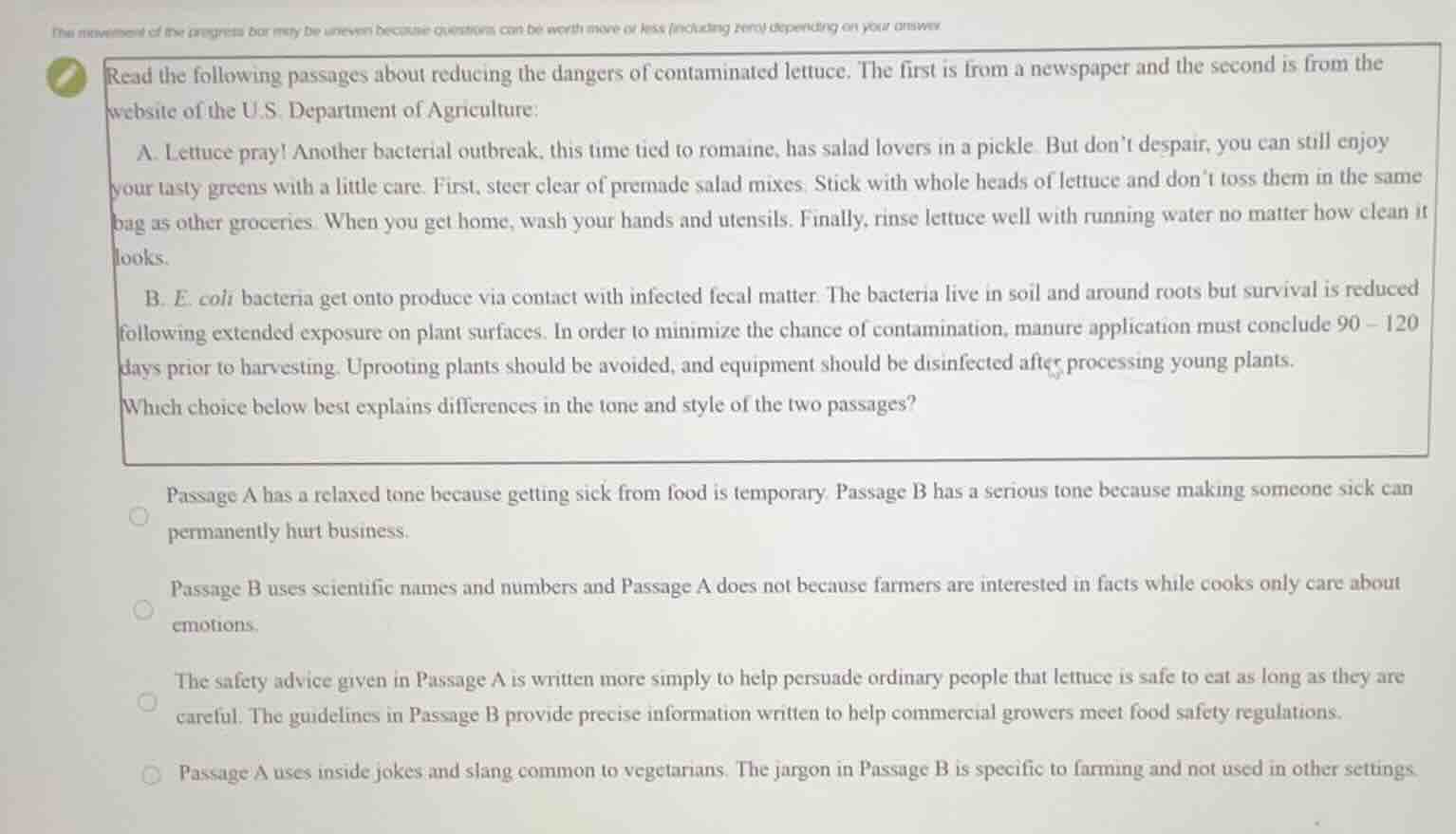
read the following passages about reducing the dangers of contaminated lettuce. the first is from a newspaper and the second is from the website of the u.s. department of agriculture:
a. lettuce pray! another bacterial outbreak, this time tied to romaine, has salad lovers in a pickle. but dont despair, you can still enjoy your tasty greens with a little care. first, steer clear of premade salad mixes. stick with whole heads of lettuce and dont toss them in the same bag as other groceries. when you get home, wash your hands and utensils. finally, rinse lettuce well with running water no matter how clean it looks.
b. e. coli bacteria get onto produce via contact with infected fecal matter. the bacteria live in soil and around roots but survival is reduced following extended exposure on plant surfaces. in order to minimize the chance of contamination, manure application must conclude 90-120 days prior to harvesting. uprooting plants should be avoided, and equipment should be disinfected after processing young plants.
which choice below best explains differences in the tone and style of the two passages?
- passage a has a relaxed tone because getting sick from food is temporary. passage b has a serious tone because making someone sick can permanently hurt business.
- passage b uses scientific names and numbers and passage a does not because farmers are interested in facts while cooks only care about emotions.
- the safety advice given in passage a is written more simply to help persuade ordinary people that lettuce is safe to eat as long as they are careful. the guidelines in passage b provide precise information written to help commercial growers meet food safety regulations.
- passage a uses inside jokes and slang common to vegetarians. the jargon in passage b is specific to farming and not used in other settings.
Analyze Passage A
Using the Reading Comprehension knowledge point, we examine the first passage. Passage A is from a newspaper. It uses informal, engaging language like "Lettuce pray!" and "in a pickle" to address everyday consumers. It offers simple, practical advice for home food preparation, such as washing hands and avoiding premade mixes.
Analyze Passage B
Using the Scientific Writing Style knowledge point, we examine the second passage. Passage B is from the U.S. Department of Agriculture website. It uses formal, technical language ("E. coli bacteria," "fecal matter," "manure application") and precise numerical guidelines ("90 - 120 days prior to harvesting"). This technical style is designed for commercial agricultural producers to comply with safety regulations.
Evaluate the Options
Using the Comparative Analysis knowledge point, we evaluate the given choices:
- Option 1: Incorrectly attributes the relaxed tone to food sickness being "temporary" and the serious tone to "business" impacts, which are not supported by the texts.
- Option 2: Overgeneralizes by claiming "cooks only care about emotions," which is inaccurate and unsupported.
- Option 3: Correctly identifies that Passage A is written simply to guide and persuade ordinary consumers, while Passage B provides precise, technical guidelines for commercial growers to meet regulations.
- Option 4: Incorrectly claims Passage A uses "inside jokes and slang common to vegetarians."
Determine the Correct Choice
The third option accurately and objectively explains the differences in tone, style, and target audience between the two passages.

Snap & solve any problem in the app
Get step-by-step solutions on Sovi AI
Photo-based solutions with guided steps
Explore more problems and detailed explanations
- Passage A has a relaxed tone because getting sick from food is temporary. Passage B has a serious tone because making someone sick can permanently hurt business.
- Passage B uses scientific names and numbers and Passage A does not because farmers are interested in facts while cooks only care about emotions.
- The safety advice given in Passage A is written more simply to help persuade ordinary people that lettuce is safe to eat as long as they are careful. The guidelines in Passage B provide precise information written to help commercial growers meet food safety regulations. (Correct answer)
- Passage A uses inside jokes and slang common to vegetarians. The jargon in Passage B is specific to farming and not used in other settings.