Sovi.AI - AI Math Tutor

Scan to solve math questions

QUESTION IMAGE

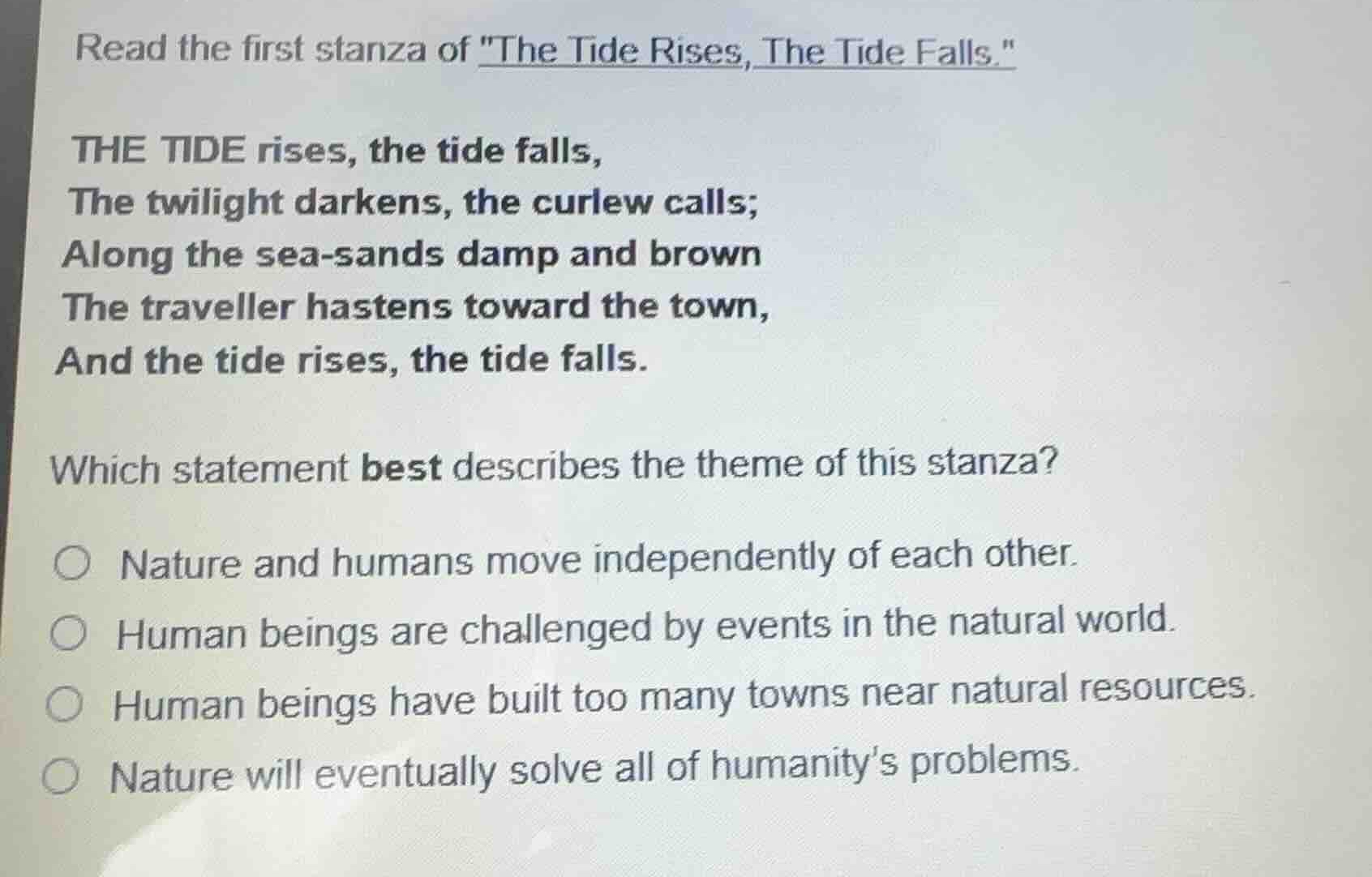
read the first stanza of \the tide rises, the tide falls.\ the tide ris…

Question

read the first stanza of \the tide rises, the tide falls.\

the tide rises, the tide falls,
the twilight darkens, the curlew calls;
along the sea-sands damp and brown
the traveller hastens toward the town,
and the tide rises, the tide falls.

which statement best describes the theme of this stanza?

nature and humans move independently of each other.
human beings are challenged by events in the natural world.
human beings have built too many towns near natural resources.
nature will eventually solve all of humanitys problems.

Explanation:

Response

<pre_analysis>
{
"quality": "clear",
"question_count": 1,
"skills_matched": [
"direct_cot",
"multiple_choice_formatter",
"explain_then_answer",
"tutor",
"mastery_adaptive_brevity"
],
"needs_drawing": false,
"concepts_used": [
"Thematic Analysis",
"Thematic Interpretation"
],
"new_concepts": [
"Fireside Poetry Analysis"
],
"current_concepts": [
"Thematic Analysis",
"Thematic Interpretation",
"Fireside Poetry Analysis"
]
}
</pre_analysis>

<reasoning>

Analyze the poem's imagery

Using the Thematic Analysis and Thematic Interpretation knowledge points:
The stanza contrasts the eternal, repetitive cycle of the natural world ("the tide rises, the tide falls") with the temporary, purposeful movement of a mortal human ("The traveller hastens toward the town").

Evaluate the relationship between nature and humans

The natural cycle continues uninterrupted and indifferent to the human traveler's journey. The traveler moves with urgency ("hastens") toward a human settlement, while nature operates on its own timeless rhythm, showing that nature and humans move independently of each other.

Assess the incorrect options

  • The traveler is not "challenged" by nature; they are simply walking through it.
  • There is no mention of overdevelopment or "too many towns."
  • Nature does not "solve" human problems; it is merely indifferent to them.

</reasoning>

<answer>
<mcq-correct>(A) Nature and humans move independently of each other.</mcq-correct>
<mcq-option>(B) Human beings are challenged by events in the natural world.</mcq-option>
<mcq-option>(C) Human beings have built too many towns near natural resources.</mcq-option>
<mcq-option>(D) Nature will eventually solve all of humanity's problems.</mcq-option>
</answer>

<post_analysis>
{
"subject": "Social Science",
"question_type": "Multiple Choice",
"knowledge_point": [
"Social Science",
"Others",
"Thematic Analysis"
]
}
</post_analysis>

Answer:

<pre_analysis>
{
"quality": "clear",
"question_count": 1,
"skills_matched": [
"direct_cot",
"multiple_choice_formatter",
"explain_then_answer",
"tutor",
"mastery_adaptive_brevity"
],
"needs_drawing": false,
"concepts_used": [
"Thematic Analysis",
"Thematic Interpretation"
],
"new_concepts": [
"Fireside Poetry Analysis"
],
"current_concepts": [
"Thematic Analysis",
"Thematic Interpretation",
"Fireside Poetry Analysis"
]
}
</pre_analysis>

<reasoning>

Analyze the poem's imagery

Using the Thematic Analysis and Thematic Interpretation knowledge points:
The stanza contrasts the eternal, repetitive cycle of the natural world ("the tide rises, the tide falls") with the temporary, purposeful movement of a mortal human ("The traveller hastens toward the town").

Evaluate the relationship between nature and humans

The natural cycle continues uninterrupted and indifferent to the human traveler's journey. The traveler moves with urgency ("hastens") toward a human settlement, while nature operates on its own timeless rhythm, showing that nature and humans move independently of each other.

Assess the incorrect options

  • The traveler is not "challenged" by nature; they are simply walking through it.
  • There is no mention of overdevelopment or "too many towns."
  • Nature does not "solve" human problems; it is merely indifferent to them.

</reasoning>

<answer>
<mcq-correct>(A) Nature and humans move independently of each other.</mcq-correct>
<mcq-option>(B) Human beings are challenged by events in the natural world.</mcq-option>
<mcq-option>(C) Human beings have built too many towns near natural resources.</mcq-option>
<mcq-option>(D) Nature will eventually solve all of humanity's problems.</mcq-option>
</answer>

<post_analysis>
{
"subject": "Social Science",
"question_type": "Multiple Choice",
"knowledge_point": [
"Social Science",
"Others",
"Thematic Analysis"
]
}
</post_analysis>