QUESTION IMAGE
Question
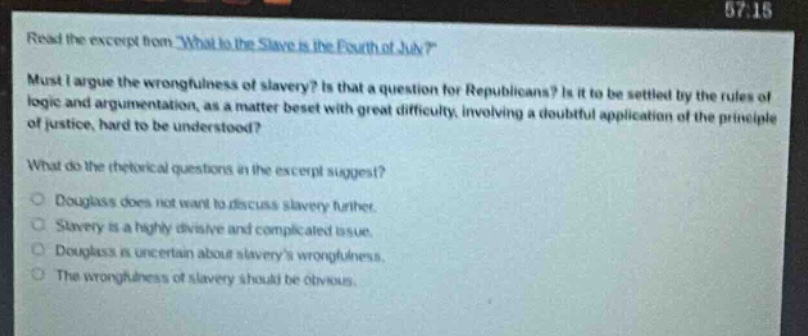
read the excerpt from \what to the slave is the fourth of july?\
must i argue the wrongfulness of slavery? is that a question for republicans? is it to be settled by the rules of logic and argumentation, as a matter beset with great difficulty, involving a doubtful application of the principle of justice, hard to be understood?
what do the rhetorical questions in the excerpt suggest?
- douglass does not want to discuss slavery further.
- slavery is a highly divisive and complicated issue.
- douglass is uncertain about slaverys wrongfulness.
- the wrongfulness of slavery should be obvious.
🆕 New Concept Discovered: Rhetorical Devices and Analysis
Using questions to emphasize an obvious truth.
Step 1: Analyze the excerpt and rhetorical questions
In this excerpt from Frederick Douglass's speech, "What to the Slave is the Fourth of July?", Douglass asks several consecutive questions:
- "Must I argue the wrongfulness of slavery?"
- "Is that a question for Republicans?"
- "Is it to be settled by the rules of logic and argumentation, as a matter beset with great difficulty...?"
These are rhetorical questions—questions asked to make a point rather than to get an actual answer.
Step 2: Determine the purpose of the questions
By asking if he must "argue" something so fundamental, or if it is a "matter beset with great difficulty," Douglass is pointing out that the injustice of slavery is not a complex, doubtful, or highly debatable intellectual puzzle. Instead, he implies that the wrongfulness of slavery is so plain and self-evident that it should not require formal, logical proof or debate.
Step 3: Evaluate the given options
- Option 1: "Douglass does not want to discuss slavery further."
- Incorrect. Douglass is giving an entire speech about slavery; he is not trying to avoid the topic, but rather changing how it is framed.
- Option 2: "Slavery is a highly divisive and complicated issue."
- Incorrect. While historically divisive, Douglass's point here is the exact opposite of "complicated"—he argues it is simple and clear-cut.
- Option 3: "Douglass is uncertain about slavery's wrongfulness."
- Incorrect. Douglass is completely certain that slavery is wrong.
- Option 4: "The wrongfulness of slavery should be obvious."
- Correct. By questioning why he must even argue the point, he suggests that the truth is already completely obvious to anyone.

Snap & solve any problem in the app
Get step-by-step solutions on Sovi AI
Photo-based solutions with guided steps
Explore more problems and detailed explanations
The wrongfulness of slavery should be obvious.