QUESTION IMAGE
Question
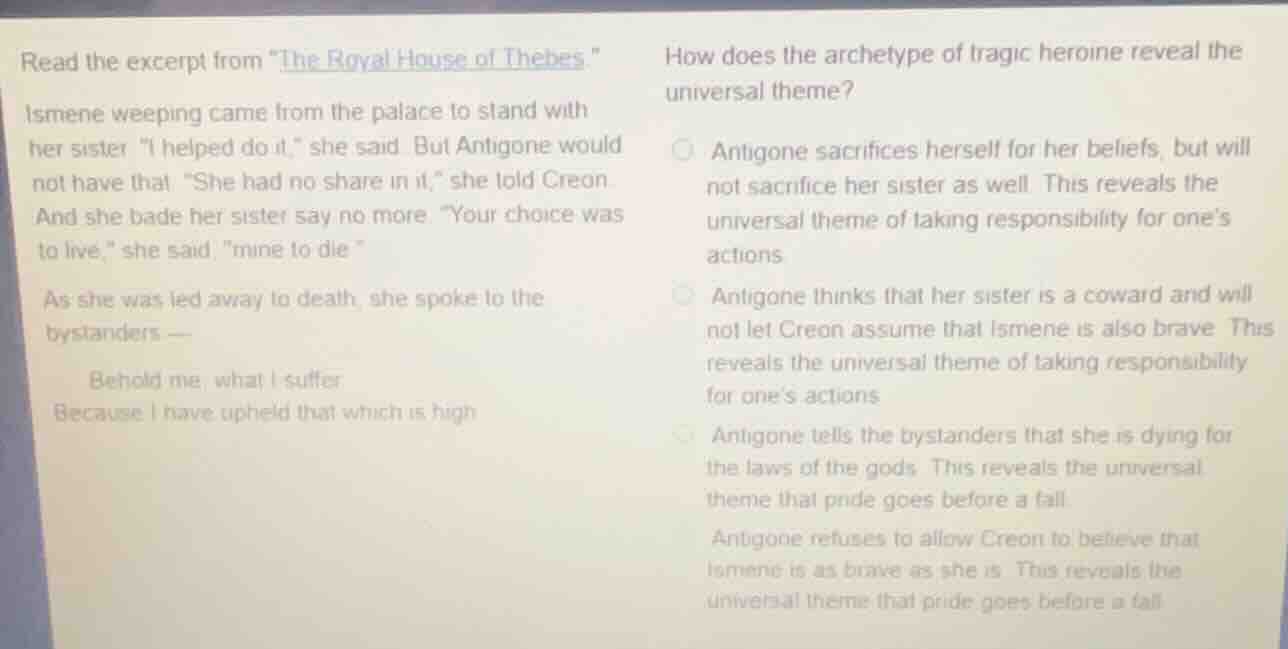
read the excerpt from \the royal house of thebes.\
ismene weeping came from the palace to stand with her sister. \i helped do it,\ she said. but antigone would not have that. \she had no share in it,\ she told creon. and she bade her sister say no more. \your choice was to live,\ she said, \mine to die.\
as she was led away to death, she spoke to the bystanders -
behold me, what i suffer
because i have upheld that which is high
how does the archetype of tragic heroine reveal the universal theme?
- antigone sacrifices herself for her beliefs, but will not sacrifice her sister as well. this reveals the universal theme of taking responsibility for ones actions.
- antigone thinks that her sister is a coward and will not let creon assume that ismene is also brave. this reveals the universal theme of taking responsibility for ones actions.
- antigone tells the bystanders that she is dying for the laws of the gods. this reveals the universal theme that pride goes before a fall.
- antigone refuses to allow creon to believe that ismene is as brave as she is. this reveals the universal theme that pride goes before a fall.
Analyze the character interactions
In the excerpt, Ismene attempts to share the blame and consequences of Antigone's actions by saying, "I helped do it." However, Antigone firmly rejects this, stating, "She had no share in it," and tells Creon that Ismene had no part in the deed. Antigone tells her sister, "Your choice was to live, mine to die." This demonstrates Antigone's protective nature over her sister, refusing to let Ismene suffer for a choice she did not make, which aligns with the Character Archetypes of a tragic heroine who accepts her fate alone.
Connect archetype to the universal theme
Antigone's refusal to let Ismene take the blame shows that she is willing to bear the full consequences of her own actions. By stating "Your choice was to live, mine to die," Antigone takes complete ownership of her moral decision to bury her brother. This self-sacrifice and refusal to drag her sister down with her directly reveals the Universal Theme Analysis of taking responsibility for one's actions.
Evaluate the given options
- Option 1: "Antigone sacrifices herself for her beliefs, but will not sacrifice her sister as well. This reveals the universal theme of taking responsibility for one's actions." This matches the textual evidence perfectly.
- Option 2: Suggests Antigone thinks her sister is a coward and wants to prevent her from looking brave. This misinterprets Antigone's protective and noble intentions.
- Option 3 & 4: Suggest the universal theme is "pride goes before a fall." While hubris is a common theme in Greek tragedy, the specific interaction of shielding Ismene and declaring "mine to die" focuses on personal accountability and choice, not pride leading to a downfall.

Snap & solve any problem in the app
Get step-by-step solutions on Sovi AI
Photo-based solutions with guided steps
Explore more problems and detailed explanations
- (A) Antigone sacrifices herself for her beliefs, but will not sacrifice her sister as well. This reveals the universal theme of taking responsibility for one's actions. (Correct answer)
- (B) Antigone thinks that her sister is a coward and will not let Creon assume that Ismene is also brave. This reveals the universal theme of taking responsibility for one's actions.
- (C) Antigone tells the bystanders that she is dying for the laws of the gods. This reveals the universal theme that pride goes before a fall.
- (D) Antigone refuses to allow Creon to believe that Ismene is as brave as she is. This reveals the universal theme that pride goes before a fall.