QUESTION IMAGE
Question
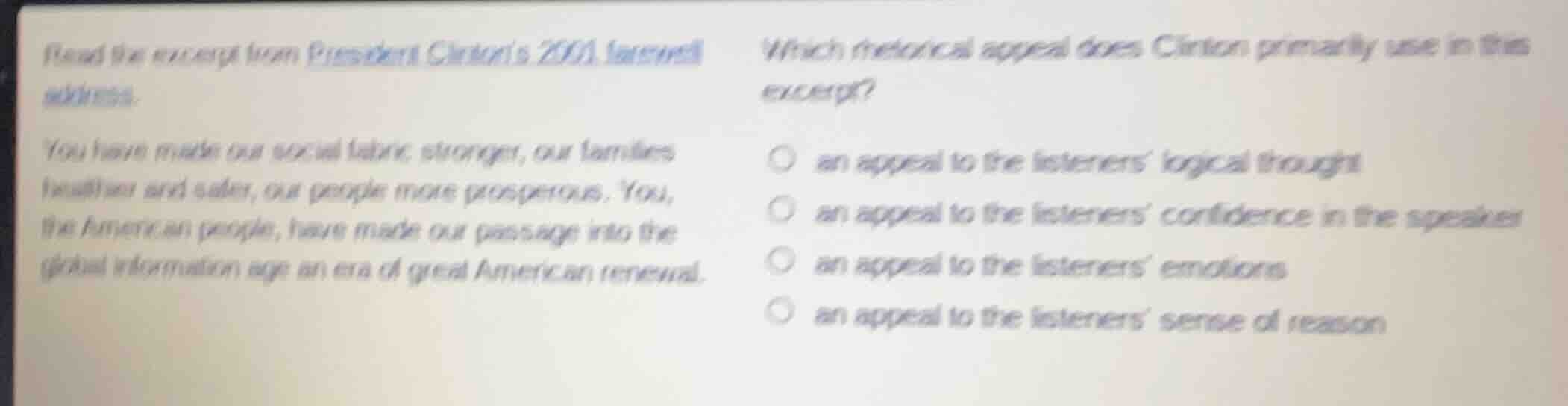
read the excerpt from president clintons 2001 farewell address.
you have made our social fabric stronger, our families healthier and safer, our people more prosperous. you, the american people, have made our passage into the global information age an era of great american renewal.
which rhetorical appeal does clinton primarily use in this excerpt?
an appeal to the listeners logical thought
an appeal to the listeners confidence in the speaker
an appeal to the listeners emotions
an appeal to the listeners sense of reason
Analyze the excerpt
The excerpt reads: "You have made our social fabric stronger, our families healthier and safer, our people more prosperous. You, the American people, have made our passage into the global information age an era of great American renewal."
Identify the rhetorical appeal
The passage uses emotionally charged, positive, and patriotic language ("social fabric stronger," "families healthier and safer," "prosperous," "great American renewal") to praise the audience. This is designed to evoke feelings of pride, unity, and hope, which constitutes an appeal to the listeners' emotions (pathos).
Evaluate the options
- "an appeal to the listeners' logical thought" (logos) is incorrect as there are no statistics, facts, or logical proofs.
- "an appeal to the listeners' confidence in the speaker" (ethos) is incorrect because the focus is on praising the audience's achievements rather than establishing the speaker's credibility.
- "an appeal to the listeners' emotions" (pathos) is correct because it inspires pride and emotional connection.
- "an appeal to the listeners' sense of reason" (logos) is incorrect for the same reason as logical thought.

Snap & solve any problem in the app
Get step-by-step solutions on Sovi AI
Photo-based solutions with guided steps
Explore more problems and detailed explanations
- an appeal to the listeners' logical thought
- an appeal to the listeners' confidence in the speaker
- an appeal to the listeners' emotions (Correct answer)
- an appeal to the listeners' sense of reason