Sovi.AI - AI Math Tutor

Scan to solve math questions

QUESTION IMAGE

read the excerpt from \the love song of j. alfred prufrock.\ shall i sa…

Question

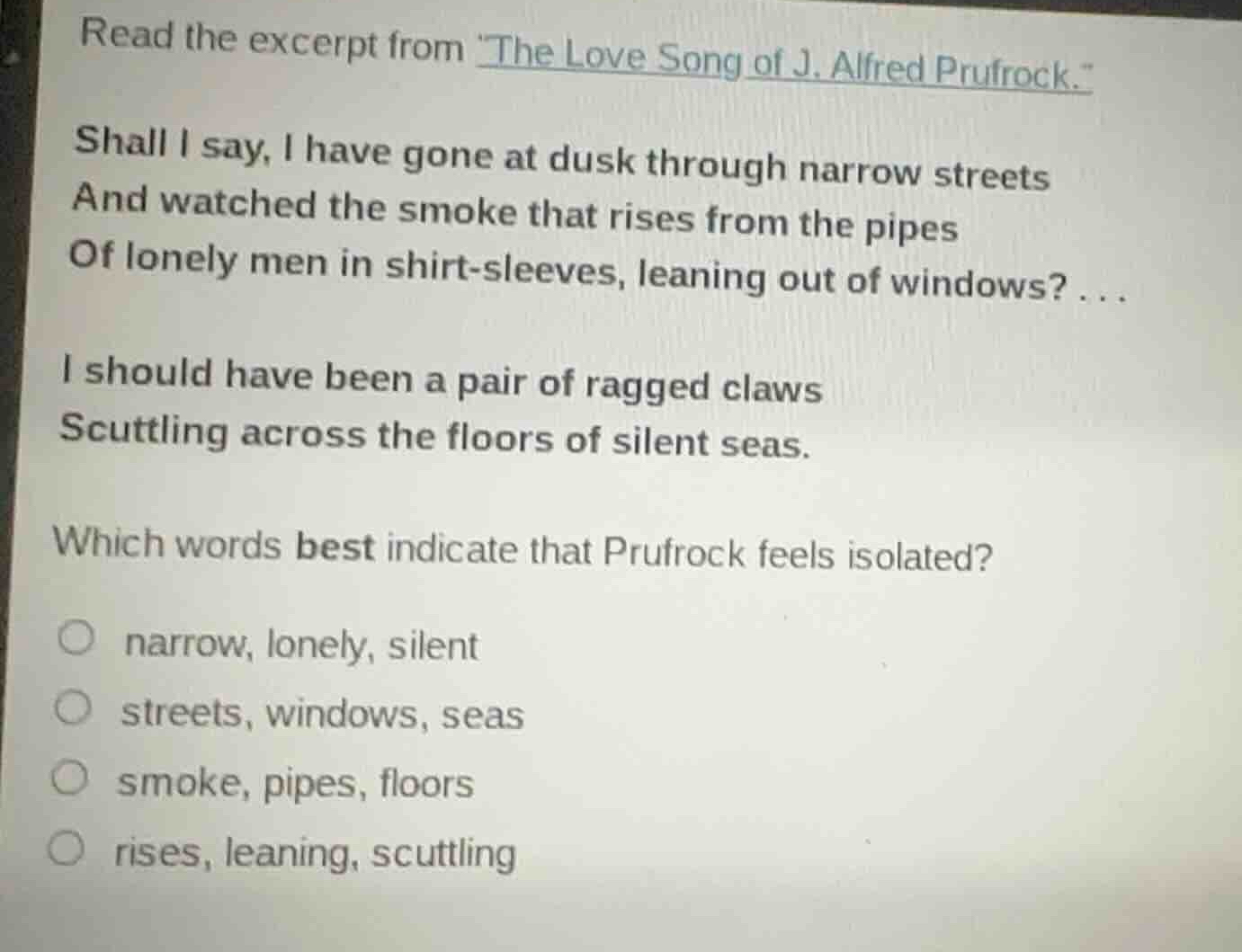
read the excerpt from \the love song of j. alfred prufrock.\

shall i say, i have gone at dusk through narrow streets
and watched the smoke that rises from the pipes
of lonely men in shirt-sleeves, leaning out of windows? ...

i should have been a pair of ragged claws
scuttling across the floors of silent seas.

which words best indicate that prufrock feels isolated?

narrow, lonely, silent
streets, windows, seas
smoke, pipes, floors
rises, leaning, scuttling

Explanation:

Response

<pre_analysis>
{
"quality": "clear",
"question_count": 1,
"skills_matched": [
"direct_cot",
"multiple_choice_formatter",
"explain_then_answer",
"quick"
],
"needs_drawing": false,
"concepts_used": [],
"new_concepts": [
"Poetic Imagery",
"Tone Analysis"
],
"current_concepts": [
"Prufrock Analysis",
"Poetic Imagery",
"Tone Analysis"
]
}
</pre_analysis>

<reasoning>

Analyze the excerpt for themes of isolation

The excerpt contains words that evoke confinement, solitude, and quietness: "narrow streets," "lonely men," and "silent seas."

Evaluate the given word groups

  • "narrow, lonely, silent": These adjectives directly describe the setting and people in a way that emphasizes solitude, confinement, and a lack of connection.
  • "streets, windows, seas": These are common nouns that establish the setting but do not inherently convey the emotional state of isolation.
  • "smoke, pipes, floors": These are concrete objects that do not directly indicate feelings of being isolated.
  • "rises, leaning, scuttling": These are action verbs describing physical movements rather than emotional isolation.

Select the best option

The words "narrow," "lonely," and "silent" are the strongest indicators of Prufrock's deep sense of isolation.
</reasoning>

<answer>
<mcq-correct>(A) narrow, lonely, silent</mcq-correct>
<mcq-option>(B) streets, windows, seas</mcq-option>
<mcq-option>(C) smoke, pipes, floors</mcq-option>
<mcq-option>(D) rises, leaning, scuttling</mcq-option>
</answer>

<post_analysis>
{
"subject": "Arts",
"question_type": "Multiple Choice",
"knowledge_point": [
"Arts",
"Others",
"Prufrock Analysis"
]
}
</post_analysis>

Answer:

<pre_analysis>
{
"quality": "clear",
"question_count": 1,
"skills_matched": [
"direct_cot",
"multiple_choice_formatter",
"explain_then_answer",
"quick"
],
"needs_drawing": false,
"concepts_used": [],
"new_concepts": [
"Poetic Imagery",
"Tone Analysis"
],
"current_concepts": [
"Prufrock Analysis",
"Poetic Imagery",
"Tone Analysis"
]
}
</pre_analysis>

<reasoning>

Analyze the excerpt for themes of isolation

The excerpt contains words that evoke confinement, solitude, and quietness: "narrow streets," "lonely men," and "silent seas."

Evaluate the given word groups

  • "narrow, lonely, silent": These adjectives directly describe the setting and people in a way that emphasizes solitude, confinement, and a lack of connection.
  • "streets, windows, seas": These are common nouns that establish the setting but do not inherently convey the emotional state of isolation.
  • "smoke, pipes, floors": These are concrete objects that do not directly indicate feelings of being isolated.
  • "rises, leaning, scuttling": These are action verbs describing physical movements rather than emotional isolation.

Select the best option

The words "narrow," "lonely," and "silent" are the strongest indicators of Prufrock's deep sense of isolation.
</reasoning>

<answer>
<mcq-correct>(A) narrow, lonely, silent</mcq-correct>
<mcq-option>(B) streets, windows, seas</mcq-option>
<mcq-option>(C) smoke, pipes, floors</mcq-option>
<mcq-option>(D) rises, leaning, scuttling</mcq-option>
</answer>

<post_analysis>
{
"subject": "Arts",
"question_type": "Multiple Choice",
"knowledge_point": [
"Arts",
"Others",
"Prufrock Analysis"
]
}
</post_analysis>