QUESTION IMAGE
Question
read the excerpt from julius caesar, act 2, scene 2.
caesar. what can be avoided
whose end is purposed by the mighty gods?
yet caesar shall go forth, for these predictions
are to the world in general as to caesar.
calpurnia. when beggars die there are no comets
seen;
the heavens themselves blaze forth the death of
princes.
caesar. cowards die many times before their deaths;
the valiant never taste of death but once.
which examples from the passage pair a symbol with its
reference in the passage? select two options.
\the heavens themselves blaze forth\ refers to the
lightning storm
\world\ symbolizes calpurnia’s dreams
\death of princes\ symbolize the death of caesar
\mighty gods\ symbolize caesar
\the valiant\ refers to beggars
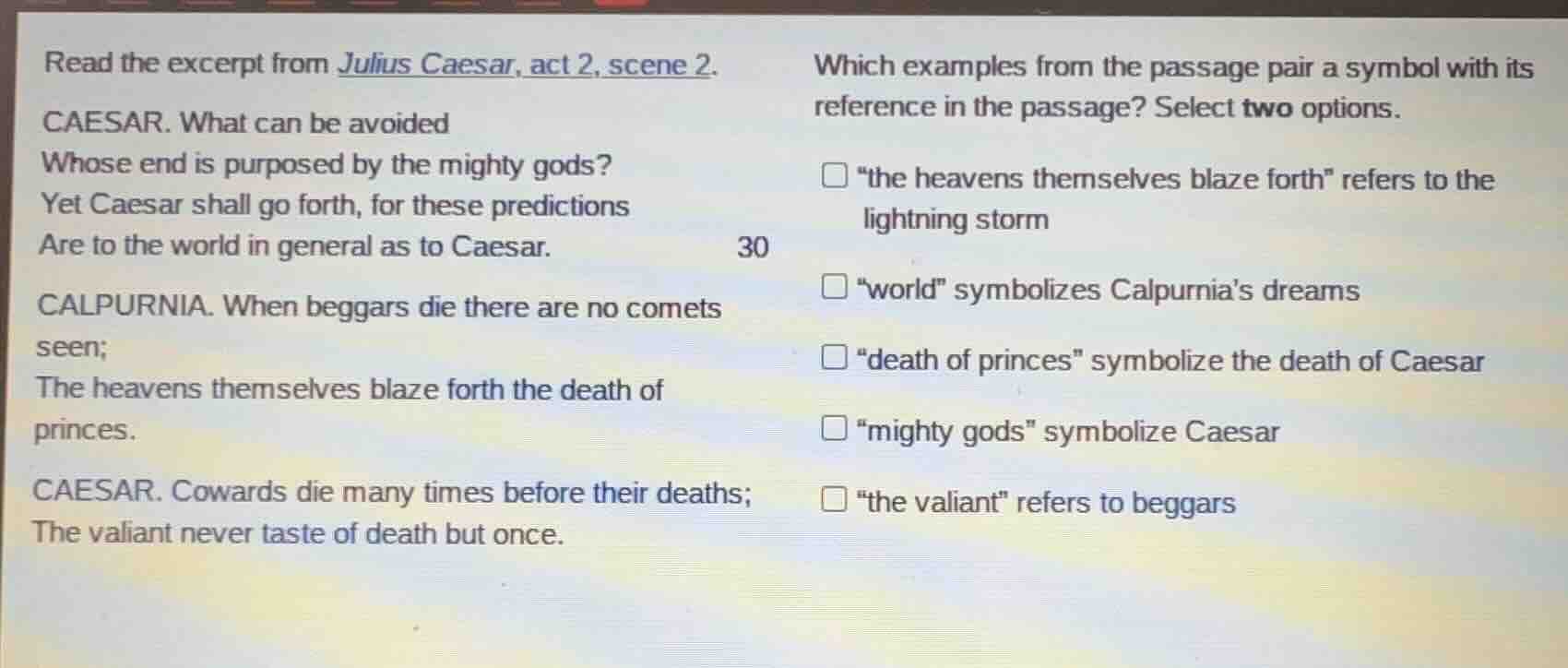
- For "the heavens themselves blaze forth" refers to the lightning storm: In the context, "the heavens themselves blaze forth" is a description of a celestial event, and a lightning storm is a plausible celestial blaze, so this is a valid symbol - reference pair.
- For "death of princes" symbolize the death of Caesar: The passage is about Caesar's situation, and the "death of princes" can be seen as a symbol foreshadowing Caesar's death (as Caesar is a prince - like figure of power), so this is a valid pair.
- The other options: "world" symbolizing Calpurnia's dreams is incorrect as "world" in the passage is used in a general sense. "mighty gods" symbolizing Caesar is incorrect as "mighty gods" are divine beings, not a symbol for Caesar. "the valiant" referring to beggars is incorrect as "the valiant" are brave people, opposite of beggars.

Snap & solve any problem in the app
Get step-by-step solutions on Sovi AI
Photo-based solutions with guided steps
Explore more problems and detailed explanations
A. "the heavens themselves blaze forth" refers to the lightning storm
C. "death of princes" symbolize the death of Caesar