QUESTION IMAGE
Question
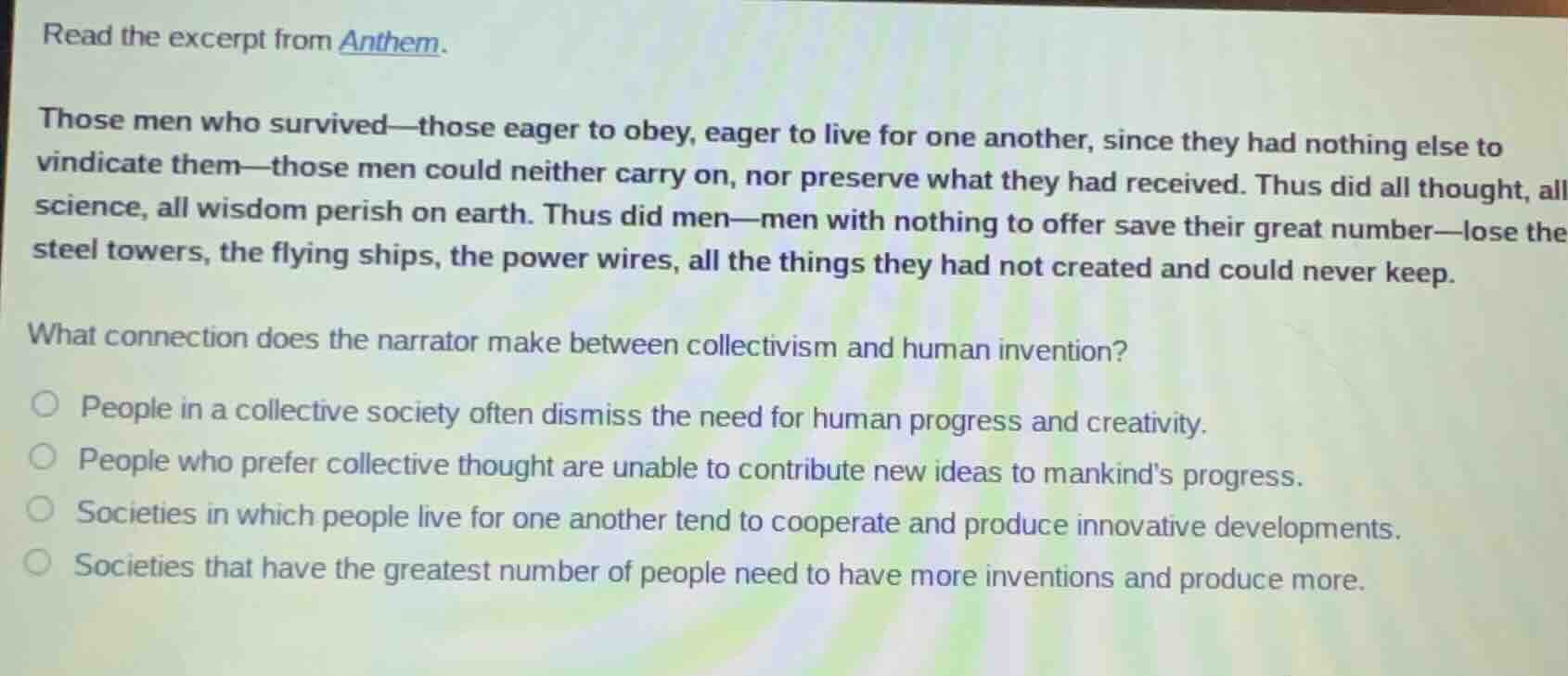
read the excerpt from anthem.
those men who survived-those eager to obey, eager to live for one another, since they had nothing else to vindicate them-those men could neither carry on, nor preserve what they had received. thus did all thought, all science, all wisdom perish on earth. thus did men-men with nothing to offer save their great number-lose the steel towers, the flying ships, the power wires, all the things they had not created and could never keep.
what connection does the narrator make between collectivism and human invention?
people in a collective society often dismiss the need for human progress and creativity.
people who prefer collective thought are unable to contribute new ideas to mankinds progress.
societies in which people live for one another tend to cooperate and produce innovative developments.
societies that have the greatest number of people need to have more inventions and produce more.
<pre_analysis>
{
"quality": "clear",
"question_count": 1,
"skills_matched": [
"direct_cot",
"multiple_choice_formatter",
"explain_then_answer",
"quick"
],
"needs_drawing": false,
"concepts_used": [
"Anthem Analysis",
"Individualism vs Collectivism"
],
"new_concepts": [],
"current_concepts": [
"Anthem Analysis",
"Individualism vs Collectivism"
]
}
</pre_analysis>
<reasoning>
Analyze the excerpt's description of collectivism
The excerpt describes "those eager to obey, eager to live for one another" (collectivists) as being unable to "carry on, nor preserve what they had received." Because of this collective mindset, "all thought, all science, all wisdom perish[ed] on earth."
Connect collectivism to human invention
The text states that these men had "nothing to offer save their great number" and lost advanced technological achievements ("steel towers, the flying ships, the power wires") because they were "things they had not created and could never keep." This directly links a preference for collective obedience and living for one another with an inability to produce or maintain technological progress and new ideas.
Evaluate the multiple-choice options
- Option 1 suggests they "dismiss the need" for progress, which is not the primary focus of the passage.
- Option 2 states that people who prefer collective thought are "unable to contribute new ideas to mankind's progress," which directly matches the text's assertion that under their rule, "all thought, all science, all wisdom perish[ed]."
- Option 3 contradicts the text, as the text shows they do not produce innovative developments.
- Option 4 is unsupported by the passage.
</reasoning>
<answer>
<mcq-option>People in a collective society often dismiss the need for human progress and creativity.</mcq-option>
<mcq-correct>People who prefer collective thought are unable to contribute new ideas to mankind's progress.</mcq-correct>
<mcq-option>Societies in which people live for one another tend to cooperate and produce innovative developments.</mcq-option>
<mcq-option>Societies that have the greatest number of people need to have more inventions and produce more.</mcq-option>
</answer>
<post_analysis>
{
"subject": "Arts",
"question_type": "Multiple Choice",
"knowledge_point": [
"Arts",
"Literary Analysis",
"Anthem Analysis"
]
}
</post_analysis>
Snap & solve any problem in the app
Get step-by-step solutions on Sovi AI
Photo-based solutions with guided steps
Explore more problems and detailed explanations
<pre_analysis>
{
"quality": "clear",
"question_count": 1,
"skills_matched": [
"direct_cot",
"multiple_choice_formatter",
"explain_then_answer",
"quick"
],
"needs_drawing": false,
"concepts_used": [
"Anthem Analysis",
"Individualism vs Collectivism"
],
"new_concepts": [],
"current_concepts": [
"Anthem Analysis",
"Individualism vs Collectivism"
]
}
</pre_analysis>
<reasoning>
Analyze the excerpt's description of collectivism
The excerpt describes "those eager to obey, eager to live for one another" (collectivists) as being unable to "carry on, nor preserve what they had received." Because of this collective mindset, "all thought, all science, all wisdom perish[ed] on earth."
Connect collectivism to human invention
The text states that these men had "nothing to offer save their great number" and lost advanced technological achievements ("steel towers, the flying ships, the power wires") because they were "things they had not created and could never keep." This directly links a preference for collective obedience and living for one another with an inability to produce or maintain technological progress and new ideas.
Evaluate the multiple-choice options
- Option 1 suggests they "dismiss the need" for progress, which is not the primary focus of the passage.
- Option 2 states that people who prefer collective thought are "unable to contribute new ideas to mankind's progress," which directly matches the text's assertion that under their rule, "all thought, all science, all wisdom perish[ed]."
- Option 3 contradicts the text, as the text shows they do not produce innovative developments.
- Option 4 is unsupported by the passage.
</reasoning>
<answer>
<mcq-option>People in a collective society often dismiss the need for human progress and creativity.</mcq-option>
<mcq-correct>People who prefer collective thought are unable to contribute new ideas to mankind's progress.</mcq-correct>
<mcq-option>Societies in which people live for one another tend to cooperate and produce innovative developments.</mcq-option>
<mcq-option>Societies that have the greatest number of people need to have more inventions and produce more.</mcq-option>
</answer>
<post_analysis>
{
"subject": "Arts",
"question_type": "Multiple Choice",
"knowledge_point": [
"Arts",
"Literary Analysis",
"Anthem Analysis"
]
}
</post_analysis>