QUESTION IMAGE
Question
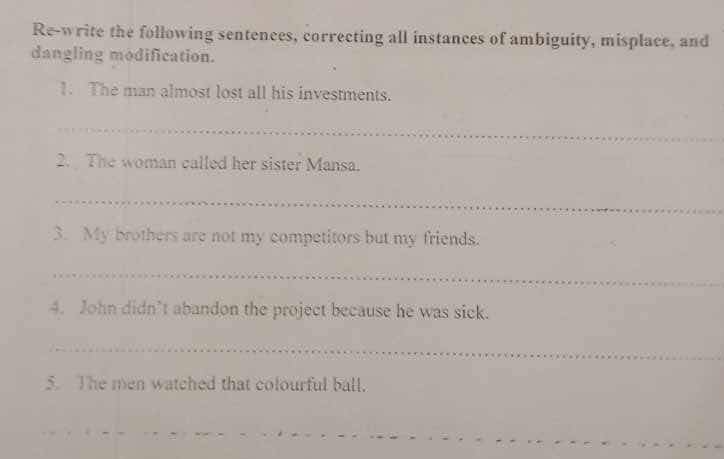
re-write the following sentences, correcting all instances of ambiguity, misplace, and dangling modification.
- the man almost lost all his investments.
- the woman called her sister mansa.
- my brothers are not my competitors but my friends.
- john didnt abandon the project because he was sick.
- the men watched that colourful ball.
<pre_analysis>
{
"quality": "clear",
"question_count": 5,
"skills_matched": [
"direct_cot",
"explain_then_answer",
"quick"
],
"needs_drawing": false,
"concepts_used": [],
"new_concepts": [
"Syntactic Ambiguity",
"Misplaced Modifiers",
"Semantic Clarification"
],
"current_concepts": [
"Syntactic Ambiguity",
"Misplaced Modifiers",
"Semantic Clarification"
]
}
</pre_analysis>
<reasoning>
Analyze syntactic and semantic ambiguities in each sentence
- "The man almost lost all his investments."
- The placement of "almost" is ambiguous. It can mean he nearly lost everything (but lost nothing), or he lost nearly all of them (lost most of them).
- Clarification 1 (nearly lost everything): "The man nearly lost all of his investments."
- Clarification 2 (lost most of them): "The man lost almost all of his investments."
- "The woman called her sister Mansa."
- Ambiguous naming/addressing structure. It can mean the sister's name is Mansa, or the woman addressed her sister by the name "Mansa", or she phoned her sister whose name is Mansa.
- Clarification 1 (sister named Mansa): "The woman called her sister, Mansa."
- Clarification 2 (naming/calling her): "The woman addressed her sister as Mansa."
- "My brothers are not my competitors but my friends."
- Lacks parallel structure or clear punctuation to separate the contrast, causing minor stylistic ambiguity.
- Clarification: "My brothers are not my competitors, but rather my friends."
- "John didn't abandon the project because he was sick."
- Ambiguity of negation scope ("not... because"). It can mean:
- He did not abandon the project, and the reason was his sickness (makes little sense logically, but syntactically possible).
- He did abandon the project, but not because of sickness (he did it for another reason).
- Because he was sick, he did not abandon the project.
- Clarification 1 (abandoned for another reason): "It was not because he was sick that John abandoned the project."
- Clarification 2 (did not abandon it): "Because he was sick, John did not abandon the project."
- "The men watched that colourful ball."
- "Ball" is homonymous (a spherical toy vs. a formal dance party).
- Clarification 1 (toy): "The men watched that colourful sphere."
- Clarification 2 (dance): "The men watched that colourful dance party."
</reasoning>
<answer>
Question 1
- Interpretation A (nearly lost everything): The man nearly lost all of his investments.
- Interpretation B (lost most of them): The man lost almost all of his investments.
Question 2
- Interpretation A (sister's name is Mansa): The woman called her sister, Mansa.
- Interpretation B (calling her by that name): The woman addressed her sister as Mansa.
Question 3
- Clarified: My brothers are not my competitors, but rather my friends.
Question 4
- Interpretation A (abandoned for another reason): It was not because he was sick that John abandoned the project.
- Interpretation B (did not abandon it): Because he was sick, John did not abandon the project.
Question 5
- Interpretation A (spherical object): The men watched that colourful toy ball.
- Interpretation B (social event): The men watched that colourful dance party.
</answer>
<post_analysis>
{
"subject": "Others",
"question_type": "Free Response",
"knowledge_point": [
"Others",
"Linguistics",
"Syntactic Ambiguity"
]
}
</post_analysis>
Snap & solve any problem in the app
Get step-by-step solutions on Sovi AI
Photo-based solutions with guided steps
Explore more problems and detailed explanations
<pre_analysis>
{
"quality": "clear",
"question_count": 5,
"skills_matched": [
"direct_cot",
"explain_then_answer",
"quick"
],
"needs_drawing": false,
"concepts_used": [],
"new_concepts": [
"Syntactic Ambiguity",
"Misplaced Modifiers",
"Semantic Clarification"
],
"current_concepts": [
"Syntactic Ambiguity",
"Misplaced Modifiers",
"Semantic Clarification"
]
}
</pre_analysis>
<reasoning>
Analyze syntactic and semantic ambiguities in each sentence
- "The man almost lost all his investments."
- The placement of "almost" is ambiguous. It can mean he nearly lost everything (but lost nothing), or he lost nearly all of them (lost most of them).
- Clarification 1 (nearly lost everything): "The man nearly lost all of his investments."
- Clarification 2 (lost most of them): "The man lost almost all of his investments."
- "The woman called her sister Mansa."
- Ambiguous naming/addressing structure. It can mean the sister's name is Mansa, or the woman addressed her sister by the name "Mansa", or she phoned her sister whose name is Mansa.
- Clarification 1 (sister named Mansa): "The woman called her sister, Mansa."
- Clarification 2 (naming/calling her): "The woman addressed her sister as Mansa."
- "My brothers are not my competitors but my friends."
- Lacks parallel structure or clear punctuation to separate the contrast, causing minor stylistic ambiguity.
- Clarification: "My brothers are not my competitors, but rather my friends."
- "John didn't abandon the project because he was sick."
- Ambiguity of negation scope ("not... because"). It can mean:
- He did not abandon the project, and the reason was his sickness (makes little sense logically, but syntactically possible).
- He did abandon the project, but not because of sickness (he did it for another reason).
- Because he was sick, he did not abandon the project.
- Clarification 1 (abandoned for another reason): "It was not because he was sick that John abandoned the project."
- Clarification 2 (did not abandon it): "Because he was sick, John did not abandon the project."
- "The men watched that colourful ball."
- "Ball" is homonymous (a spherical toy vs. a formal dance party).
- Clarification 1 (toy): "The men watched that colourful sphere."
- Clarification 2 (dance): "The men watched that colourful dance party."
</reasoning>
<answer>
Question 1
- Interpretation A (nearly lost everything): The man nearly lost all of his investments.
- Interpretation B (lost most of them): The man lost almost all of his investments.
Question 2
- Interpretation A (sister's name is Mansa): The woman called her sister, Mansa.
- Interpretation B (calling her by that name): The woman addressed her sister as Mansa.
Question 3
- Clarified: My brothers are not my competitors, but rather my friends.
Question 4
- Interpretation A (abandoned for another reason): It was not because he was sick that John abandoned the project.
- Interpretation B (did not abandon it): Because he was sick, John did not abandon the project.
Question 5
- Interpretation A (spherical object): The men watched that colourful toy ball.
- Interpretation B (social event): The men watched that colourful dance party.
</answer>
<post_analysis>
{
"subject": "Others",
"question_type": "Free Response",
"knowledge_point": [
"Others",
"Linguistics",
"Syntactic Ambiguity"
]
}
</post_analysis>