QUESTION IMAGE
Question
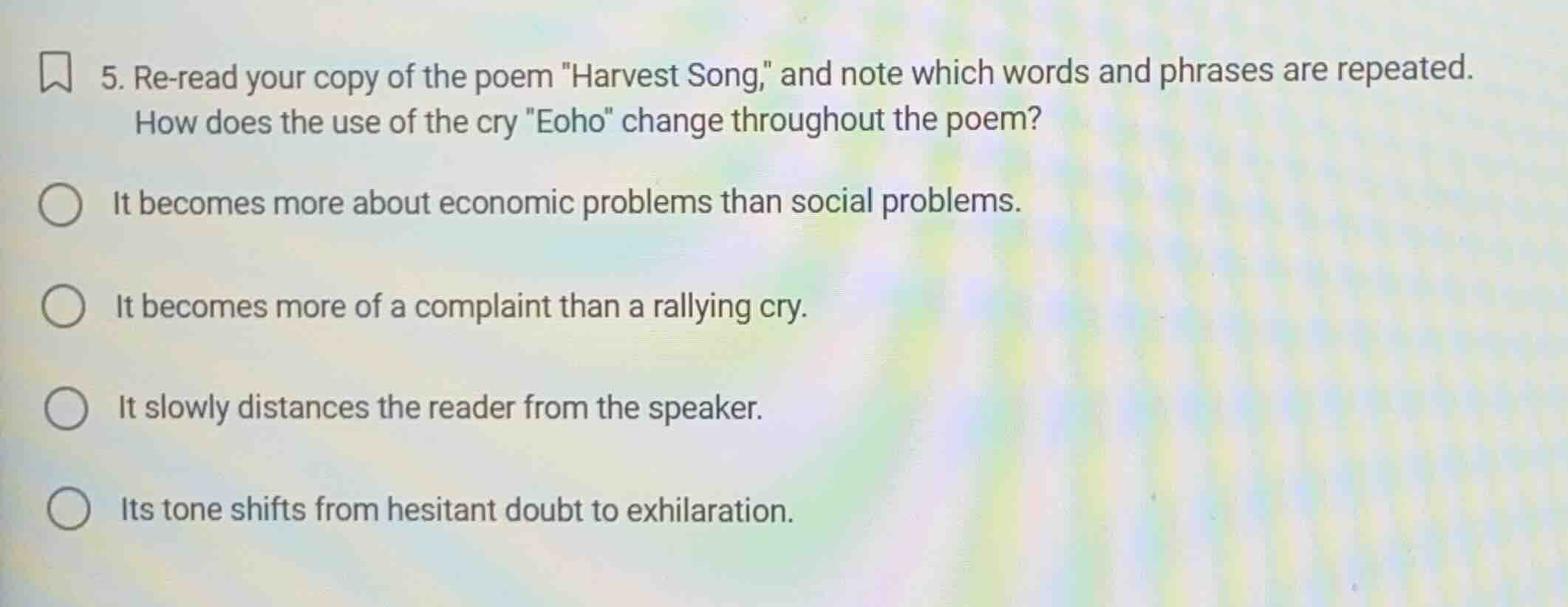
- re-read your copy of the poem \harvest song,\ and note which words and phrases are repeated. how does the use of the cry \eoho\ change throughout the poem?
it becomes more about economic problems than social problems.
it becomes more of a complaint than a rallying cry.
it slowly distances the reader from the speaker.
its tone shifts from hesitant doubt to exhilaration.
Analyze the poem's structure
Using the Jean Toomer Literature and Harvest Song Analysis knowledge points
In Jean Toomer's poem "Harvest Song" from his 1923 book Cane, the speaker is a tired reaper. The call "Eoho" is repeated throughout the poem.
Examine the function of "Eoho"
Using the Harvest Song Analysis knowledge point
Initially, "Eoho" functions as a traditional work song call, meant to signal or rally other workers across the fields. However, as the speaker's physical fatigue, hunger, and sense of isolation deepen, the cry loses its strength as a call to others.
Evaluate the shift in tone
Using the Harvest Song Analysis knowledge point
As the poem progresses, the speaker admits to being too tired to hear the other reapers and fears their physical contact. The cry "Eoho" transitions from a potential rallying call for connection into a weary, internal complaint of pain and hunger.
Compare the multiple-choice options
Using the Harvest Song Analysis knowledge point
- Option 1 suggests a shift from economic to social problems, which does not match the personal, physical weariness of the cry.
- Option 2 states it becomes more of a complaint than a rallying cry, which accurately reflects the speaker's growing exhaustion and isolation.
- Option 3 suggests it distances the reader, but the poem actually draws the reader closer to the speaker's internal suffering.
- Option 4 suggests a shift to exhilaration, which contradicts the poem's heavy, exhausted tone.

Snap & solve any problem in the app
Get step-by-step solutions on Sovi AI
Photo-based solutions with guided steps
Explore more problems and detailed explanations
- It becomes more about economic problems than social problems.
- It becomes more of a complaint than a rallying cry. (Correct answer)
- It slowly distances the reader from the speaker.
- Its tone shifts from hesitant doubt to exhilaration.