QUESTION IMAGE
Question
7.1.5 quiz: chronological thinking
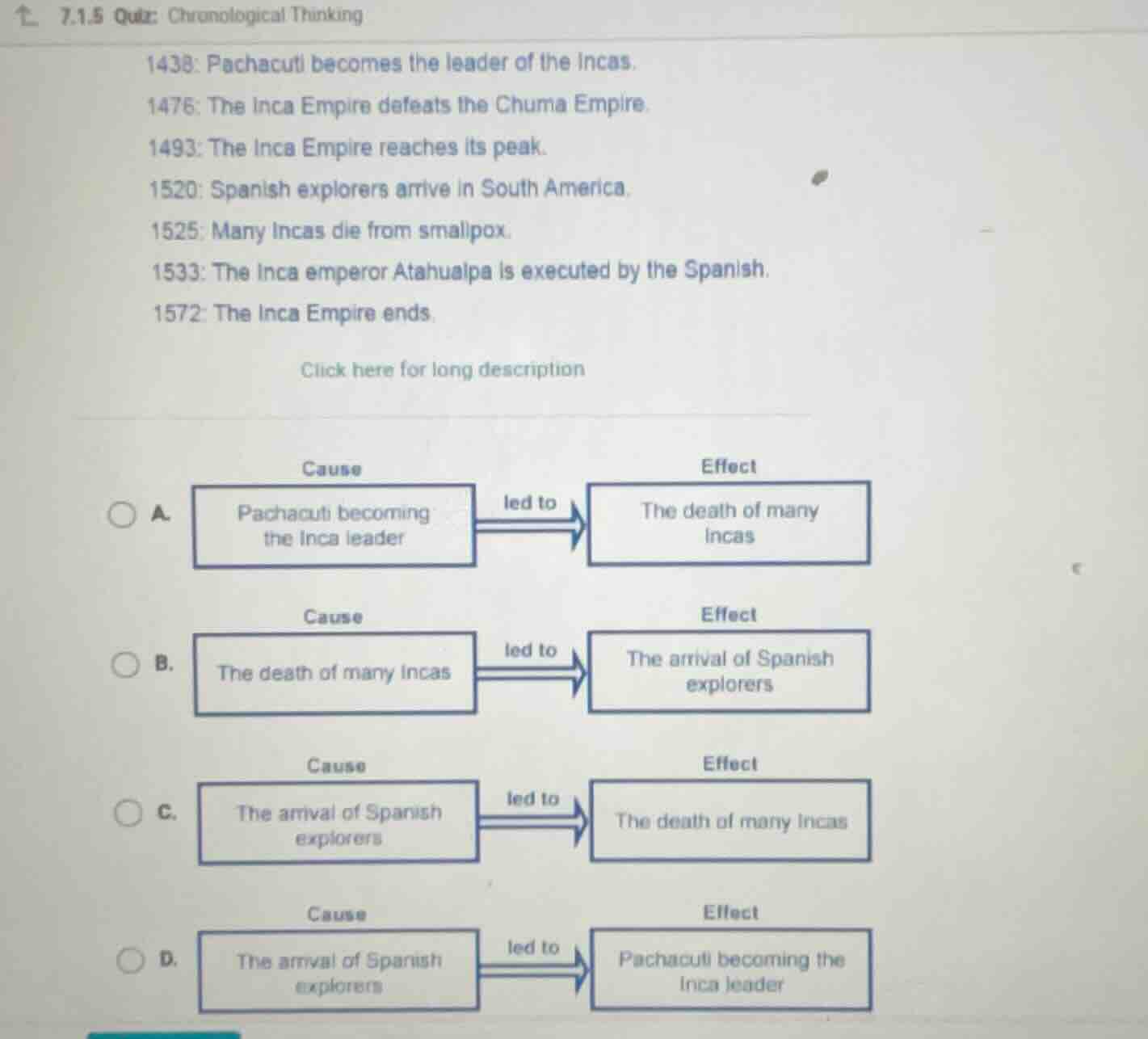
1438: pachacuti becomes the leader of the incas.
1476: the inca empire defeats the chuma empire.
1493: the inca empire reaches its peak.
1520: spanish explorers arrive in south america.
1525: many incas die from smallpox.
1533: the inca emperor atahualpa is executed by the spanish.
1572: the inca empire ends.
click here for long description
a. cause: pachacuti becoming the inca leader led to effect: the death of many incas
b. cause: the death of many incas led to effect: the arrival of spanish explorers
c. cause: the arrival of spanish explorers led to effect: the death of many incas
d. cause: the arrival of spanish explorers led to effect: pachacuti becoming the inca leader
Analyze the chronological timeline
The provided timeline lists key events in the history of the Inca Empire:
- 1438: Pachacuti becomes the leader of the Incas.
- 1476: The Inca Empire defeats the Chuma Empire.
- 1493: The Inca Empire reaches its peak.
- 1520: Spanish explorers arrive in South America.
- 1525: Many Incas die from smallpox.
- 1533: The Inca emperor Atahualpa is executed by the Spanish.
- 1572: The Inca Empire ends.
Evaluate cause-and-effect relationships
We need to identify which option correctly represents a logical cause-and-effect relationship based on historical facts and the timeline:
- Option A: "Pachacuti becoming the Inca leader" (1438) led to "The death of many Incas" (1525). There is no direct causal link here; the death of many Incas was caused by smallpox, not Pachacuti's ascension nearly a century earlier.
- Option B: "The death of many Incas" (1525) led to "The arrival of Spanish explorers" (1520). This is chronologically impossible because the effect occurred before the cause.
- Option C: "The arrival of Spanish explorers" (1520) led to "The death of many Incas" (1525). This is historically accurate. Spanish explorers brought Eurasian diseases such as smallpox to South America, to which the Indigenous populations had no immunity, resulting in devastating epidemics. This demonstrates Historical Causation.
- Option D: "The arrival of Spanish explorers" (1520) led to "Pachacuti becoming the Inca leader" (1438). This is chronologically impossible as the effect happened before the cause.
Confirm the correct option
Option C correctly identifies that the arrival of Spanish explorers was the cause of the smallpox epidemic that resulted in the deaths of many Incas.

Snap & solve any problem in the app
Get step-by-step solutions on Sovi AI
Photo-based solutions with guided steps
Explore more problems and detailed explanations
- (A) Cause: Pachacuti becoming the Inca leader -> led to -> Effect: The death of many Incas
- (B) Cause: The death of many Incas -> led to -> Effect: The arrival of Spanish explorers
- (C) Cause: The arrival of Spanish explorers -> led to -> Effect: The death of many Incas (Correct answer)
- (D) Cause: The arrival of Spanish explorers -> led to -> Effect: Pachacuti becoming the Inca leader