QUESTION IMAGE
Question
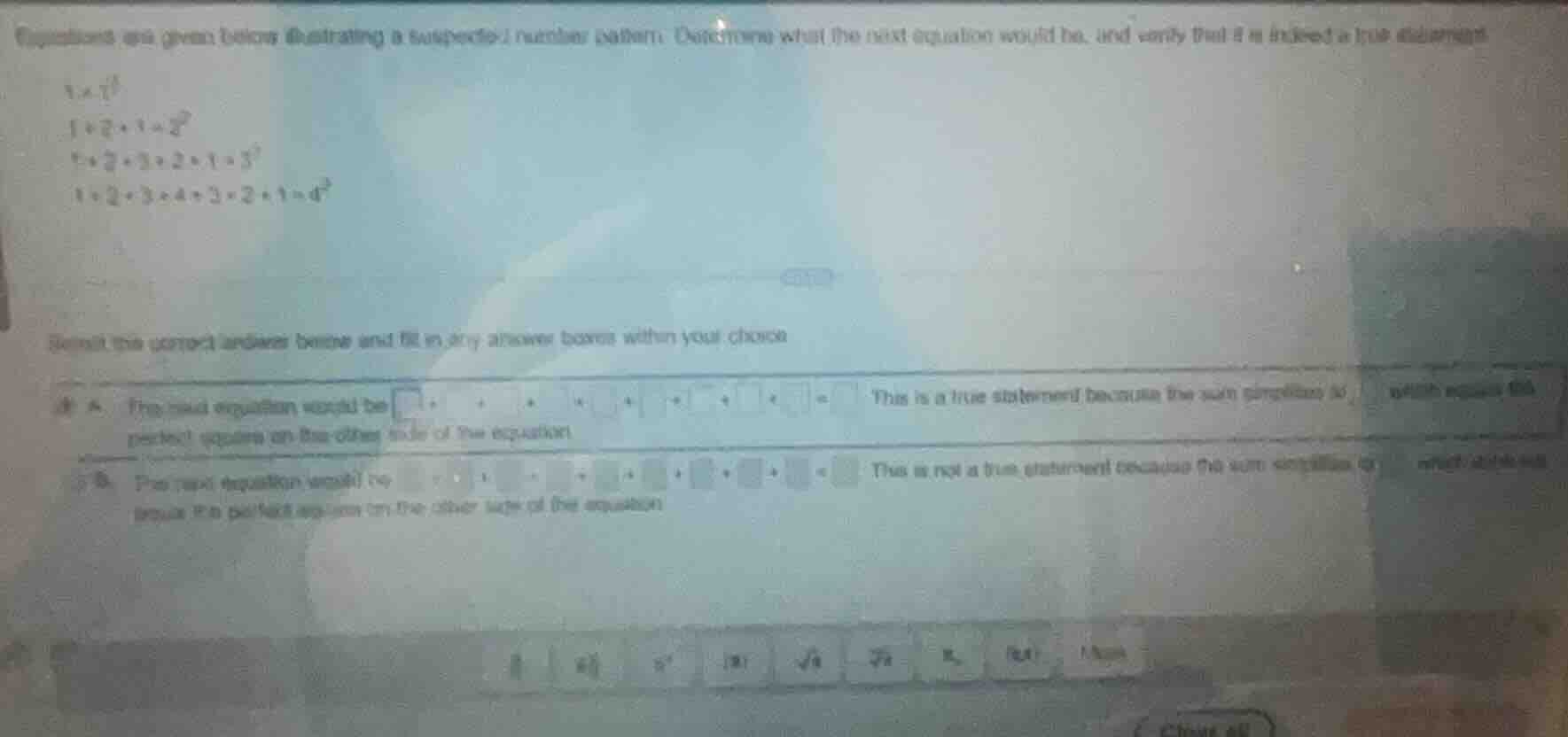
questions are given below illustrating a number pattern. determine what the next equation would be, and verify that it is indeed a true statement.
$1=1^2$
$1 + 2 + 1 = 2^2$
$1 + 2 + 3 + 2 + 1 = 3^2$
$1 + 2 + 3 + 4 + 3 + 2 + 1 = 4^2$
select the correct answer below and fill in any answer boxes within your choice.
a. the next equation would be $\square + \square + \square + \square + \square + \square + \square + \square + \square = \square$. this is a true statement because the sum simplifies to $\square$, which equals the perfect square on the other side of the equation.
b. the next equation would be $\square + \square + \square + \square + \square + \square + \square + \square + \square = \square$. this is not a true statement because the sum simplifies to $\square$, which does not equal the perfect square on the other side of the equation.
Step1: Identify pattern in equations
Observe given equations:
$1=1^2$
$1+2+1=2^2$
$1+2+3+2+1=3^2$
$1+2+3+4+3+2+1=4^2$
Each equation builds up to $n$ then back down to 1, equal to $n^2$.
Step2: Write next equation
For $n=5$, the left side is $1+2+3+4+5+4+3+2+1$, right side is $5^2$.
Expression: $1+2+3+4+5+4+3+2+1=5^2$
Step3: Verify the sum
Calculate left side:
$1+2+3+4+5+4+3+2+1=(1+2+3+4)+5+(4+3+2+1)=10+5+10=25$
Right side: $5^2=25$

Snap & solve any problem in the app
Get step-by-step solutions on Sovi AI
Photo-based solutions with guided steps
Explore more problems and detailed explanations
A. The next equation would be $1+2+3+4+5+4+3+2+1=5^2$. This is a true statement because the sum simplifies to 25, which equals the perfect square on the other side of the equation.