QUESTION IMAGE
Question
question 4
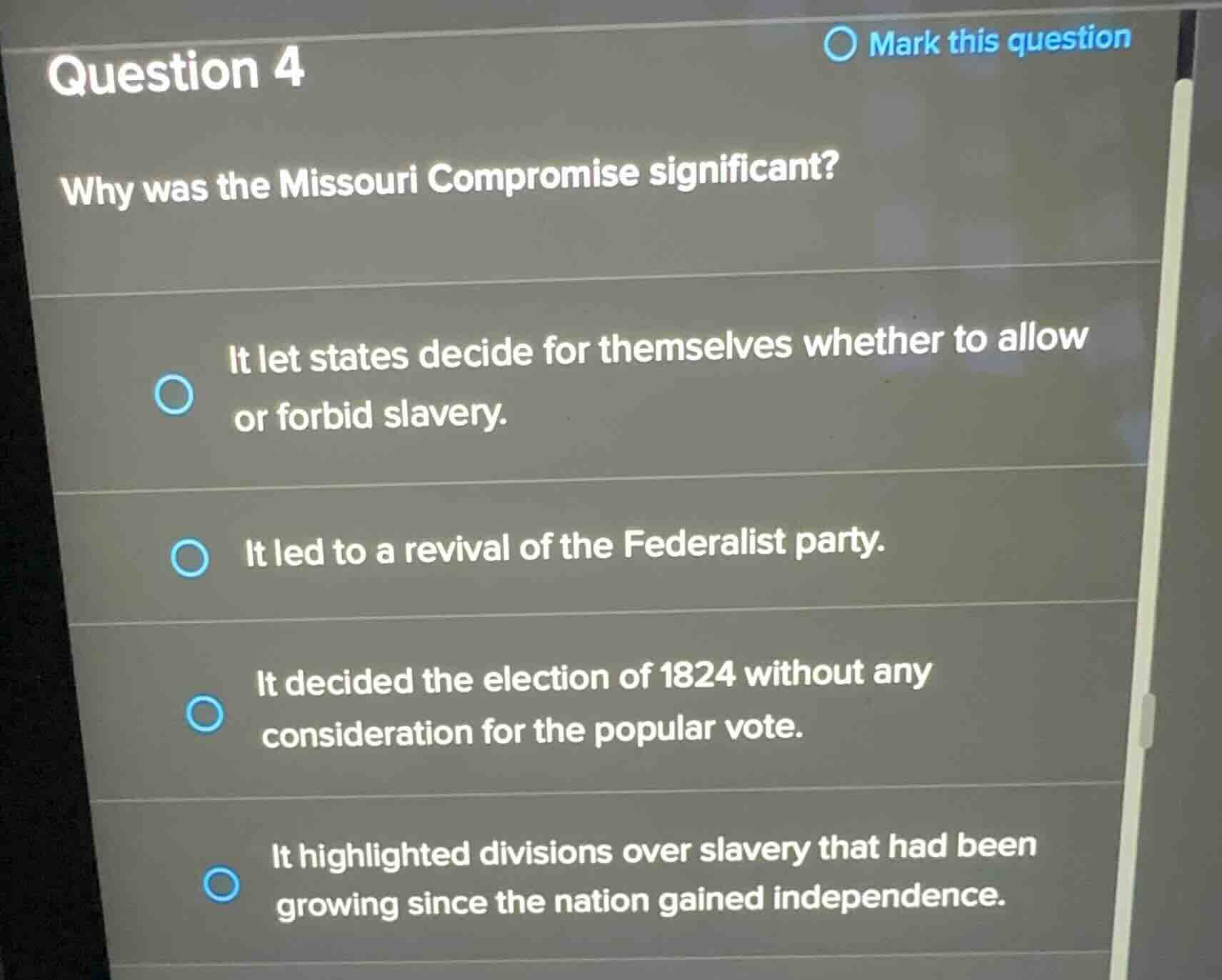
why was the missouri compromise significant?
- it let states decide for themselves whether to allow or forbid slavery.
- it led to a revival of the federalist party.
- it decided the election of 1824 without any consideration for the popular vote.
- it highlighted divisions over slavery that had been growing since the nation gained independence.
Analyze the Missouri Compromise of 1820
The Missouri Compromise was passed in 1820 to address growing sectional tensions over the expansion of slavery. Missouri's request for admission as a slave state threatened to upset the delicate balance of power between free and slave states in the U.S. Senate.
Evaluate the historical significance
The compromise admitted Missouri as a slave state and Maine as a free state, while establishing the \(36^\circ 30'\) parallel as the boundary line for slavery in the remainder of the Louisiana Purchase territory. This agreement did not permanently resolve the issue; instead, it brought the deep, underlying sectional divisions over slavery into sharp focus, showing how much they had grown since the nation's founding.
Assess the given options
- Option 1: "It let states decide for themselves whether to allow or forbid slavery." This describes popular sovereignty, which was introduced later (e.g., in the Kansas-Nebraska Act of 1854), not the Missouri Compromise.
- Option 2: "It led to a revival of the Federalist party." The Federalist Party was essentially defunct by 1820 during the "Era of Good Feelings" and was not revived by this compromise.
- Option 3: "It decided the election of 1824 without any consideration for the popular vote." The election of 1824 was decided by the House of Representatives (the "Corrupt Bargain"), which was unrelated to the terms of the Missouri Compromise.
- Option 4: "It highlighted divisions over slavery that had been growing since the nation gained independence." This is correct. Thomas Jefferson famously referred to the Missouri crisis as a "fire bell in the night," recognizing that the debate exposed deep-seated sectional animosities over slavery that threatened the Union.

Snap & solve any problem in the app
Get step-by-step solutions on Sovi AI
Photo-based solutions with guided steps
Explore more problems and detailed explanations
- (A) It let states decide for themselves whether to allow or forbid slavery.
- (B) It led to a revival of the Federalist party.
- (C) It decided the election of 1824 without any consideration for the popular vote.
- (D) It highlighted divisions over slavery that had been growing since the nation gained independence. (Correct answer)