Sovi.AI - AI Math Tutor

Scan to solve math questions

QUESTION IMAGE

question #5 which organ is the most sensitive to the absence of glucose…

Question

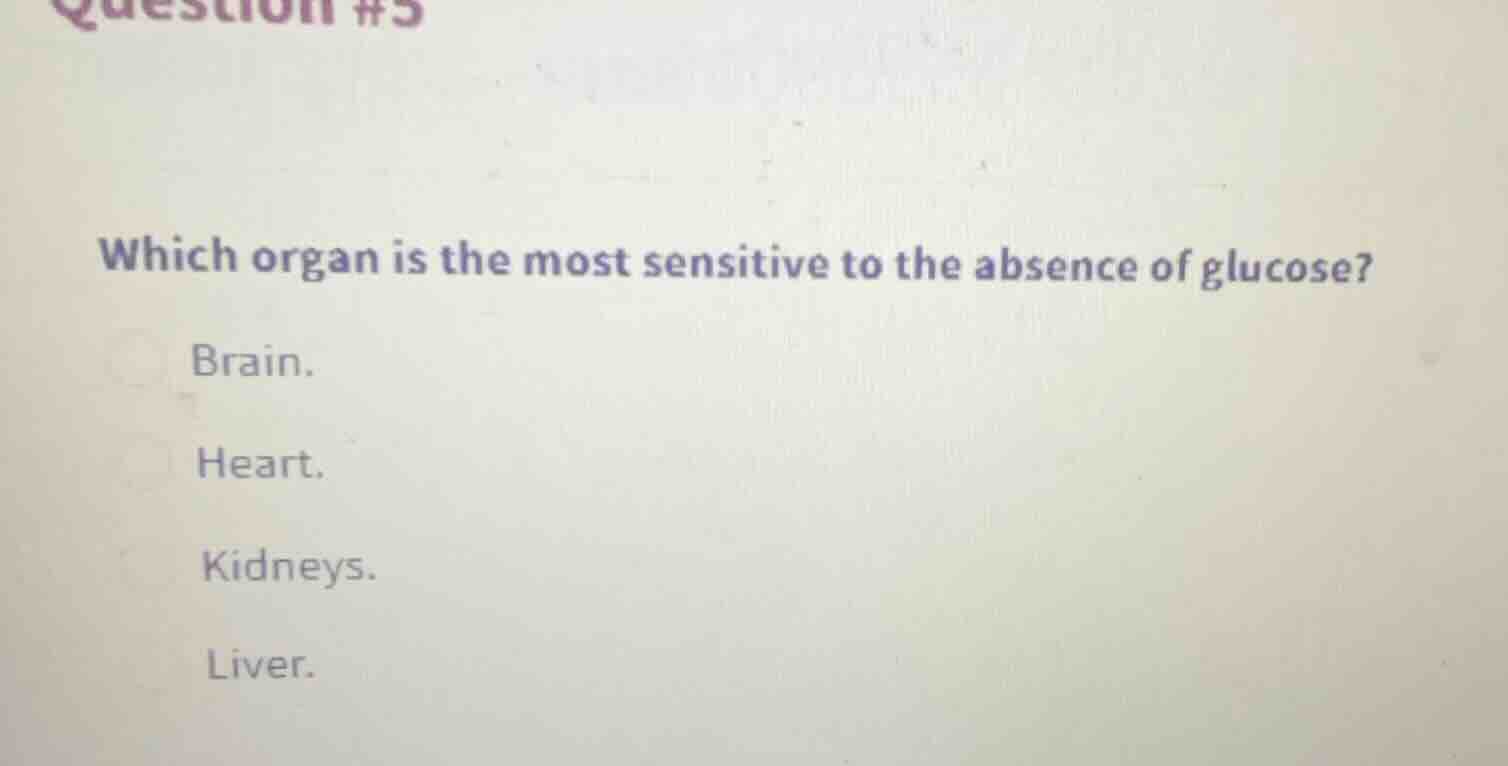
question #5

which organ is the most sensitive to the absence of glucose?

brain.
heart.
kidneys.
liver.

Explanation:

Response

<pre_analysis>
{
"quality": "clear",
"question_count": 1,
"skills_matched": [
"direct_cot",
"multiple_choice_formatter",
"explain_then_answer",
"tutor"
],
"needs_drawing": false,
"concepts_used": [
"Insulin-Independent Tissues"
],
"new_concepts": [
"Cerebral Glucose Metabolism",
"Hypoglycemia Pathophysiology"
],
"current_concepts": [
"Insulin-Independent Tissues",
"Cerebral Glucose Metabolism",
"Hypoglycemia Pathophysiology"
]
}
</pre_analysis>

<reasoning>

Identify the metabolic demands of the organs

The human body utilizes glucose as a primary energy source, but different organs have varying degrees of metabolic flexibility. The heart, kidneys, and liver can readily metabolize alternative substrates such as fatty acids, ketone bodies, and lactate when glucose levels are low.

Analyze the brain's unique energy requirements

Using the Insulin-Independent Tissues knowledge point, we know that the brain relies almost exclusively on glucose for its metabolic needs under normal physiological conditions. Because neurons cannot store glucose or synthesize it, and the blood-brain barrier limits the rapid uptake of large lipid molecules, the brain is highly dependent on a continuous supply of glucose from the bloodstream.

Determine the most sensitive organ

Because the brain lacks significant glycogen stores and has an extremely high metabolic rate, any interruption in glucose delivery (hypoglycemia) rapidly impairs neuronal function, leading to immediate cognitive deficits, loss of consciousness, or irreversible brain damage. Therefore, the brain is the most sensitive organ to the absence of glucose.
</reasoning>

<answer>
<mcq-correct>Brain.</mcq-correct>
<mcq-option>Heart.</mcq-option>
<mcq-option>Kidneys.</mcq-option>
<mcq-option>Liver.</mcq-option>
</answer>

<post_analysis>
{
"subject": "Natural Science",
"question_type": "Multiple Choice",
"knowledge_point": [
"Natural Science",
"Biology",
"Human Physiology"
]
}
</post_analysis>

Answer:

<pre_analysis>
{
"quality": "clear",
"question_count": 1,
"skills_matched": [
"direct_cot",
"multiple_choice_formatter",
"explain_then_answer",
"tutor"
],
"needs_drawing": false,
"concepts_used": [
"Insulin-Independent Tissues"
],
"new_concepts": [
"Cerebral Glucose Metabolism",
"Hypoglycemia Pathophysiology"
],
"current_concepts": [
"Insulin-Independent Tissues",
"Cerebral Glucose Metabolism",
"Hypoglycemia Pathophysiology"
]
}
</pre_analysis>

<reasoning>

Identify the metabolic demands of the organs

The human body utilizes glucose as a primary energy source, but different organs have varying degrees of metabolic flexibility. The heart, kidneys, and liver can readily metabolize alternative substrates such as fatty acids, ketone bodies, and lactate when glucose levels are low.

Analyze the brain's unique energy requirements

Using the Insulin-Independent Tissues knowledge point, we know that the brain relies almost exclusively on glucose for its metabolic needs under normal physiological conditions. Because neurons cannot store glucose or synthesize it, and the blood-brain barrier limits the rapid uptake of large lipid molecules, the brain is highly dependent on a continuous supply of glucose from the bloodstream.

Determine the most sensitive organ

Because the brain lacks significant glycogen stores and has an extremely high metabolic rate, any interruption in glucose delivery (hypoglycemia) rapidly impairs neuronal function, leading to immediate cognitive deficits, loss of consciousness, or irreversible brain damage. Therefore, the brain is the most sensitive organ to the absence of glucose.
</reasoning>

<answer>
<mcq-correct>Brain.</mcq-correct>
<mcq-option>Heart.</mcq-option>
<mcq-option>Kidneys.</mcq-option>
<mcq-option>Liver.</mcq-option>
</answer>

<post_analysis>
{
"subject": "Natural Science",
"question_type": "Multiple Choice",
"knowledge_point": [
"Natural Science",
"Biology",
"Human Physiology"
]
}
</post_analysis>