QUESTION IMAGE
Question
question 2
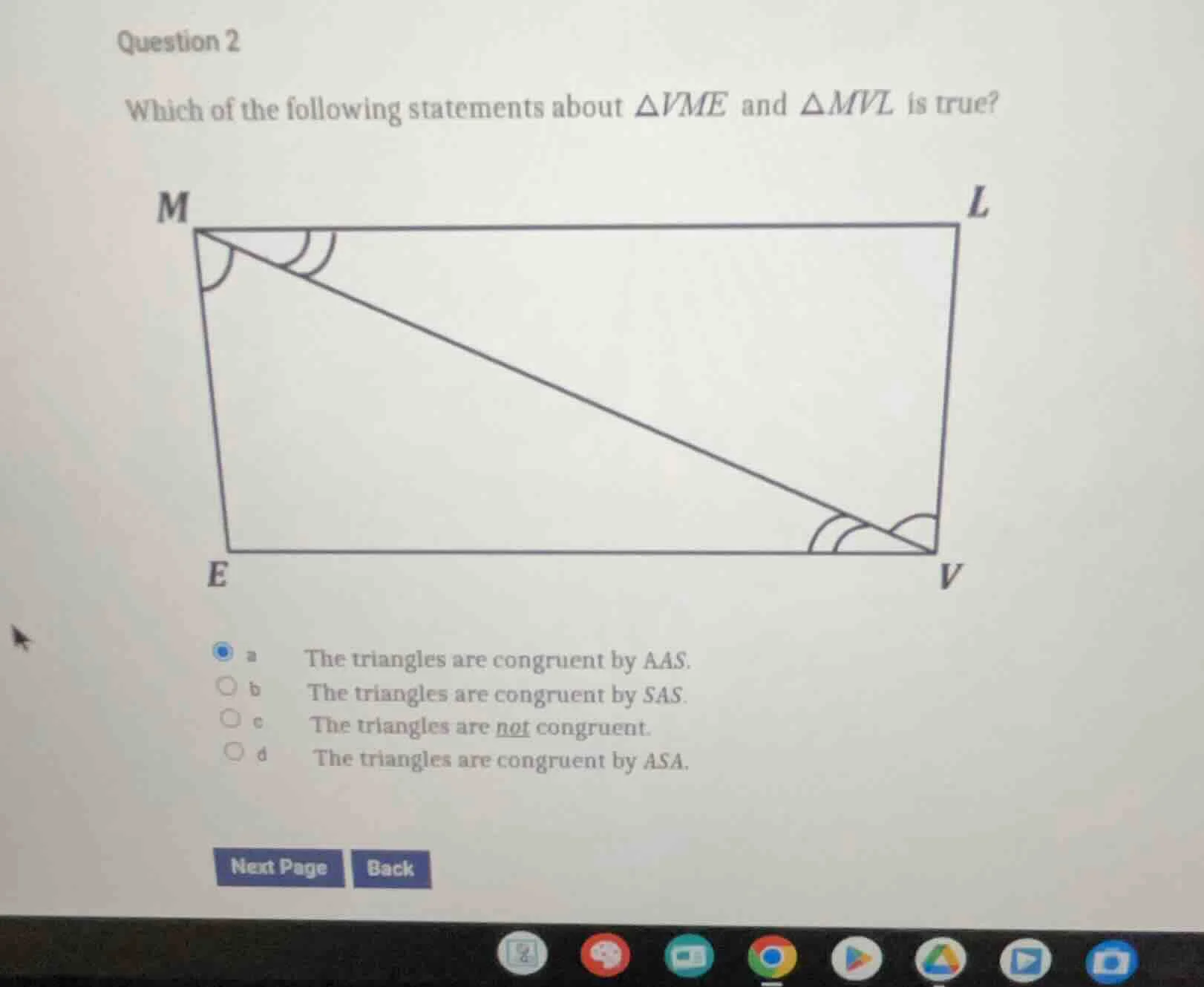
which of the following statements about \\(\delta vme\\) and \\(\delta mvl\\) is true?
a the triangles are congruent by aas.
b the triangles are congruent by sas.
c the triangles are not congruent.
d the triangles are congruent by asa.
Identify given congruent angles
The diagram shows two triangles, \(\Delta VME\) and \(\Delta MVL\), sharing a common side \(MV\).
Looking at the angle markings:
- \(\angle EMV\) has a single arc marking.
- \(\angle LVM\) has a single arc marking.
Therefore, \(\angle EMV \cong \angle LVM\).
- \(\angle EVM\) has a double arc marking.
- \(\angle LMV\) has a double arc marking.
Therefore, \(\angle EVM \cong \angle LMV\).
Identify the shared side
Both triangles share the side \(MV\).
By the Reflexive Property of Congruence:
\(MV \cong VM\).
Apply congruence postulate
We have:
- An angle: \(\angle EMV \cong \angle LVM\)
- An included side: \(MV \cong VM\)
- Another angle: \(\angle EVM \cong \angle LMV\)
Since the congruent side is directly between the two pairs of congruent angles, we use the Angle-Side-Angle (ASA) congruence postulate.
Thus, \(\Delta VME \cong \Delta MVL\) by ASA.

Snap & solve any problem in the app
Get step-by-step solutions on Sovi AI
Photo-based solutions with guided steps
Explore more problems and detailed explanations
- a The triangles are congruent by AAS.
- b The triangles are congruent by SAS.
- c The triangles are not congruent.
- d The triangles are congruent by ASA. (Correct answer)