QUESTION IMAGE
Question
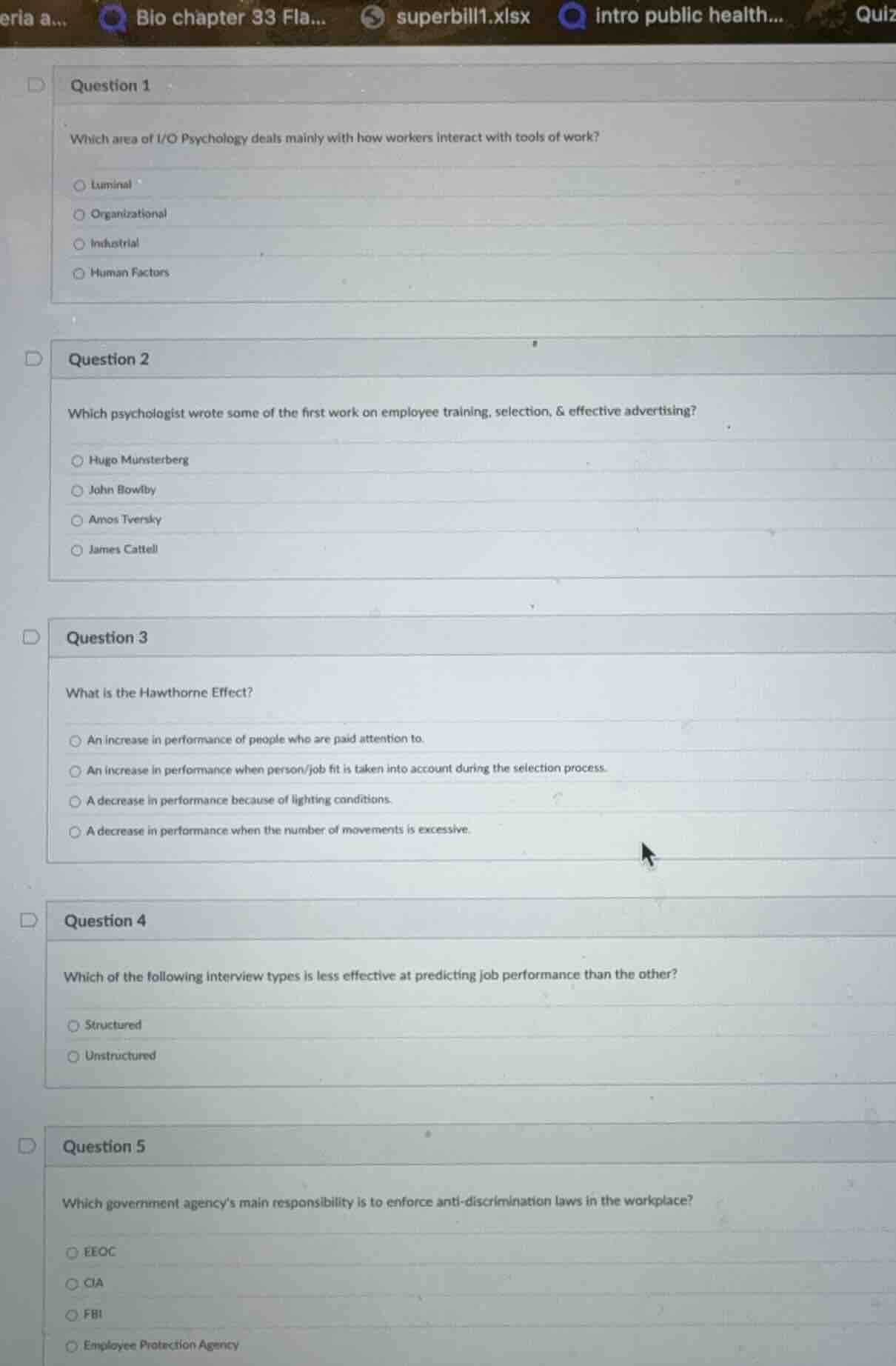
question 1
which area of i/o psychology deals mainly with how workers interact with tools of work?
- luminal
- organizational
- industrial
- human factors
question 2
which psychologist wrote some of the first work on employee training, selection, & effective advertising?
- hugo münsterberg
- john bowlby
- amos tversky
- james cattell
question 3
what is the hawthorne effect?
- an increase in performance of people who are paid attention to.
- an increase in performance when person/job fit is taken into account during the selection process.
- a decrease in performance because of lighting conditions.
- a decrease in performance when the number of movements is excessive.
question 4
which of the following interview types is less effective at predicting job performance than the other?
- structured
- unstructured
question 5
which government agencys main responsibility is to enforce anti-discrimination laws in the workplace?
- eeoc
- cia
- fbi
- employee protection agency
Analyze Question 1: Interaction with tools of work
The question asks which area of Industrial-Organizational (I/O) Psychology deals mainly with how workers interact with tools of work.
- Human Factors Psychology (also known as ergonomics) specifically studies the interaction between humans, tools, machines, and work environments to optimize safety, productivity, and comfort.
- Industrial Psychology focuses on job analysis, recruitment, selection, training, and performance appraisal.
- Organizational Psychology focuses on social dynamics, employee satisfaction, motivation, leadership, and organizational culture.
- Luminal is not a standard subfield of I/O psychology.
Therefore, the correct option is Human Factors.
Analyze Question 2: Pioneer of employee training, selection, and advertising
The question asks which psychologist wrote some of the first work on employee training, selection, and effective advertising.
- Hugo Münsterberg was one of the pioneering figures of industrial psychology. He published influential early works such as Psychology and Industrial Efficiency (1913), which covered employee selection, training, and advertising.
- John Bowlby is famous for attachment theory.
- Amos Tversky is known for cognitive biases and prospect theory.
- James Cattell focused on individual differences and mental testing, but Münsterberg is specifically recognized for these combined applied areas.
Therefore, the correct option is Hugo Münsterberg.
Analyze Question 3: Definition of the Hawthorne Effect
The question asks for the definition of the Hawthorne Effect.
- The Hawthorne Effect refers to a phenomenon where individuals modify or improve an aspect of their behavior in response to their awareness of being observed or receiving attention.
- This was discovered during studies at Western Electric's Hawthorne Works, where researchers noticed worker productivity increased simply because they were being studied, regardless of physical changes like lighting.
Therefore, the correct option is "An increase in performance of people who are paid attention to."
Analyze Question 4: Interview effectiveness comparison
The question asks which interview type is less effective at predicting job performance than the other.
- Research in I/O psychology consistently shows that structured interviews (where questions are standardized and evaluated using a systematic rubric) are highly reliable and valid predictors of job performance.
- Unstructured interviews (which are conversational, non-standardized, and subjective) are significantly less effective and more prone to bias.
Therefore, the unstructured interview is the less effective one.
Analyze Question 5: Government agency enforcing anti-discrimination laws
The question asks which government agency's main responsibility is to enforce anti-discrimination laws in the workplace.
- The EEOC (Equal Employment Opportunity Commission) is the federal agen…

Snap & solve any problem in the app
Get step-by-step solutions on Sovi AI
Photo-based solutions with guided steps
Explore more problems and detailed explanations
Question 1
- Luminal
- Organizational
- Industrial
- Human Factors (Correct answer)
Question 2
- Hugo Münsterberg (Correct answer)
- John Bowlby
- Amos Tversky
- James Cattell
Question 3
- An increase in performance of people who are paid attention to. (Correct answer)
- An increase in performance when person/job fit is taken into account during the selection process.
- A decrease in performance because of lighting conditions.
- A decrease in performance when the number of movements is excessive.
Question 4
- Structured
- Unstructured (Correct answer)
Question 5
- EEOC (Correct answer)
- CIA
- FBI
- Employee Protection Agency