QUESTION IMAGE
Question
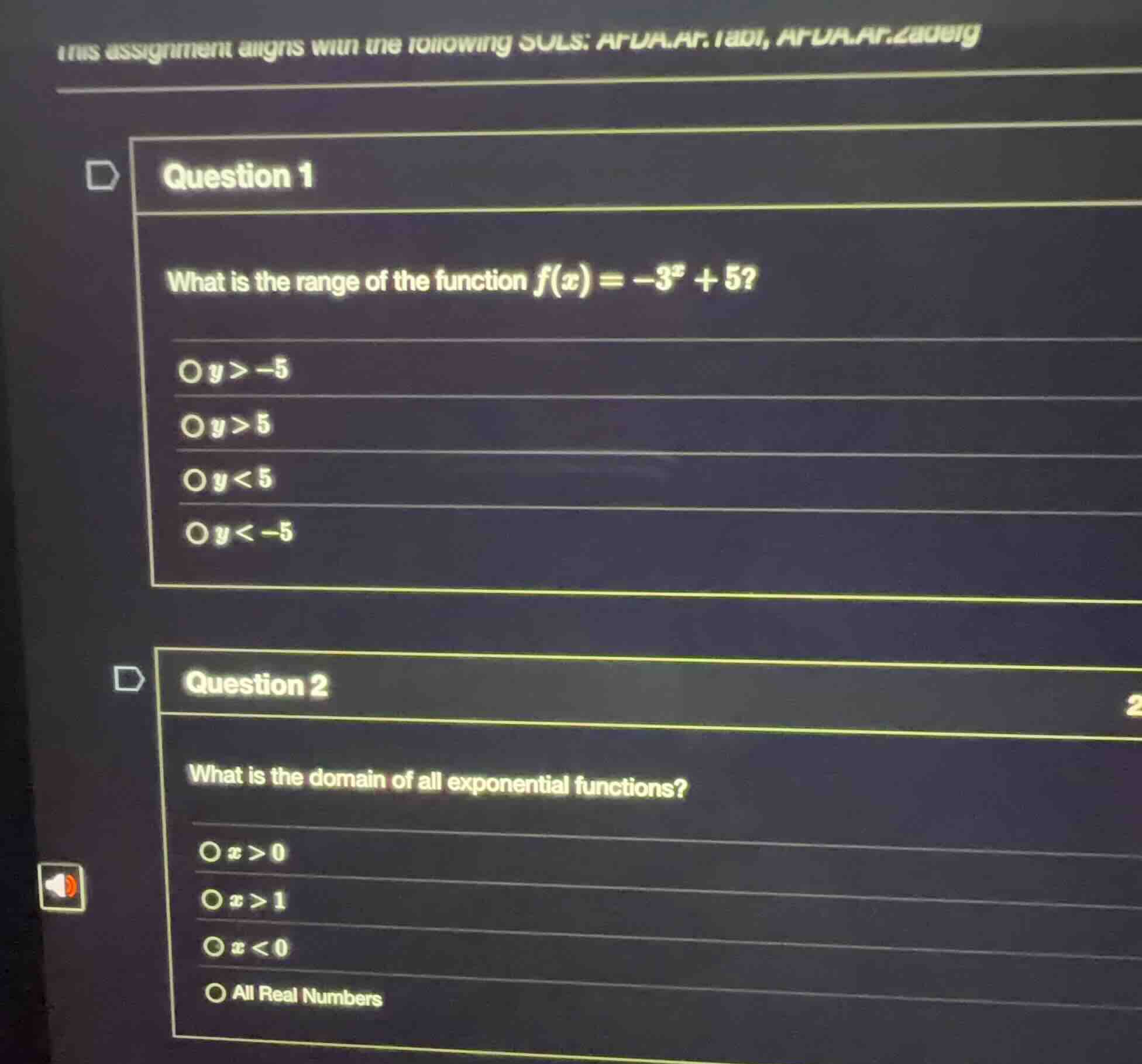
question 1
what is the range of the function (f(x) = -3^x + 5)?
(y > -5)
(y > 5)
(y < 5)
(y < -5)
question 2
what is the domain of all exponential functions?
(x > 0)
(x > 1)
(x < 0)
all real numbers
Analyze the range of the first function
We are given the function \(f(x) = -3^x + 5\). Let's analyze its behavior step-by-step:
- The basic exponential term is \(3^x\). For all real numbers \(x\), the value of \(3^x\) is strictly positive:
$$3^x > 0$$
- Multiplying this term by \(-1\) reverses the inequality:
$$-3^x < 0$$
- Adding \(5\) to both sides of the inequality gives:
$$-3^x + 5 < 5$$
Therefore, the range of the function \(f(x) = -3^x + 5\) is \(y < 5\).
Analyze the domain of exponential functions
An exponential function in its general form is written as \(g(x) = a \cdot b^x + c\), where \(b > 0\) and \(b
eq 1\).
- The exponent \(x\) can be any real number (positive, negative, or zero) because we can raise any positive base \(b\) to any real power.
- There are no division-by-zero operations or even-degree roots of negative numbers to restrict the input values.
Therefore, the domain of all basic exponential functions is all real numbers.

Snap & solve any problem in the app
Get step-by-step solutions on Sovi AI
Photo-based solutions with guided steps
Explore more problems and detailed explanations
Question 1
- (A) \(y > -5\)
- (B) \(y > 5\)
- (C) \(y < 5\) (Correct answer)
- (D) \(y < -5\)
Question 2
- (A) \(x > 0\)
- (B) \(x > 1\)
- (C) \(x < 0\)
- (D) All Real Numbers (Correct answer)