QUESTION IMAGE
Question
question 4
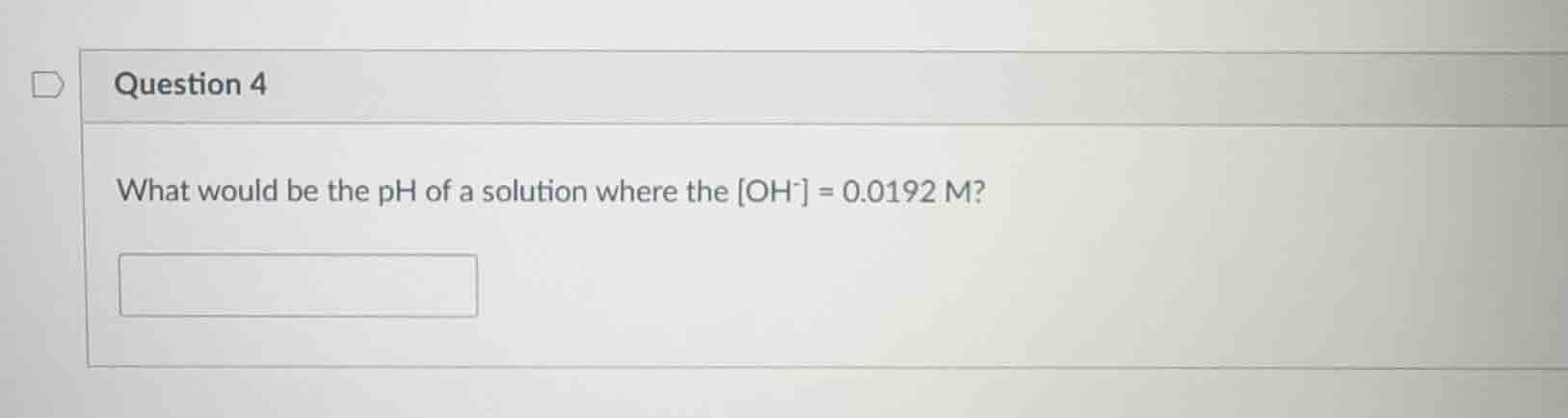
what would be the ph of a solution where the \\(\text{oh}^- = 0.0192\text{ m}\\)?
<pre_analysis>
{
"quality": "clear",
"question_count": 1,
"skills_matched": [
"step_cot",
"blank_filling_formatter",
"explain_then_answer",
"tutor"
],
"needs_drawing": false,
"concepts_used": [
"Significant Figures"
],
"new_concepts": [
"pH and pOH Calculations",
"Hydroxide Ion Concentration"
],
"current_concepts": [
"Significant Figures",
"pH and pOH Calculations",
"Hydroxide Ion Concentration"
]
}
</pre_analysis>
<reasoning>
Calculate the pOH of the solution
We calculate the \(\text{pOH}\) from the given hydroxide ion concentration \([\text{OH}^-]\).
\[
\text{pOH} = -\log[\text{OH}^-]
\]
\[
\text{pOH} = -\log(0.0192) \approx 1.7167
\]
Calculate the pH of the solution
We use the relationship between \(\text{pH}\) and \(\text{pOH}\) at \(25^\circ\text{C}\).
\[
\text{pH} + \text{pOH} = 14.00
\]
\[
\text{pH} = 14.00 - \text{pOH}
\]
\[
\text{pH} = 14.00 - 1.7167 = 12.2833
\]
Apply significant figures
Using the Significant Figures rules for logarithms, the number of decimal places in the logarithm value must equal the number of significant figures in the original concentration.
The concentration \(0.0192\text{ M}\) has three significant figures.
Therefore, the final \(\text{pH}\) value should be rounded to three decimal places.
\[
\text{pH} \approx 12.283
\]
</reasoning>
<answer>
What would be the pH of a solution where the \([\text{OH}^-] = 0.0192\text{ M}\)? <blank>\(12.283\)</blank>
</answer>
<post_analysis>
{
"subject": "Natural Science",
"question_type": "Fill-in-the-blank",
"knowledge_point": [
"Natural Science",
"Chemistry",
"pH and pOH Calculations"
]
}
</post_analysis>
Snap & solve any problem in the app
Get step-by-step solutions on Sovi AI
Photo-based solutions with guided steps
Explore more problems and detailed explanations
<pre_analysis>
{
"quality": "clear",
"question_count": 1,
"skills_matched": [
"step_cot",
"blank_filling_formatter",
"explain_then_answer",
"tutor"
],
"needs_drawing": false,
"concepts_used": [
"Significant Figures"
],
"new_concepts": [
"pH and pOH Calculations",
"Hydroxide Ion Concentration"
],
"current_concepts": [
"Significant Figures",
"pH and pOH Calculations",
"Hydroxide Ion Concentration"
]
}
</pre_analysis>
<reasoning>
Calculate the pOH of the solution
We calculate the \(\text{pOH}\) from the given hydroxide ion concentration \([\text{OH}^-]\).
\[
\text{pOH} = -\log[\text{OH}^-]
\]
\[
\text{pOH} = -\log(0.0192) \approx 1.7167
\]
Calculate the pH of the solution
We use the relationship between \(\text{pH}\) and \(\text{pOH}\) at \(25^\circ\text{C}\).
\[
\text{pH} + \text{pOH} = 14.00
\]
\[
\text{pH} = 14.00 - \text{pOH}
\]
\[
\text{pH} = 14.00 - 1.7167 = 12.2833
\]
Apply significant figures
Using the Significant Figures rules for logarithms, the number of decimal places in the logarithm value must equal the number of significant figures in the original concentration.
The concentration \(0.0192\text{ M}\) has three significant figures.
Therefore, the final \(\text{pH}\) value should be rounded to three decimal places.
\[
\text{pH} \approx 12.283
\]
</reasoning>
<answer>
What would be the pH of a solution where the \([\text{OH}^-] = 0.0192\text{ M}\)? <blank>\(12.283\)</blank>
</answer>
<post_analysis>
{
"subject": "Natural Science",
"question_type": "Fill-in-the-blank",
"knowledge_point": [
"Natural Science",
"Chemistry",
"pH and pOH Calculations"
]
}
</post_analysis>