QUESTION IMAGE
Question
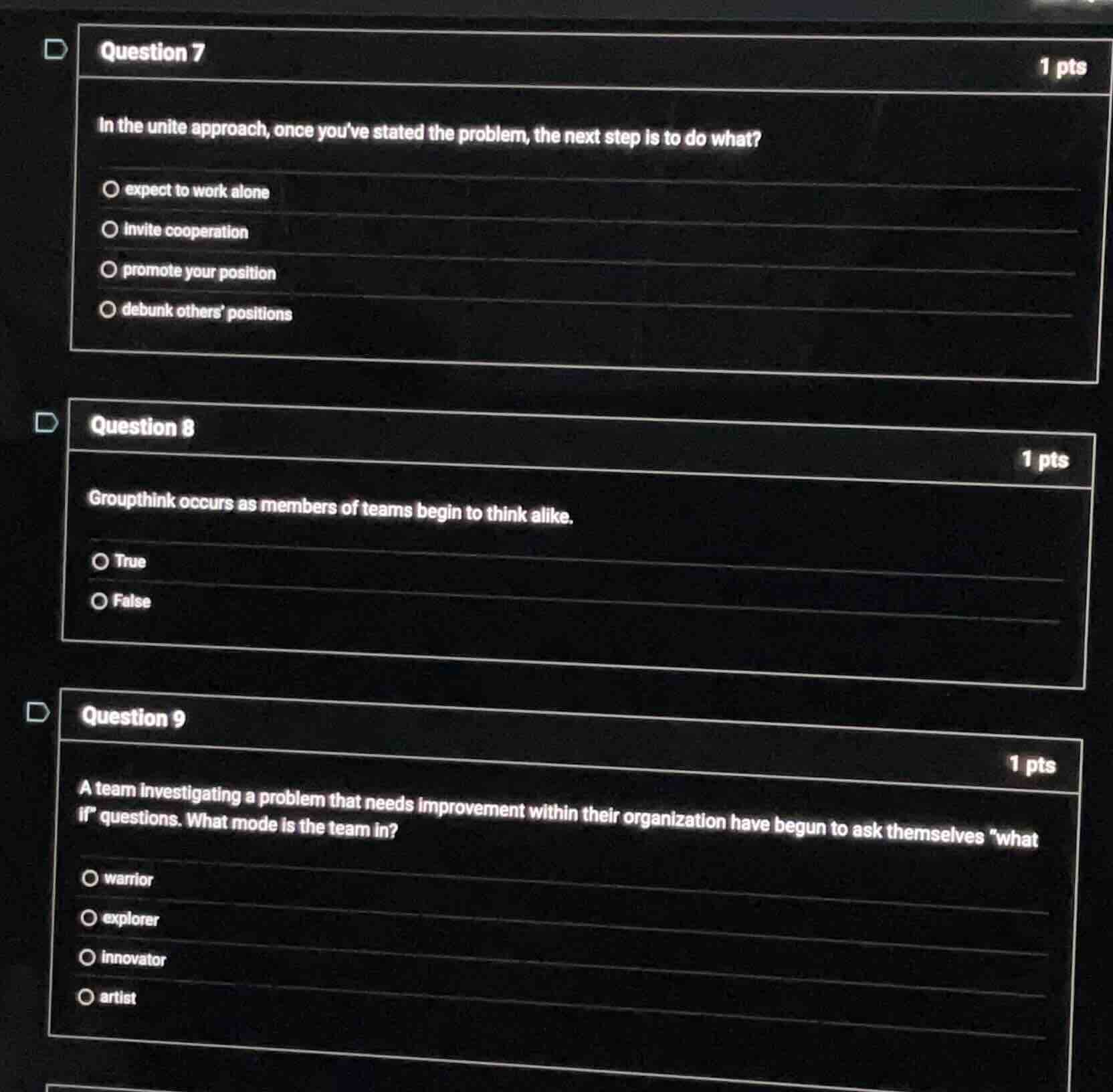
question 7
in the unite approach, once youve stated the problem, the next step is to do what?
- expect to work alone
- invite cooperation
- promote your position
- debunk others positions
question 8
groupthink occurs as members of teams begin to think alike.
- true
- false
question 9
a team investigating a problem that needs improvement within their organization have begun to ask themselves \what if\ questions. what mode is the team in?
- warrior
- explorer
- innovator
- artist
<pre_analysis>
{
"quality": "clear",
"question_count": 3,
"skills_matched": [
"direct_cot",
"multiple_choice_formatter",
"explain_then_answer",
"tutor"
],
"needs_drawing": false,
"concepts_used": [],
"new_concepts": [
"UNITE Approach",
"Groupthink",
"Team Roles and Modes"
],
"current_concepts": [
"UNITE Approach",
"Groupthink",
"Team Roles and Modes"
]
}
</pre_analysis>
<reasoning>
Analyze Question 7
The UNITE approach is a collaborative conflict resolution and problem-solving framework. The acronym stands for:
- Understand the problem (state the problem)
- Nurture cooperation (invite cooperation)
- Invent options
- Take action
- Evaluate results
Once you have stated the problem, the next step is to invite cooperation.
Analyze Question 8
Groupthink is a psychological phenomenon that occurs within a group of people in which the desire for harmony or conformity in the group results in an irrational or dysfunctional decision-making outcome. It is characterized by members of teams beginning to think alike, suppressing dissenting viewpoints, and isolating themselves from outside influences. Therefore, the statement is true.
Analyze Question 9
In creative problem-solving and team dynamics (often based on Roger von Oech's roles of the creative process: Explorer, Artist, Judge, Warrior):
- The Explorer searches for new information and asks "what if" questions to investigate possibilities and gather raw materials.
- The Artist turns the resources into new ideas.
- The Judge evaluates the ideas.
- The Warrior carries the decision into action.
Asking "what if" questions to investigate a problem indicates the team is in the explorer mode.
</reasoning>
<answer>
Question 7
<mcq-option>O expect to work alone</mcq-option>
<mcq-correct>O invite cooperation</mcq-correct>
<mcq-option>O promote your position</mcq-option>
<mcq-option>O debunk others' positions</mcq-option>
Question 8
<mcq-correct>O True</mcq-correct>
<mcq-option>O False</mcq-option>
Question 9
<mcq-option>O warrior</mcq-option>
<mcq-correct>O explorer</mcq-correct>
<mcq-option>O innovator</mcq-option>
<mcq-option>O artist</mcq-option>
</answer>
<post_analysis>
{
"subject": "Social Science",
"question_type": "Multiple Choice",
"knowledge_point": [
"Social Science",
"Communication Studies",
"Group Communication and Decision Making"
]
}
</post_analysis>
Snap & solve any problem in the app
Get step-by-step solutions on Sovi AI
Photo-based solutions with guided steps
Explore more problems and detailed explanations
<pre_analysis>
{
"quality": "clear",
"question_count": 3,
"skills_matched": [
"direct_cot",
"multiple_choice_formatter",
"explain_then_answer",
"tutor"
],
"needs_drawing": false,
"concepts_used": [],
"new_concepts": [
"UNITE Approach",
"Groupthink",
"Team Roles and Modes"
],
"current_concepts": [
"UNITE Approach",
"Groupthink",
"Team Roles and Modes"
]
}
</pre_analysis>
<reasoning>
Analyze Question 7
The UNITE approach is a collaborative conflict resolution and problem-solving framework. The acronym stands for:
- Understand the problem (state the problem)
- Nurture cooperation (invite cooperation)
- Invent options
- Take action
- Evaluate results
Once you have stated the problem, the next step is to invite cooperation.
Analyze Question 8
Groupthink is a psychological phenomenon that occurs within a group of people in which the desire for harmony or conformity in the group results in an irrational or dysfunctional decision-making outcome. It is characterized by members of teams beginning to think alike, suppressing dissenting viewpoints, and isolating themselves from outside influences. Therefore, the statement is true.
Analyze Question 9
In creative problem-solving and team dynamics (often based on Roger von Oech's roles of the creative process: Explorer, Artist, Judge, Warrior):
- The Explorer searches for new information and asks "what if" questions to investigate possibilities and gather raw materials.
- The Artist turns the resources into new ideas.
- The Judge evaluates the ideas.
- The Warrior carries the decision into action.
Asking "what if" questions to investigate a problem indicates the team is in the explorer mode.
</reasoning>
<answer>
Question 7
<mcq-option>O expect to work alone</mcq-option>
<mcq-correct>O invite cooperation</mcq-correct>
<mcq-option>O promote your position</mcq-option>
<mcq-option>O debunk others' positions</mcq-option>
Question 8
<mcq-correct>O True</mcq-correct>
<mcq-option>O False</mcq-option>
Question 9
<mcq-option>O warrior</mcq-option>
<mcq-correct>O explorer</mcq-correct>
<mcq-option>O innovator</mcq-option>
<mcq-option>O artist</mcq-option>
</answer>
<post_analysis>
{
"subject": "Social Science",
"question_type": "Multiple Choice",
"knowledge_point": [
"Social Science",
"Communication Studies",
"Group Communication and Decision Making"
]
}
</post_analysis>