QUESTION IMAGE
Question
question 5
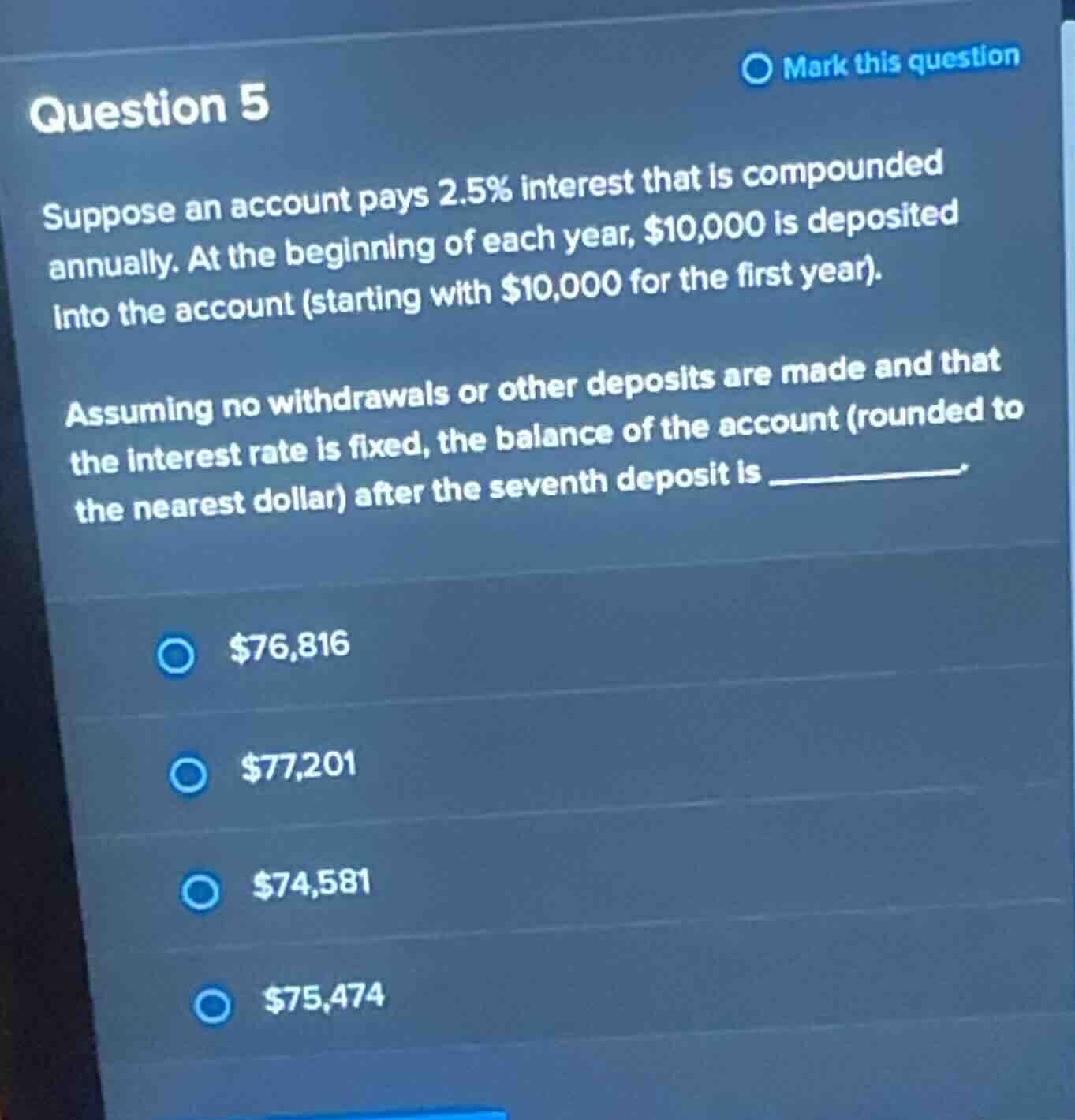
suppose an account pays 2.5% interest that is compounded annually. at the beginning of each year, $10,000 is deposited into the account (starting with $10,000 for the first year).
assuming no withdrawals or other deposits are made and that the interest rate is fixed, the balance of the account (rounded to the nearest dollar) after the seventh deposit is ______.
$76,816
$77,201
$74,581
$75,474
Identify the financial model parameters
Using the Future Value of an Annuity Due and Annuity Calculations knowledge points
We identify the parameters for an annuity due because deposits are made at the beginning of each year:
- Periodic payment \(P = \$10,000\)
- Annual interest rate \(r = 2.5\% = 0.025\)
- Number of periods \(n = 7\) (since we want the balance immediately after the seventh deposit is made)
Formulate the balance equation
Using the Annuity Calculations knowledge point
Let \(FV_{\text{due}}\) be the future value of the annuity due immediately after the seventh deposit.
The seventh deposit is made at the beginning of Year 7 and has earned no interest yet.
The first deposit has earned interest for 6 years, the second for 5 years, and so on.
The total balance \(B\) immediately after the seventh deposit is:
This is a geometric series with first term \(a = P\) and common ratio \(q = 1+r\):
Calculate the numerical value
Using the Annuity Calculations knowledge point
Substitute the values into the formula:
Rounding to the nearest dollar gives \(\$75,474\).

Snap & solve any problem in the app
Get step-by-step solutions on Sovi AI
Photo-based solutions with guided steps
Explore more problems and detailed explanations
- (A) $76,816
- (B) $77,201
- (C) $74,581
- (D) $75,474 (Correct answer)