QUESTION IMAGE
Question
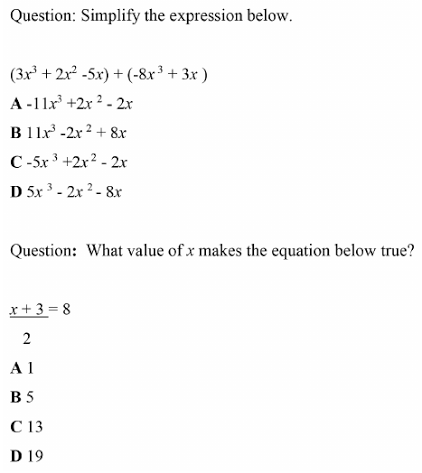
question: simplify the expression below.
((3x^3 + 2x^2 - 5x) + (-8x^3 + 3x))
a (-11x^3 + 2x^2 - 2x)
b (11x^3 - 2x^2 + 8x)
c (-5x^3 + 2x^2 - 2x)
d (5x^3 - 2x^2 - 8x)
question: what value of (x) makes the equation below true?
(\frac{x + 3}{2} = 8)
a 1
b 5
c 13
d 19
🆕 New Concept Discovered: Adding and Subtracting Polynomials
Combine terms with matching variable powers.
---
Part 1: Simplify the expression \((3x^3 + 2x^2 - 5x) + (-8x^3 + 3x)\)
Step 1: Group like terms
To simplify the expression, we group terms that have the exact same variable and exponent (like terms):
Step 2: Combine the coefficients
Now, we add or subtract the coefficients for each group of like terms:
- For \(x^3\): \(3 - 8 = -5\), giving \(-5x^3\)
- For \(x^2\): \(2x^2\) remains as it is
- For \(x\): \(-5 + 3 = -2\), giving \(-2x\)
Combining these results gives:
This matches option C.
---
Part 2: Solve the equation \(\frac{x + 3}{2} = 8\)
🆕 New Concept Discovered: Solving Multi-Step Equations
Isolate the variable by performing inverse operations.
Step 3: Eliminate the fraction
To undo the division by \(2\), multiply both sides of the equation by \(2\):
Step 4: Isolate the variable \(x\)
To undo the addition of \(3\), subtract \(3\) from both sides of the equation:
This matches option C.

Snap & solve any problem in the app
Get step-by-step solutions on Sovi AI
Photo-based solutions with guided steps
Explore more problems and detailed explanations
First Question:
C \(-5x^3 + 2x^2 - 2x\)
Second Question:
C \(13\)