QUESTION IMAGE
Question
question 5
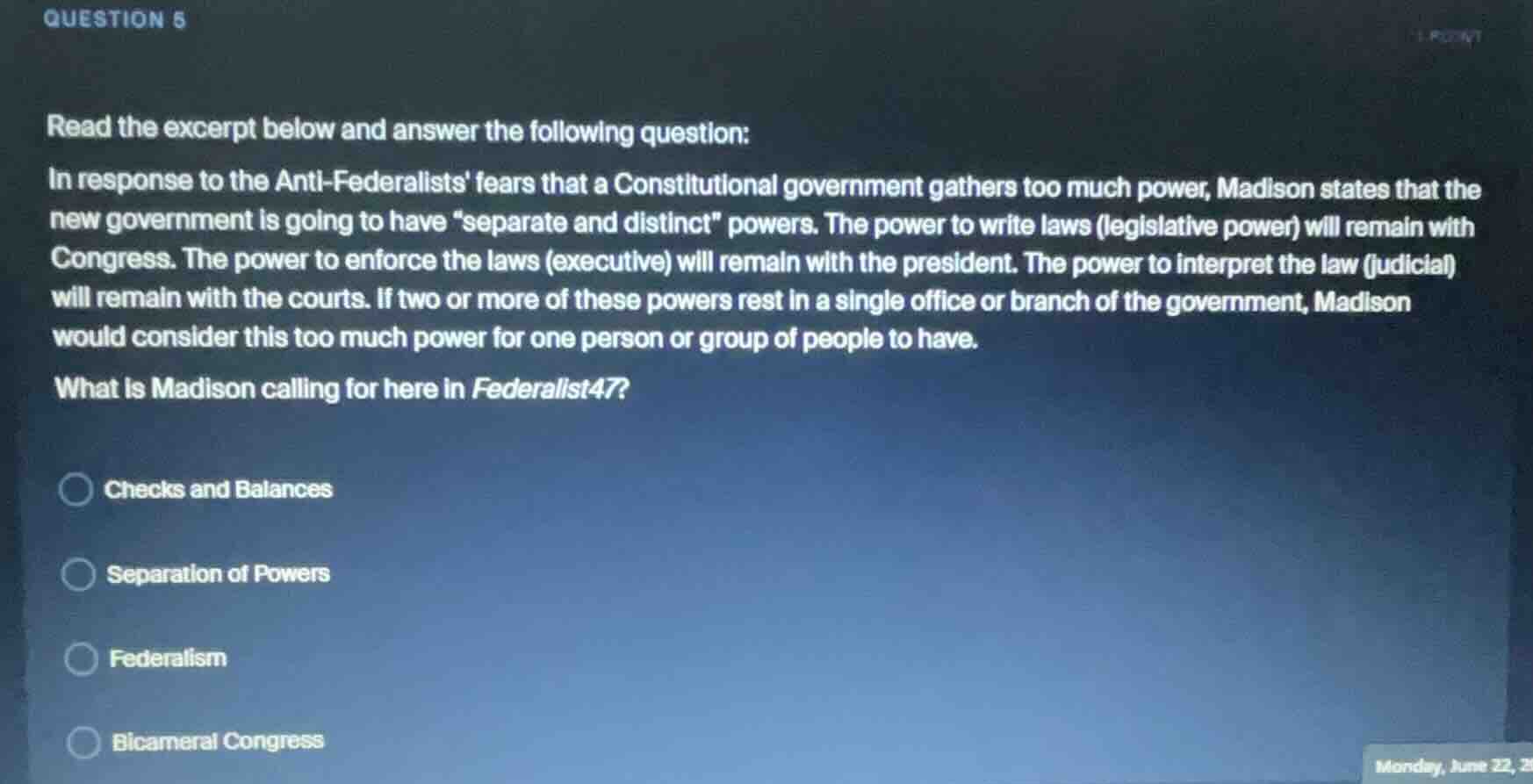
read the excerpt below and answer the following question:
in response to the anti-federalists fears that a constitutional government gathers too much power, madison states that the new government is going to have \separate and distinct\ powers. the power to write laws (legislative power) will remain with congress. the power to enforce the laws (executive) will remain with the president. the power to interpret the law (judicial) will remain with the courts. if two or more of these powers rest in a single office or branch of the government, madison would consider this too much power for one person or group of people to have.
what is madison calling for here in federalist 47?
checks and balances
separation of powers
federalism
bicameral congress
Analyze the excerpt
The text describes Madison's argument for "separate and distinct" powers. It divides government into three distinct branches:
- Legislative power (writing laws) remains with Congress.
- Executive power (enforcing laws) remains with the president.
- Judicial power (interpreting laws) remains with the courts.
Identify the core concept
The division of government responsibilities into distinct branches is the definition of Separation of Powers. Madison warns that combining these powers in a single office leads to tyranny.
Evaluate the options
- Checks and Balances: Refers to the constitutional mechanisms allowing branches to limit each other's power. While related, the excerpt specifically focuses on keeping the branches "separate and distinct."
- Separation of Powers: Directly matches the division of legislative, executive, and judicial powers described.
- Federalism: The division of power between national and state governments, which is not the focus here.
- Bicameral Congress: A two-house legislature, which is only a sub-component of the legislative branch.

Snap & solve any problem in the app
Get step-by-step solutions on Sovi AI
Photo-based solutions with guided steps
Explore more problems and detailed explanations
- Checks and Balances
- Separation of Powers (Correct answer)
- Federalism
- Bicameral Congress