QUESTION IMAGE
Question
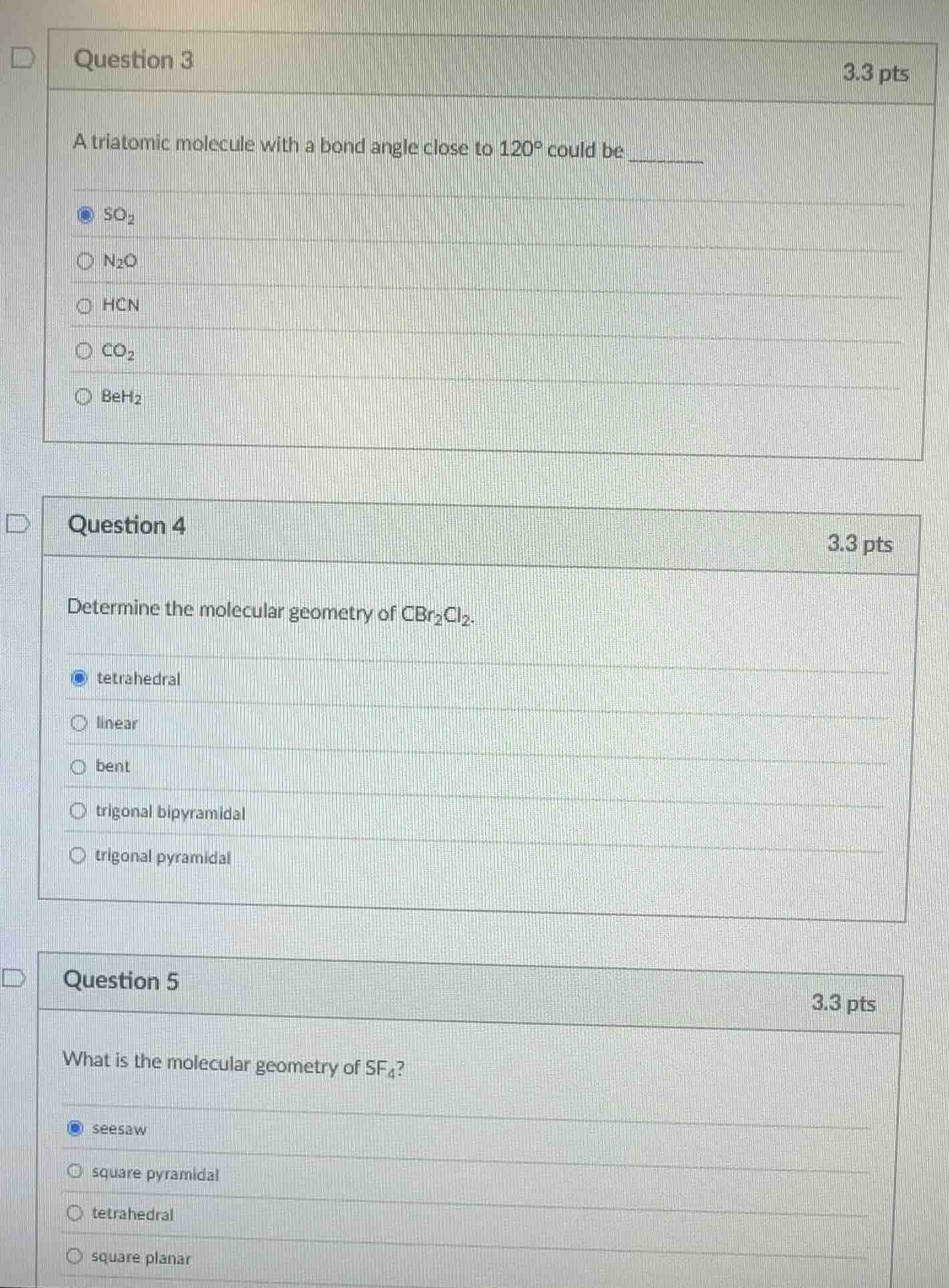
question 3
3.3 pts
a triatomic molecule with a bond angle close to 120° could be _______
so2
n2o
hcn
co2
beh2
question 4
3.3 pts
determine the molecular geometry of cbr2cl2.
tetrahedral
linear
bent
trigonal bipyramidal
trigonal pyramidal
question 5
3.3 pts
what is the molecular geometry of sf4?
seesaw
square pyramidal
tetrahedral
square planar
Analyze Question 3: Triatomic molecule with bond angle close to 120°
To find a triatomic molecule with a bond angle close to \(120^\circ\), we look for a central atom with \(sp^2\) hybridization (trigonal planar electron-group geometry) and one lone pair, which gives a bent molecular geometry.
- \(\text{SO}_2\): Sulfur has 6 valence electrons. It forms two bonds with oxygen and has 1 lone pair on the central S atom (3 electron groups, \(sp^2\) hybridized). The molecular geometry is bent, with a bond angle slightly less than \(120^\circ\) (around \(119^\circ\)).
- \(\text{N}_2\text{O}\), \(\text{HCN}\), \(\text{CO}_2\), \(\text{BeH}_2\): These are all linear molecules with \(sp\) hybridization and bond angles of \(180^\circ\).
Therefore, \(\text{SO}_2\) is the correct choice.
Analyze Question 4: Molecular geometry of CBr₂Cl₂
To determine the molecular geometry of \(\text{CBr}_2\text{Cl}_2\):
- Carbon is the central atom (4 valence electrons) and forms 4 single covalent bonds (two with Br, two with Cl).
- There are 4 bonding pairs and 0 lone pairs on the central carbon atom.
- According to VSEPR theory, 4 electron groups arrange themselves in a tetrahedral electron-group geometry to minimize repulsion.
- With 0 lone pairs, the molecular geometry is also tetrahedral.
Analyze Question 5: Molecular geometry of SF₄
To determine the molecular geometry of \(\text{SF}_4\):
- Sulfur has 6 valence electrons, and each of the 4 fluorine atoms contributes 1 electron for bonding, giving a total of 34 valence electrons.
- The central S atom forms 4 single bonds with F and has 1 lone pair remaining (\(6 - 4 = 2\) non-bonding electrons).
- This results in 5 electron groups (4 bonding pairs, 1 lone pair), which corresponds to a trigonal bipyramidal electron-group geometry.
- To minimize repulsion, the lone pair occupies an equatorial position, resulting in a seesaw molecular geometry.

Snap & solve any problem in the app
Get step-by-step solutions on Sovi AI
Photo-based solutions with guided steps
Explore more problems and detailed explanations
Question 3
- (A) \(\text{SO}_2\) (Correct answer)
- (B) \(\text{N}_2\text{O}\)
- (C) \(\text{HCN}\)
- (D) \(\text{CO}_2\)
- (E) \(\text{BeH}_2\)
Question 4
- (A) tetrahedral (Correct answer)
- (B) linear
- (C) bent
- (D) trigonal bipyramidal
- (E) trigonal pyramidal
Question 5
- (A) seesaw (Correct answer)
- (B) square pyramidal
- (C) tetrahedral
- (D) square planar