QUESTION IMAGE
Question
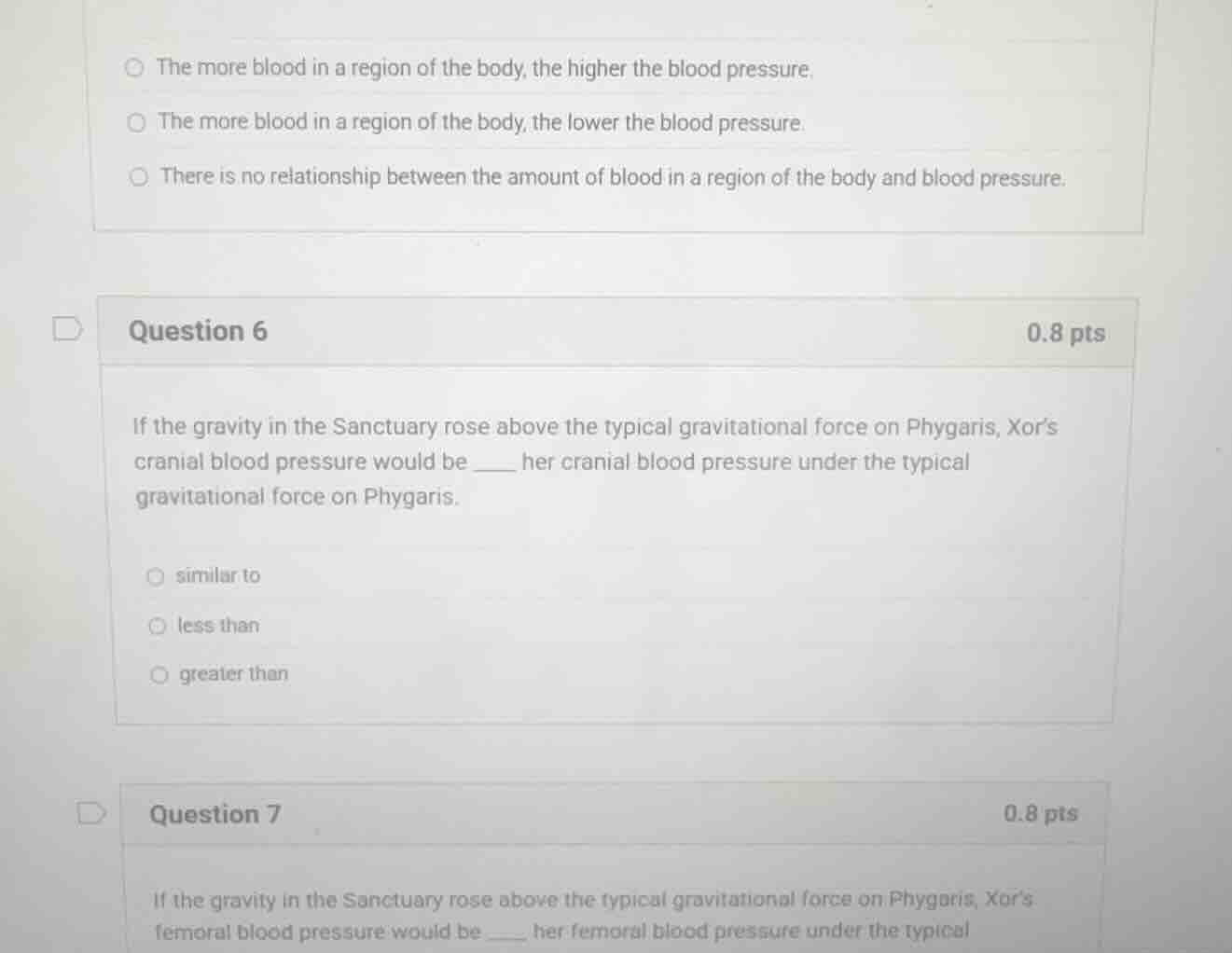
question 6
0.8 pts
if the gravity in the sanctuary rose above the typical gravitational force on phygaris, xors cranial blood pressure would be ____ her cranial blood pressure under the typical gravitational force on phygaris.
similar to
less than
greater than
Analyze hydrostatic pressure and gravity
Using the Fluid Redistribution and Cardiovascular Adaptation knowledge points, we analyze how gravity affects blood pressure in different regions of the body. Hydrostatic pressure in a fluid column is directly proportional to gravitational acceleration (\(g\)), density (\(
ho\)), and height (\(h\)) via \(P =
ho g h\). When gravity increases, the downward pull on blood increases, causing more blood to pool in the lower extremities (femoral region) and less blood to remain in the upper extremities (cranial region).
Determine cranial blood pressure changes
As gravity rises above typical levels, the increased downward pull drains blood away from the head toward the lower body. This reduction in cranial blood volume and the increased downward gravitational pull results in a lower hydrostatic pressure in the head. Therefore, the cranial blood pressure under hyper-gravity will be less than under typical gravity.
Determine femoral blood pressure changes
Conversely, the increased gravitational force pulls more blood downward into the lower limbs. The increased weight of the blood column above the femoral region, combined with the increased local pooling, significantly increases the hydrostatic pressure in the lower body. Therefore, the femoral blood pressure under hyper-gravity will be greater than under typical gravity.

Snap & solve any problem in the app
Get step-by-step solutions on Sovi AI
Photo-based solutions with guided steps
Explore more problems and detailed explanations
Question 6
- similar to
- less than (Correct answer)
- greater than
Question 7
- similar to
- less than
- greater than (Correct answer)