QUESTION IMAGE
Question
question 1
1 pts
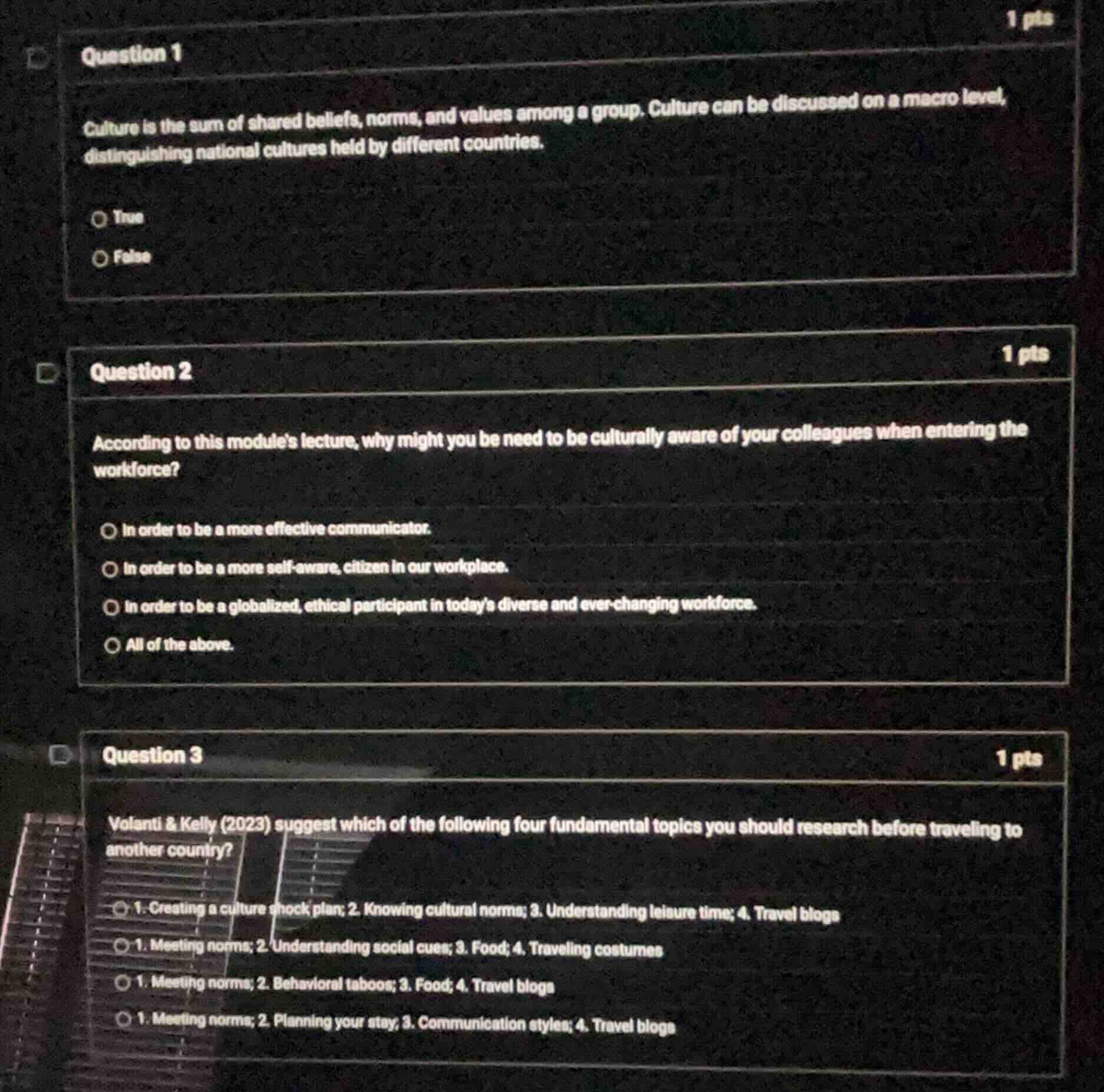
culture is the sum of shared beliefs, norms, and values among a group. culture can be discussed on a macro level, distinguishing national cultures held by different countries.
true
false
question 2
1 pts
according to this modules lecture, why might you be need to be culturally aware of your colleagues when entering the workforce?
in order to be a more effective communicator.
in order to be a more self-aware, citizen in our workplace.
in order to be a globalized, ethical participant in todays diverse and ever-changing workforce.
all of the above.
question 3
1 pts
volanti & kelly (2023) suggest which of the following four fundamental topics you should research before traveling to another country?
- creating a culture shock plan; 2. knowing cultural norms; 3. understanding leisure time; 4. travel blogs
- meeting norms; 2. understanding social cues; 3. food; 4. traveling costumes
- meeting norms; 2. behavioral taboos; 3. food; 4. travel blogs
- meeting norms; 2. planning your stay; 3. communication styles; 4. travel blogs
Analyze Question 1
The statement defines culture as "the sum of shared beliefs, norms, and values among a group." It also asserts that culture can be discussed on a macro level, which distinguishes national cultures held by different countries. In intercultural communication studies, culture is indeed defined by shared beliefs, values, and norms. Discussing it on a macro level refers to looking at large-scale social systems, such as national cultures, which differentiate one country from another. Therefore, the statement is true.
Analyze Question 2
The question asks why one needs to be culturally aware of colleagues when entering the workforce. Let's evaluate the options:
- "In order to be a more effective communicator": Cultural awareness helps us understand different communication styles, reducing misunderstandings.
- "In order to be a more self-aware, citizen in our workplace": Recognizing others' cultural backgrounds encourages us to reflect on our own cultural biases and assumptions.
- "In order to be a globalized, ethical participant in today's diverse and ever-changing workforce": Respecting diversity is a core component of ethical and global citizenship in modern professional environments.
Since all three individual options represent valid, comprehensive reasons for cultural awareness in the workplace, "All of the above" is the most complete and correct choice.
Analyze Question 3
The question asks which four fundamental topics Volanti & Kelly (2023) suggest researching before traveling to another country.
Looking at the options:
- Option 1: 1. Creating a culture shock plan; 2. Knowing cultural norms; 3. Understanding leisure time; 4. Travel blogs
- Option 2: 1. Meeting norms; 2. Understanding social cues; 3. Food; 4. Traveling costumes
- Option 3: 1. Meeting norms; 2. Behavioral taboos; 3. Food; 4. Travel blogs
- Option 4: 1. Meeting norms; 2. Planning your stay; 3. Communication styles; 4. Travel blogs
According to standard intercultural communication preparation guidelines outlined by Volanti & Kelly (2023), the four fundamental, practical topics recommended for pre-travel research to ensure respectful and smooth interactions are:
- Meeting norms (how to greet people, introduce oneself, and show respect upon arrival)
- Behavioral taboos (actions, gestures, or topics to avoid so as not to cause offense)
- Food (dining etiquette, dietary customs, and what to expect)
- Travel blogs (first-hand contemporary accounts and practical tips from other travelers)
This matches the third option.

Snap & solve any problem in the app
Get step-by-step solutions on Sovi AI
Photo-based solutions with guided steps
Explore more problems and detailed explanations
Question 1
- True (Correct answer)
- False
Question 2
- In order to be a more effective communicator.
- In order to be a more self-aware, citizen in our workplace.
- In order to be a globalized, ethical participant in today's diverse and ever-changing workforce.
- All of the above. (Correct answer)
Question 3
- 1. Creating a culture shock plan; 2. Knowing cultural norms; 3. Understanding leisure time; 4. Travel blogs
- 1. Meeting norms; 2. Understanding social cues; 3. Food; 4. Traveling costumes
- 1. Meeting norms; 2. Behavioral taboos; 3. Food; 4. Travel blogs (Correct answer)
- 1. Meeting norms; 2. Planning your stay; 3. Communication styles; 4. Travel blogs