QUESTION IMAGE
Question
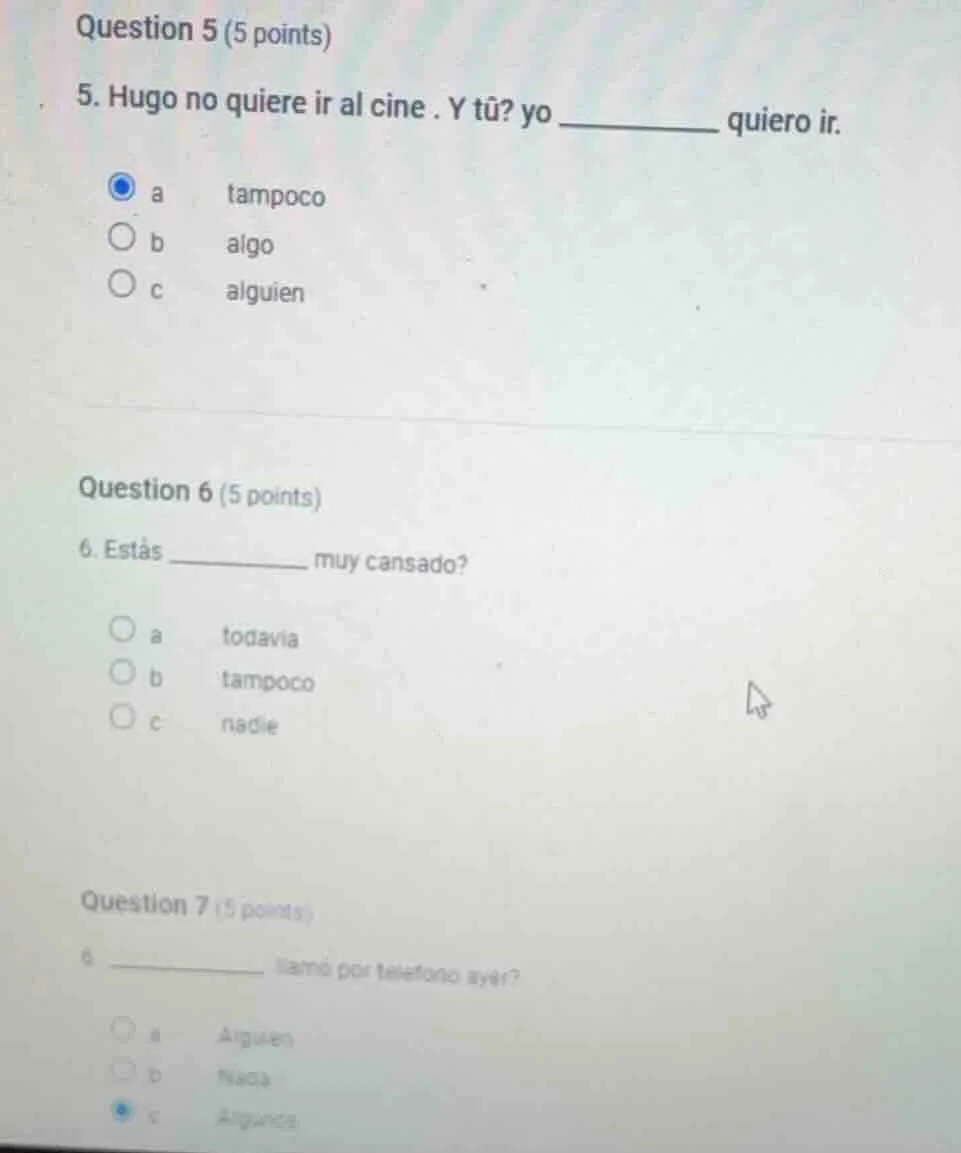
question 5 (5 points)
- hugo no quiere ir al cine. y tú? yo ______ quiero ir.
a tampoco
b algo
c alguien
question 6 (5 points)
- estás ______ muy cansado?
a todavía
b tampoco
c nadie
question 7 (5 points)
- ______ llamo por teléfono ayer?
a alguien
b nada
c alguno
Question 5
The sentence "Hugo no quiere ir al cine. Y tú? yo ____ quiero ir." means "Hugo doesn't want to go to the cinema. And you? I ____ want to go." "tampoco" means "neither" or "also not" (used in negative sentences to agree with a previous negative statement), "algo" means "something", and "alguien" means "someone". Since the first part is negative (Hugo no quiere...), we use "tampoco" to say "I also don't want to go".
The sentence "Estás ____ muy cansado?" means "Are you ____ very tired?". "todavía" means "still", "tampoco" means "neither" (used in negative contexts), and "nadie" means "nobody". The context here is asking if the person is still very tired, so "todavía" fits.
The sentence "____ llamo por teléfono ayer?" means "____ did I call by phone yesterday?". "Alguien" means "someone" (refers to a person), "Nada" means "nothing", and "Alguno" (assuming it's a typo and should be "Algún" or related, but likely "Alguien" was miswritten? Wait, maybe the options are "Alguien", "Nada", "Alguno" (but "Alguno" is an adjective, "Alguien" is a pronoun for a person). Wait, maybe the correct option is "Alguien" (someone) as in "Did I call someone by phone yesterday?". "Nada" (nothing) doesn't fit, and "Alguno" is incorrect here. Wait, maybe the options were miswritten, but based on the options, "Alguien" (a. Alguien) would be the one that makes sense as we are asking about a person we called.

Snap & solve any problem in the app
Get step-by-step solutions on Sovi AI
Photo-based solutions with guided steps
Explore more problems and detailed explanations
a. tampoco