QUESTION IMAGE
Question
question 7
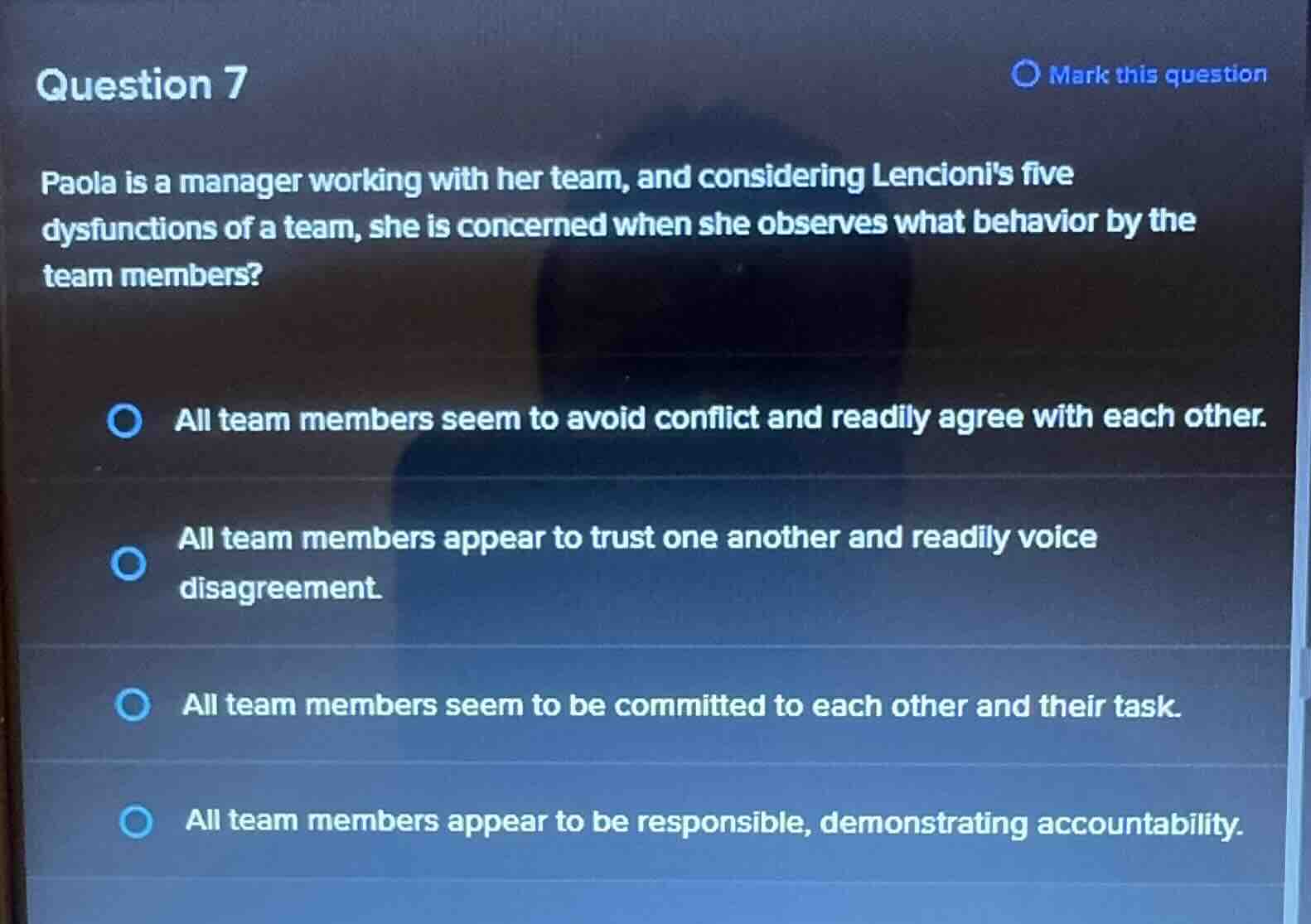
paola is a manager working with her team, and considering lencionis five dysfunctions of a team, she is concerned when she observes what behavior by the team members?
- all team members seem to avoid conflict and readily agree with each other.
- all team members appear to trust one another and readily voice disagreement.
- all team members seem to be committed to each other and their task.
- all team members appear to be responsible, demonstrating accountability.
Identify Lencioni's Five Dysfunctions
Patrick Lencioni's model outlines five core dysfunctions that teams face:
- Absence of Trust: Unwillingness to be vulnerable within the group.
- Fear of Conflict: Seeking artificial harmony over constructive debate.
- Lack of Commitment: Feigning buy-in without genuine alignment.
- Avoidance of Accountability: Ducking the responsibility to call out peers.
- Inattention to Results: Focusing on personal success or status over collective goals.
Analyze the observed behaviors
We evaluate each option against Lencioni's model to find which behavior represents a dysfunction:
- All team members seem to avoid conflict and readily agree with each other: This describes "artificial harmony," which is the primary symptom of the second dysfunction, Fear of Conflict. This is a major concern for a manager.
- All team members appear to trust one another and readily voice disagreement: This describes a healthy team dynamic (high trust and constructive conflict).
- All team members seem to be committed to each other and their task: This describes a highly functional, committed team.
- All team members appear to be responsible, demonstrating accountability: This describes a healthy team with strong peer-to-peer accountability.
Determine the correct choice
The only behavior listed that represents one of Lencioni's dysfunctions (specifically, the Fear of Conflict leading to artificial harmony) is when team members avoid conflict and readily agree with each other.

Snap & solve any problem in the app
Get step-by-step solutions on Sovi AI
Photo-based solutions with guided steps
Explore more problems and detailed explanations
Question 7
- (A) All team members seem to avoid conflict and readily agree with each other. (Correct answer)
- (B) All team members appear to trust one another and readily voice disagreement.
- (C) All team members seem to be committed to each other and their task.
- (D) All team members appear to be responsible, demonstrating accountability.