QUESTION IMAGE
Question
question
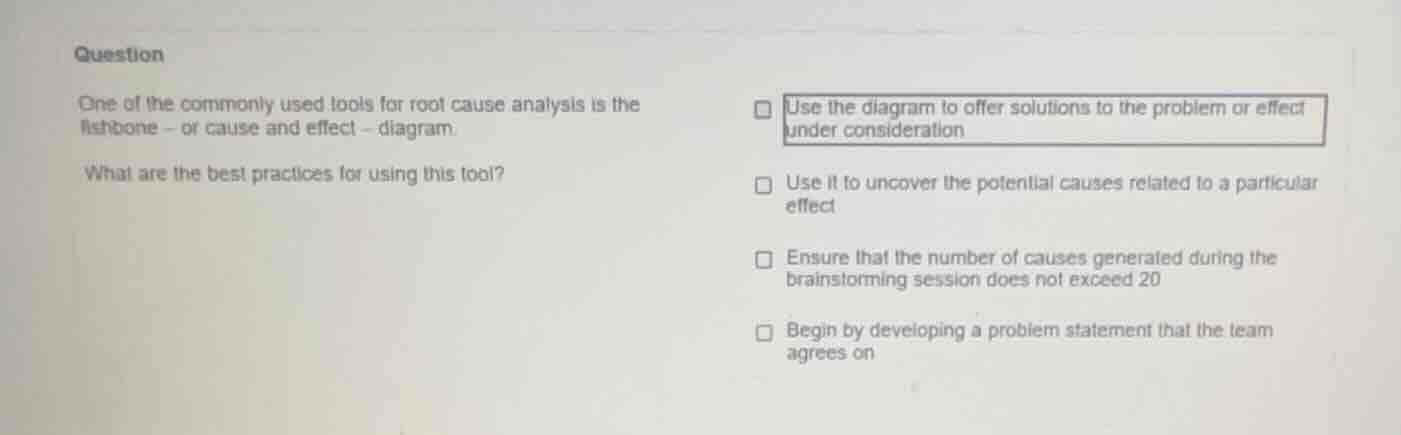
one of the commonly used tools for root cause analysis is the fishbone - or cause and effect - diagram.
what are the best practices for using this tool?
- use the diagram to offer solutions to the problem or effect under consideration
- use it to uncover the potential causes related to a particular effect
- ensure that the number of causes generated during the brainstorming session does not exceed 20
- begin by developing a problem statement that the team agrees on
Understand the purpose of a fishbone diagram
The fishbone diagram (also known as an Ishikawa or cause-and-effect diagram) is a structured brainstorming tool. It is designed to systematically identify and organize potential causes of a specific problem (the "effect") to find its root causes. It is not used to directly offer solutions, but rather to map out the landscape of possible causes.
Evaluate the first option
The first option states: "Use the diagram to offer solutions to the problem or effect under consideration." This is incorrect because the primary purpose of a fishbone diagram is cause identification, not solution generation. Solutions are developed after the root causes have been verified.
Evaluate the second option
The second option states: "Use it to uncover the potential causes related to a particular effect." This aligns perfectly with the core definition and best practice of using a cause-and-effect diagram. It helps teams brainstorm and categorize potential causes.
Evaluate the third option
The third option states: "Ensure that the number of causes generated during the brainstorming session does not exceed 20." This is incorrect. Brainstorming sessions should be open and expansive; placing an arbitrary limit of 20 causes restricts the team's ability to thoroughly explore all potential factors.
Evaluate the fourth option
The fourth option states: "Begin by developing a problem statement that the team agrees on." This is a fundamental best practice. Before mapping causes, the team must clearly define the "effect" (the problem statement) at the head of the fishbone so everyone is brainstorming around the exact same issue.
Synthesize the correct choices
Based on the analysis of Six Sigma Tools and Quality Control methodologies, the two correct best practices for using a fishbone diagram are:
- Use it to uncover the potential causes related to a particular effect.
- Begin by developing a problem statement that the team agrees on.

Snap & solve any problem in the app
Get step-by-step solutions on Sovi AI
Photo-based solutions with guided steps
Explore more problems and detailed explanations
- Use the diagram to offer solutions to the problem or effect under consideration
- Use it to uncover the potential causes related to a particular effect (Correct answer)
- Ensure that the number of causes generated during the brainstorming session does not exceed 20
- Begin by developing a problem statement that the team agrees on (Correct answer)