QUESTION IMAGE
Question
question 6
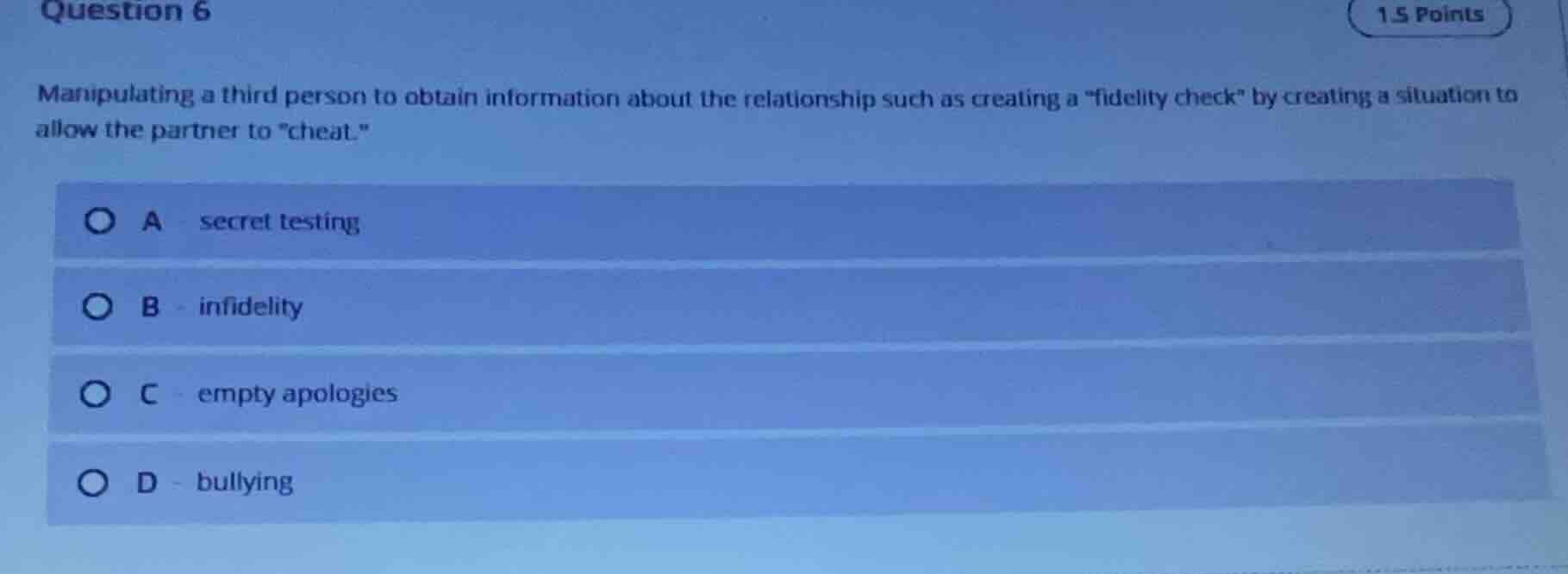
manipulating a third person to obtain information about the relationship such as creating a \fidelity check\ by creating a situation to allow the partner to \cheat.\
a. secret testing
b. infidelity
c. empty apologies
d. bullying
<pre_analysis>
{
"quality": "clear",
"question_count": 1,
"skills_matched": [
"direct_cot",
"multiple_choice_formatter",
"explain_then_answer",
"tutor"
],
"needs_drawing": false,
"concepts_used": [
"Interpersonal Communication"
],
"new_concepts": [
"Secret Testing",
"Relationship Maintenance Strategies"
],
"current_concepts": [
"Interpersonal Communication",
"Secret Testing",
"Relationship Maintenance Strategies"
]
}
</pre_analysis>
<reasoning>
Analyze the definition in the prompt
The prompt describes a specific behavior: "Manipulating a third person to obtain information about the relationship such as creating a 'fidelity check' by creating a situation to allow the partner to 'cheat'." This involves covertly gathering information about a partner's commitment or feelings without asking them directly.
Evaluate the options
- A. secret testing: In Interpersonal Communication studies (specifically Baxter and Wilmot's relationship test strategies), "secret testing" refers to active, covert strategies individuals use to determine their partner's commitment level. A "triangle test" is a classic subtype of secret testing where a third person is introduced (e.g., a fidelity check) to see how the partner responds.
- B. infidelity: This refers to the act of being unfaithful, not the manipulative testing strategy itself.
- C. empty apologies: This refers to insincere expressions of regret, which does not match the description.
- D. bullying: This refers to repetitive, aggressive behavior intended to harm or intimidate, which does not fit this specific relational testing scenario.
Match the concept
The described behavior of using a third party to test a partner's fidelity is a textbook example of a triangle test, which is a form of secret testing.
</reasoning>
<answer>
<mcq-correct>(A) secret testing</mcq-correct>
<mcq-option>(B) infidelity</mcq-option>
<mcq-option>(C) empty apologies</mcq-option>
<mcq-option>(D) bullying</mcq-option>
</answer>
<post_analysis>
{
"subject": "Social Science",
"question_type": "Multiple Choice",
"knowledge_point": [
"Social Science",
"Communication Studies",
"Interpersonal Communication"
]
}
</post_analysis>
Snap & solve any problem in the app
Get step-by-step solutions on Sovi AI
Photo-based solutions with guided steps
Explore more problems and detailed explanations
<pre_analysis>
{
"quality": "clear",
"question_count": 1,
"skills_matched": [
"direct_cot",
"multiple_choice_formatter",
"explain_then_answer",
"tutor"
],
"needs_drawing": false,
"concepts_used": [
"Interpersonal Communication"
],
"new_concepts": [
"Secret Testing",
"Relationship Maintenance Strategies"
],
"current_concepts": [
"Interpersonal Communication",
"Secret Testing",
"Relationship Maintenance Strategies"
]
}
</pre_analysis>
<reasoning>
Analyze the definition in the prompt
The prompt describes a specific behavior: "Manipulating a third person to obtain information about the relationship such as creating a 'fidelity check' by creating a situation to allow the partner to 'cheat'." This involves covertly gathering information about a partner's commitment or feelings without asking them directly.
Evaluate the options
- A. secret testing: In Interpersonal Communication studies (specifically Baxter and Wilmot's relationship test strategies), "secret testing" refers to active, covert strategies individuals use to determine their partner's commitment level. A "triangle test" is a classic subtype of secret testing where a third person is introduced (e.g., a fidelity check) to see how the partner responds.
- B. infidelity: This refers to the act of being unfaithful, not the manipulative testing strategy itself.
- C. empty apologies: This refers to insincere expressions of regret, which does not match the description.
- D. bullying: This refers to repetitive, aggressive behavior intended to harm or intimidate, which does not fit this specific relational testing scenario.
Match the concept
The described behavior of using a third party to test a partner's fidelity is a textbook example of a triangle test, which is a form of secret testing.
</reasoning>
<answer>
<mcq-correct>(A) secret testing</mcq-correct>
<mcq-option>(B) infidelity</mcq-option>
<mcq-option>(C) empty apologies</mcq-option>
<mcq-option>(D) bullying</mcq-option>
</answer>
<post_analysis>
{
"subject": "Social Science",
"question_type": "Multiple Choice",
"knowledge_point": [
"Social Science",
"Communication Studies",
"Interpersonal Communication"
]
}
</post_analysis>