Sovi.AI - AI Math Tutor

Scan to solve math questions

QUESTION IMAGE

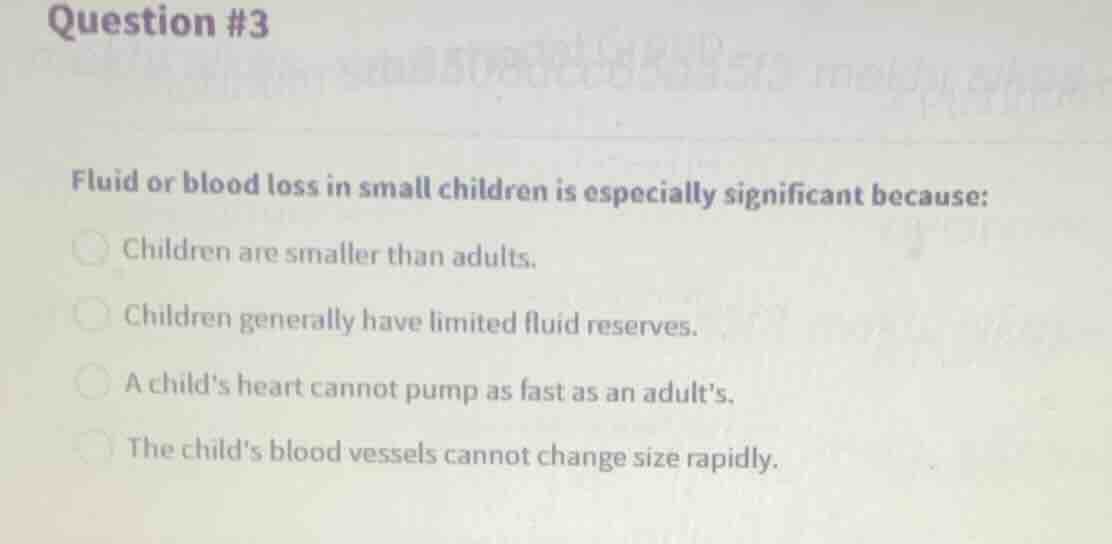
question #3 fluid or blood loss in small children is especially signifi…

Question

question #3

fluid or blood loss in small children is especially significant because:

children are smaller than adults.
children generally have limited fluid reserves.
a childs heart cannot pump as fast as an adults.
the childs blood vessels cannot change size rapidly.

Explanation:

Response

<pre_analysis>
{
"quality": "clear",
"question_count": 1,
"skills_matched": [
"direct_cot",
"multiple_choice_formatter",
"explain_then_answer",
"tutor"
],
"needs_drawing": false,
"concepts_used": [
"Pediatric Emergencies"
],
"new_concepts": [
"Pediatric Shock Pathophysiology",
"Pediatric Fluid Dynamics"
],
"current_concepts": [
"Pediatric Emergencies",
"Pediatric Shock Pathophysiology",
"Pediatric Fluid Dynamics"
]
}
</pre_analysis>

<reasoning>

Analyze the physiological differences in pediatric patients

In Pediatric Emergencies, understanding anatomical and physiological differences between children and adults is critical. Small children have a significantly smaller total blood volume compared to adults. Because of this small baseline volume, even a minor absolute loss of blood or fluid represents a large percentage of their total circulatory volume.

Evaluate the physiological reserves of children

Children have limited physiological fluid reserves. A small amount of fluid loss (due to vomiting, diarrhea, or hemorrhage) can rapidly deplete their circulating volume, leading to hypovolemic shock much faster than in an adult.

Assess the incorrect options

  • "Children are smaller than adults": While true, this is a general physical observation rather than the direct physiological reason why fluid loss is clinically significant and dangerous.
  • "A child's heart cannot pump as fast as an adult's": This is incorrect. A child's normal heart rate is significantly faster than an adult's, and they rely heavily on increasing their heart rate (tachycardia) to maintain cardiac output during hypovolemia.
  • "The child's blood vessels cannot change size rapidly": This is incorrect. Children actually have strong compensatory mechanisms, including powerful vasoconstriction, to maintain blood pressure until they suddenly decompensate.

</reasoning>

<answer>
<mcq-option>Children are smaller than adults.</mcq-option>
<mcq-correct>Children generally have limited fluid reserves.</mcq-correct>
<mcq-option>A child's heart cannot pump as fast as an adult's.</mcq-option>
<mcq-option>The child's blood vessels cannot change size rapidly.</mcq-option>
</answer>

<post_analysis>
{
"subject": "Natural Science",
"question_type": "Multiple Choice",
"knowledge_point": [
"Natural Science",
"Medicine",
"Pediatric Emergencies"
]
}
</post_analysis>

Answer:

<pre_analysis>
{
"quality": "clear",
"question_count": 1,
"skills_matched": [
"direct_cot",
"multiple_choice_formatter",
"explain_then_answer",
"tutor"
],
"needs_drawing": false,
"concepts_used": [
"Pediatric Emergencies"
],
"new_concepts": [
"Pediatric Shock Pathophysiology",
"Pediatric Fluid Dynamics"
],
"current_concepts": [
"Pediatric Emergencies",
"Pediatric Shock Pathophysiology",
"Pediatric Fluid Dynamics"
]
}
</pre_analysis>

<reasoning>

Analyze the physiological differences in pediatric patients

In Pediatric Emergencies, understanding anatomical and physiological differences between children and adults is critical. Small children have a significantly smaller total blood volume compared to adults. Because of this small baseline volume, even a minor absolute loss of blood or fluid represents a large percentage of their total circulatory volume.

Evaluate the physiological reserves of children

Children have limited physiological fluid reserves. A small amount of fluid loss (due to vomiting, diarrhea, or hemorrhage) can rapidly deplete their circulating volume, leading to hypovolemic shock much faster than in an adult.

Assess the incorrect options

  • "Children are smaller than adults": While true, this is a general physical observation rather than the direct physiological reason why fluid loss is clinically significant and dangerous.
  • "A child's heart cannot pump as fast as an adult's": This is incorrect. A child's normal heart rate is significantly faster than an adult's, and they rely heavily on increasing their heart rate (tachycardia) to maintain cardiac output during hypovolemia.
  • "The child's blood vessels cannot change size rapidly": This is incorrect. Children actually have strong compensatory mechanisms, including powerful vasoconstriction, to maintain blood pressure until they suddenly decompensate.

</reasoning>

<answer>
<mcq-option>Children are smaller than adults.</mcq-option>
<mcq-correct>Children generally have limited fluid reserves.</mcq-correct>
<mcq-option>A child's heart cannot pump as fast as an adult's.</mcq-option>
<mcq-option>The child's blood vessels cannot change size rapidly.</mcq-option>
</answer>

<post_analysis>
{
"subject": "Natural Science",
"question_type": "Multiple Choice",
"knowledge_point": [
"Natural Science",
"Medicine",
"Pediatric Emergencies"
]
}
</post_analysis>