QUESTION IMAGE
Question
question
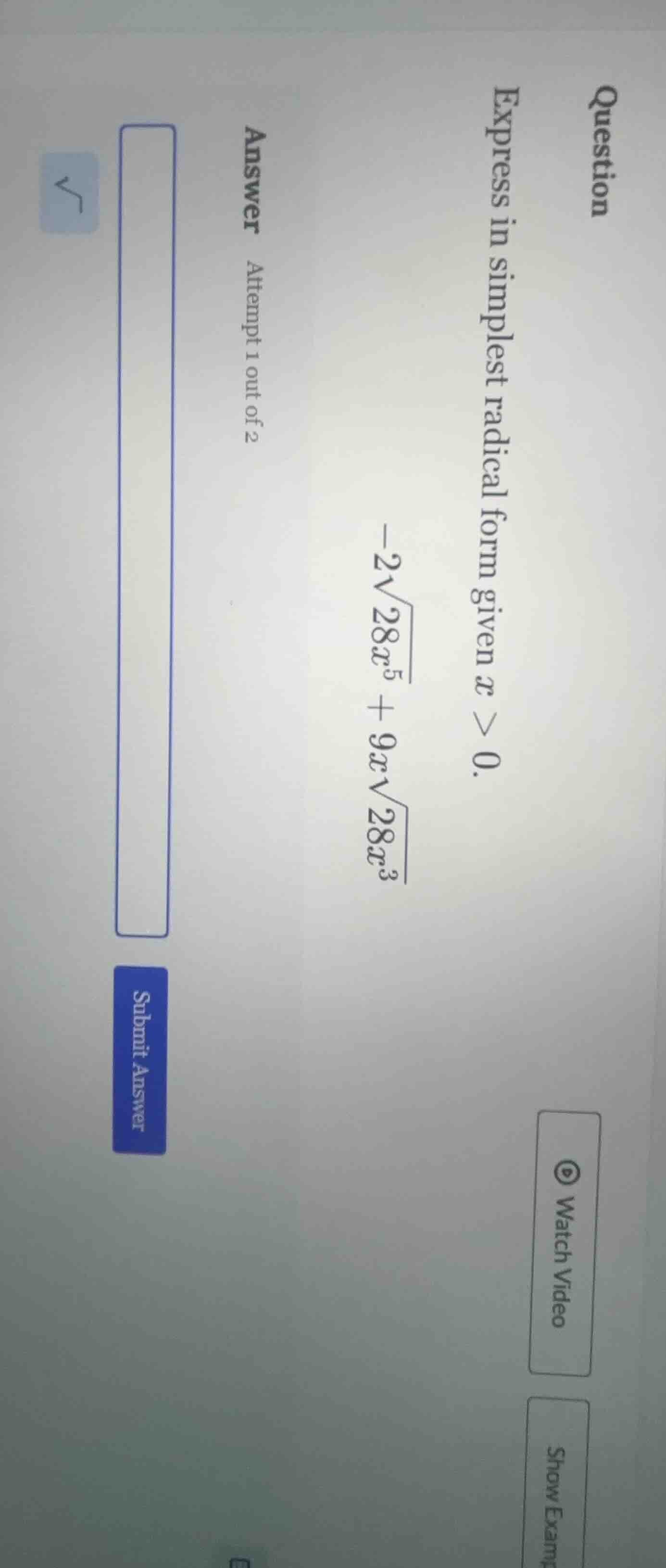
express in simplest radical form given ( x > 0 ).
( -2sqrt{28x^5} + 9xsqrt{28x^3} )
answer
attempt 1 out of 2
watch video
show examp
Step1: Simplify each radical term
First, factor out perfect squares from the radicands:
$\sqrt{28x^5} = \sqrt{4 \cdot 7 \cdot x^4 \cdot x} = \sqrt{4x^4} \cdot \sqrt{7x} = 2x^2\sqrt{7x}$
$\sqrt{28x^3} = \sqrt{4 \cdot 7 \cdot x^2 \cdot x} = \sqrt{4x^2} \cdot \sqrt{7x} = 2x\sqrt{7x}$
Substitute back into the original expression:
$-2 \cdot 2x^2\sqrt{7x} + 9x \cdot 2x\sqrt{7x}$
Step2: Calculate coefficients and exponents
Simplify each term's coefficients and variables:
$-2 \cdot 2x^2\sqrt{7x} = -4x^2\sqrt{7x}$
$9x \cdot 2x\sqrt{7x} = 18x^2\sqrt{7x}$
Step3: Combine like radical terms
Add the simplified like terms together:
$-4x^2\sqrt{7x} + 18x^2\sqrt{7x} = (18-4)x^2\sqrt{7x}$

Snap & solve any problem in the app
Get step-by-step solutions on Sovi AI
Photo-based solutions with guided steps
Explore more problems and detailed explanations
$14x^2\sqrt{7x}$