QUESTION IMAGE
Question
question 2
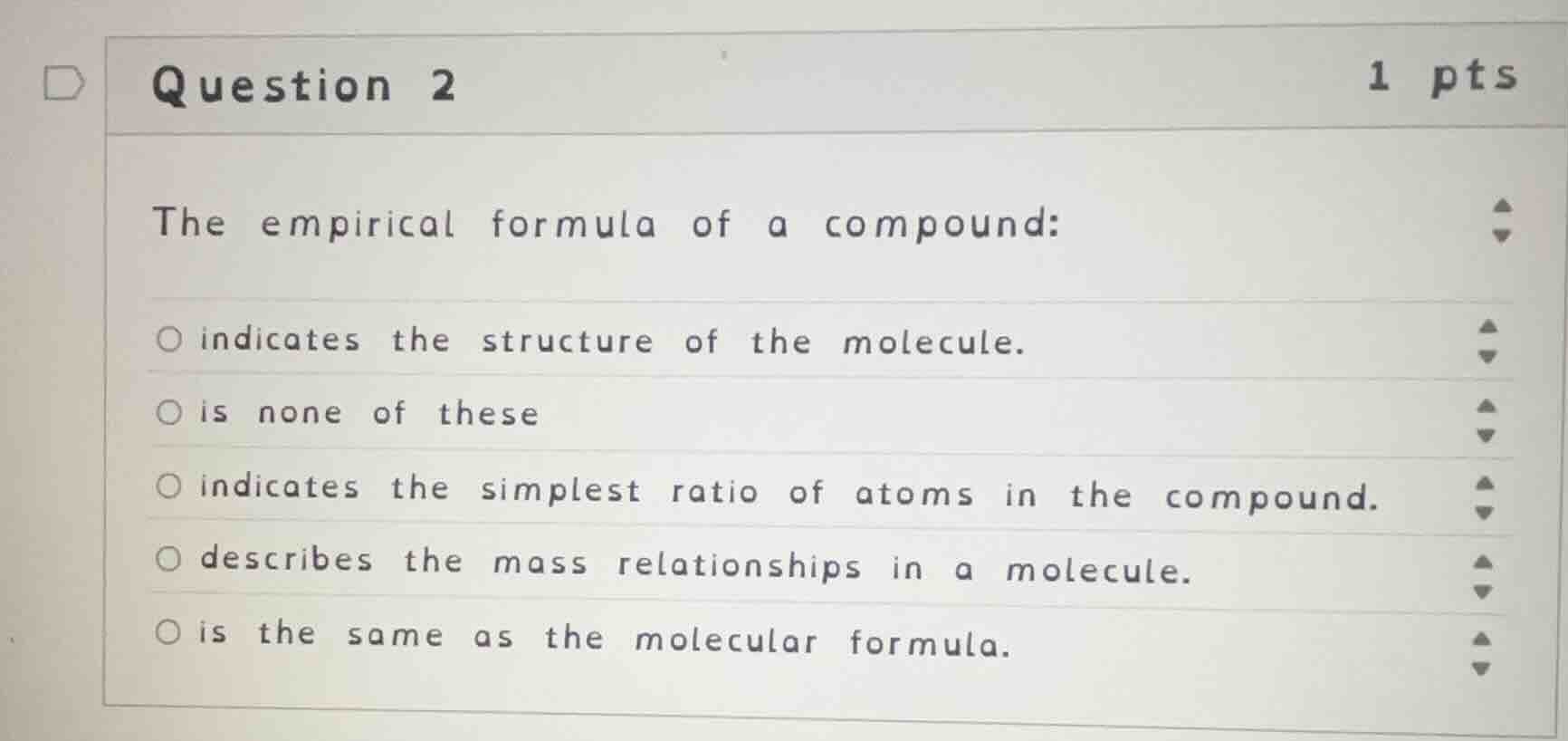
the empirical formula of a compound:
- indicates the structure of the molecule.
- is none of these
- indicates the simplest ratio of atoms in the compound.
- describes the mass relationships in a molecule.
- is the same as the molecular formula.
🆕 New Concept Discovered: Empirical vs. Molecular Formulas
The simplest whole-number ratio of atoms.
Step 1: Define Empirical Formula
An empirical formula represents the simplest, most reduced whole-number ratio of the elements present in a compound. It does not necessarily show the actual number of atoms in a single molecule (which is what a molecular formula does), nor does it show how those atoms are arranged in space (which is what a structural formula does).
For example, glucose has the molecular formula \( \text{C}_6\text{H}_{12}\text{O}_6 \). If we divide all the subscripts by their greatest common divisor (6), we get its empirical formula: \( \text{CH}_2\text{O} \).
Step 2: Evaluate the Given Options
- "indicates the structure of the molecule": Incorrect. Structural formulas show how atoms are connected, not empirical formulas.
- "is none of these": Incorrect, as one of the other options is correct.
- "indicates the simplest ratio of atoms in the compound": Correct. This matches the fundamental definition of an empirical formula.
- "describes the mass relationships in a molecule": Incorrect. While it can be used to find mass percentages, the formula itself directly represents atom ratios, not mass.
- "is the same as the molecular formula": Incorrect. They can sometimes be the same (like for water, \( \text{H}_2\text{O} \)), but they are not always the same.

Snap & solve any problem in the app
Get step-by-step solutions on Sovi AI
Photo-based solutions with guided steps
Explore more problems and detailed explanations
indicates the simplest ratio of atoms in the compound.