QUESTION IMAGE
Question
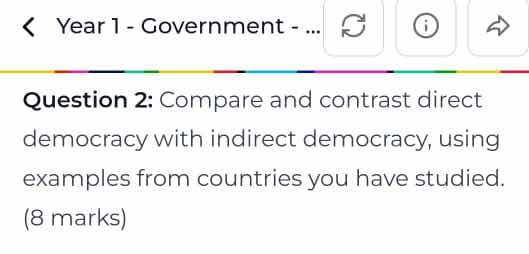
question 2: compare and contrast direct democracy with indirect democracy, using examples from countries you have studied. (8 marks)
🆕 New Concept Discovered: Models of Democratic Governance
How citizens exercise power: directly or through representatives.
Step 1: Define the Core Concepts
To compare and contrast the two systems, we must first establish what they mean:
- Direct Democracy: A system where citizens personally participate in decision-making and vote directly on laws, policies, or public initiatives, rather than electing representatives to do so on their behalf.
- Indirect (Representative) Democracy: A system where citizens elect representatives (such as Members of Parliament, Congress members, or Presidents) to make laws and govern the country on their behalf.
Step 2: Identify Key Similarities (Compare)
Despite their structural differences, both systems share fundamental democratic principles:
- Popular Sovereignty: In both systems, ultimate power and legitimacy lie with the people. Government authority is derived from the consent of the governed.
- Protection of Rights: Both models aim to protect individual liberties, promote the rule of law, and ensure that the political system remains accountable to the public.
- Political Participation: Both systems require active citizen engagement to function, whether that involvement is voting on specific policies or voting for political candidates.
Step 3: Identify Key Differences (Contrast)
The two systems differ significantly in execution, scale, and efficiency:
- Decision-Making Process: In a direct democracy, citizens vote directly on legislation (e.g., via referendums). In an indirect democracy, citizens vote for representatives who debate and pass legislation in a parliament or congress.
- Scale and Practicality: Direct democracy is highly challenging to implement in large, populous nations due to the logistical difficulty of gathering everyone to vote on every issue. Indirect democracy is highly scalable and practical for modern nation-states.
- Level of Citizen Expertise: Direct democracy assumes citizens have the time and knowledge to understand complex policy issues. Indirect democracy allows elected representatives to specialize in policy areas, supported by professional civil servants and advisors.
Step 4: Provide Real-World Examples
- Direct Democracy Example (Switzerland / Ancient Athens):
- Ancient Athens is the classic historical example where male citizens gathered in the Assembly to vote on laws.
- In modern times, Switzerland utilizes elements of direct democracy through frequent national referendums and initiatives, allowing citizens to challenge laws passed by parliament or propose constitutional amendments.
- Indirect Democracy Example (United Kingdom / United States):
- In the United Kingdom, citizens elect Members of Parliament (MPs) to the House of Commons to debate and pass laws.
- In the United States, citizens elect members of Congress and a President to represent their interests and manage the federal government.

Snap & solve any problem in the app
Get step-by-step solutions on Sovi AI
Photo-based solutions with guided steps
Explore more problems and detailed explanations
Comparison and Contrast of Direct and Indirect Democracy
1. Similarities (Compare)
- Popular Sovereignty: Both systems are built on the principle that political power originates from the people.
- Accountability: Both models seek to represent the will of the public and hold decision-makers accountable to the citizenry.
- Citizen Engagement: Both require public participation (voting) to maintain legitimacy.
2. Differences (Contrast)
- Mechanism of Power: In a direct democracy, citizens vote directly on laws and policies (e.g., Swiss referendums). In an indirect democracy, citizens elect representatives (e.g., UK MPs or US Congress members) to make those decisions on their behalf.
- Scalability: Direct democracy is difficult to manage in large populations, whereas indirect democracy is highly efficient for large, modern nation-states.
- Policy Specialization: Indirect democracy allows elected representatives to dedicate themselves full-time to understanding complex legislation, whereas direct democracy relies on the general public to educate themselves on every issue.