QUESTION IMAGE
Question
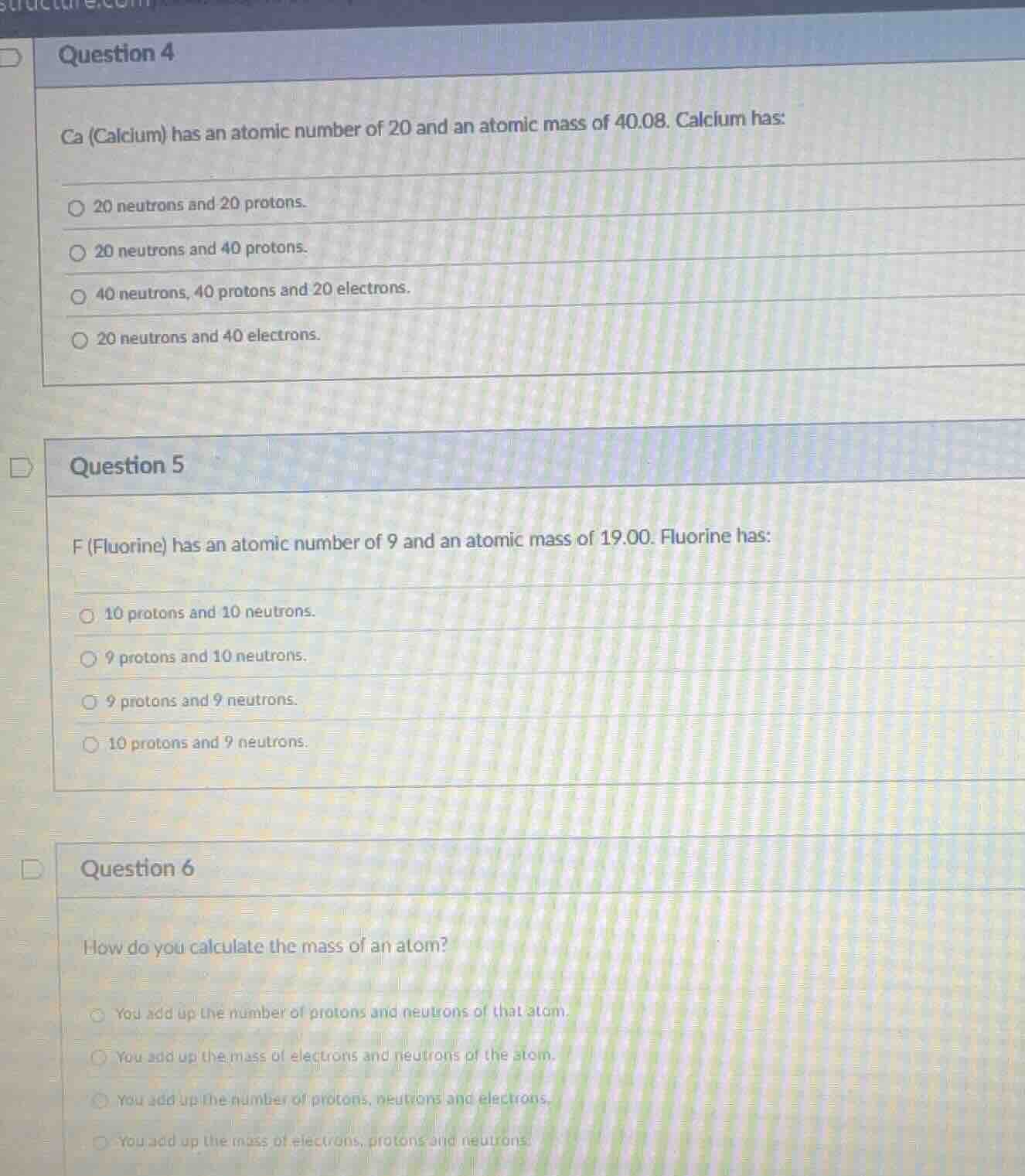
question 4
ca (calcium) has an atomic number of 20 and an atomic mass of 40.08. calcium has:
- 20 neutrons and 20 protons.
- 20 neutrons and 40 protons.
- 40 neutrons, 40 protons and 20 electrons.
- 20 neutrons and 40 electrons.
question 5
f (fluorine) has an atomic number of 9 and an atomic mass of 19.00. fluorine has:
- 10 protons and 10 neutrons.
- 9 protons and 10 neutrons.
- 9 protons and 9 neutrons.
- 10 protons and 9 neutrons.
question 6
how do you calculate the mass of an atom?
- you add up the number of protons and neutrons of that atom.
- you add up the mass of electrons and neutrons of the atom.
- you add up the number of protons, neutrons and electrons.
- you add up the mass of electrons, protons and neutrons.
Determine subatomic particles of Calcium
Using the Atomic Number and Protons and Mass Number and Neutrons knowledge points
Determine subatomic particles of Fluorine
Using the Atomic Number and Protons and Mass Number and Neutrons knowledge points
Calculate the mass of an atom
The mass of an atom is concentrated in its nucleus, which contains protons and neutrons. Electrons have negligible mass. Therefore, the mass number of an atom is calculated by adding the number of protons and neutrons.

Snap & solve any problem in the app
Get step-by-step solutions on Sovi AI
Photo-based solutions with guided steps
Explore more problems and detailed explanations
Question 4
- 20 neutrons and 20 protons. (Correct answer)
- 20 neutrons and 40 protons.
- 40 neutrons, 40 protons and 20 electrons.
- 20 neutrons and 40 electrons.
Question 5
- 10 protons and 10 neutrons.
- 9 protons and 10 neutrons. (Correct answer)
- 9 protons and 9 neutrons.
- 10 protons and 9 neutrons.
Question 6
- You add up the number of protons and neutrons of that atom. (Correct answer)
- You add up the mass of electrons and neutrons of the atom.
- You add up the number of protons, neutrons and electrons.
- You add up the mass of electrons, protons and neutrons.