QUESTION IMAGE
Question
question 1
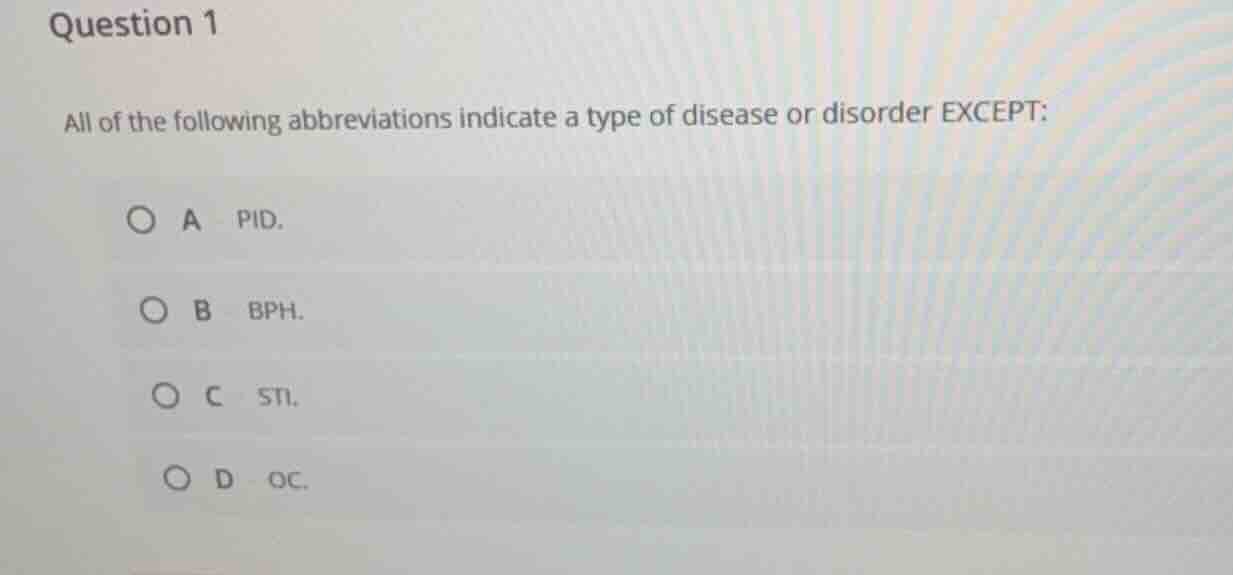
all of the following abbreviations indicate a type of disease or disorder except:
a pid.
b bph.
c sti.
d oc.
<pre_analysis>
{
"quality": "clear",
"question_count": 1,
"skills_matched": [
"direct_cot",
"multiple_choice_formatter",
"explain_then_answer",
"tutor"
],
"needs_drawing": false,
"concepts_used": [],
"new_concepts": [
"Medical Abbreviations",
"Reproductive System Pathology",
"Pharmacological Abbreviations"
],
"current_concepts": [
"Medical Abbreviations",
"Reproductive System Pathology",
"Pharmacological Abbreviations"
]
}
</pre_analysis>
<reasoning>
Define the medical abbreviation PID
PID stands for Pelvic Inflammatory Disease. This is an infection and inflammation of the female reproductive organs, which is classified as a disease or disorder.
Define the medical abbreviation BPH
BPH stands for Benign Prostatic Hyperplasia. This is a common condition in aging men where the prostate gland becomes enlarged, which is classified as a disease or disorder.
Define the medical abbreviation STI
STI stands for Sexually Transmitted Infection. This refers to infections spread primarily through sexual contact, which is classified as a disease or disorder.
Define the medical abbreviation OC
OC stands for Oral Contraceptive. Oral contraceptives (birth control pills) are medications used to prevent pregnancy, not a disease or disorder.
Identify the exception
Comparing the definitions, PID, BPH, and STI all represent diseases, infections, or pathological disorders. OC represents a pharmacological intervention (medication). Therefore, OC is the correct exception.
</reasoning>
<answer>
<mcq-option>(A) PID.</mcq-option>
<mcq-option>(B) BPH.</mcq-option>
<mcq-option>(C) STI.</mcq-option>
<mcq-correct>(D) OC.</mcq-correct>
</answer>
<post_analysis>
{
"subject": "Natural Science",
"question_type": "Multiple Choice",
"knowledge_point": [
"Natural Science",
"Medicine",
"Medical Terminology"
]
}
</post_analysis>
Snap & solve any problem in the app
Get step-by-step solutions on Sovi AI
Photo-based solutions with guided steps
Explore more problems and detailed explanations
<pre_analysis>
{
"quality": "clear",
"question_count": 1,
"skills_matched": [
"direct_cot",
"multiple_choice_formatter",
"explain_then_answer",
"tutor"
],
"needs_drawing": false,
"concepts_used": [],
"new_concepts": [
"Medical Abbreviations",
"Reproductive System Pathology",
"Pharmacological Abbreviations"
],
"current_concepts": [
"Medical Abbreviations",
"Reproductive System Pathology",
"Pharmacological Abbreviations"
]
}
</pre_analysis>
<reasoning>
Define the medical abbreviation PID
PID stands for Pelvic Inflammatory Disease. This is an infection and inflammation of the female reproductive organs, which is classified as a disease or disorder.
Define the medical abbreviation BPH
BPH stands for Benign Prostatic Hyperplasia. This is a common condition in aging men where the prostate gland becomes enlarged, which is classified as a disease or disorder.
Define the medical abbreviation STI
STI stands for Sexually Transmitted Infection. This refers to infections spread primarily through sexual contact, which is classified as a disease or disorder.
Define the medical abbreviation OC
OC stands for Oral Contraceptive. Oral contraceptives (birth control pills) are medications used to prevent pregnancy, not a disease or disorder.
Identify the exception
Comparing the definitions, PID, BPH, and STI all represent diseases, infections, or pathological disorders. OC represents a pharmacological intervention (medication). Therefore, OC is the correct exception.
</reasoning>
<answer>
<mcq-option>(A) PID.</mcq-option>
<mcq-option>(B) BPH.</mcq-option>
<mcq-option>(C) STI.</mcq-option>
<mcq-correct>(D) OC.</mcq-correct>
</answer>
<post_analysis>
{
"subject": "Natural Science",
"question_type": "Multiple Choice",
"knowledge_point": [
"Natural Science",
"Medicine",
"Medical Terminology"
]
}
</post_analysis>