QUESTION IMAGE
Question
question 43 points 3
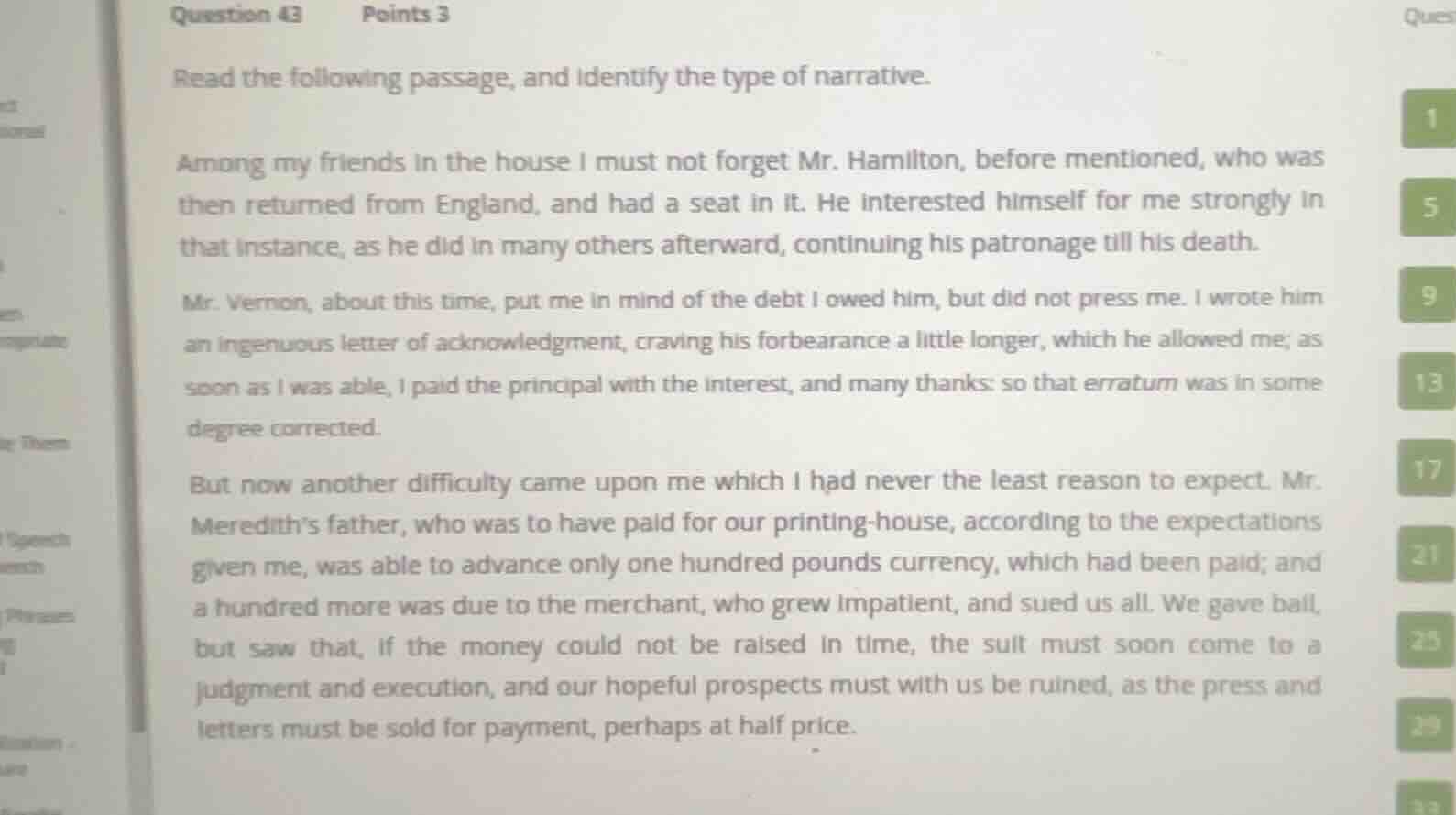
read the following passage, and identify the type of narrative.
among my friends in the house i must not forget mr. hamilton, before mentioned, who was then returned from england, and had a seat in it. he interested himself for me strongly in that instance, as he did in many others afterward, continuing his patronage till his death.
mr. vernon, about this time, put me in mind of the debt i owed him, but did not press me. i wrote him an ingenuous letter of acknowledgment, craving his forbearance a little longer, which he allowed me; as soon as i was able, i paid the principal with the interest, and many thanks: so that erratum was in some degree corrected.
but now another difficulty came upon me which i had never the least reason to expect. mr. merediths father, who was to have paid for our printing-house, according to the expectations given me, was able to advance only one hundred pounds currency, which had been paid; and a hundred more was due to the merchant, who grew impatient, and sued us all. we gave bail, but saw that, if the money could not be raised in time, the suit must soon come to a judgment and execution, and our hopeful prospects must with us be ruined, as the press and letters must be sold for payment, perhaps at half price.
🆕 New Concept Discovered: Narrative Types
Identifying the genre and perspective of a text.
Step 1: Analyze the pronoun usage and perspective
To identify the type of narrative, we first look at who is telling the story.
Throughout the passage, the narrator uses first-person pronouns:
- "Among my friends..."
- "...interested himself for me strongly..."
- "...put me in mind of the debt I owed him..."
- "...I wrote him..."
This tells us that the narrative is written from a first-person point of view, where the author is recounting events from their own life.
Step 2: Analyze the content and tone
Next, we look at what is being described:
- The narrator discusses real-life personal relationships, financial debts, business dealings (a printing-house), and personal struggles.
- The tone is factual, reflective, and historical rather than fictional.
- The mention of correcting an "erratum" (a mistake) and dealing with real historical figures (like Mr. Hamilton and Mr. Vernon) indicates this is a non-fictional account of the writer's own life.
This specific style of writing—a first-person, non-fictional account of one's own life experiences—is an autobiography (specifically, this passage is an excerpt from The Autobiography of Benjamin Franklin).

Snap & solve any problem in the app
Get step-by-step solutions on Sovi AI
Photo-based solutions with guided steps
Explore more problems and detailed explanations
Autobiographical narrative (or First-person non-fiction / Autobiography)