QUESTION IMAGE
Question
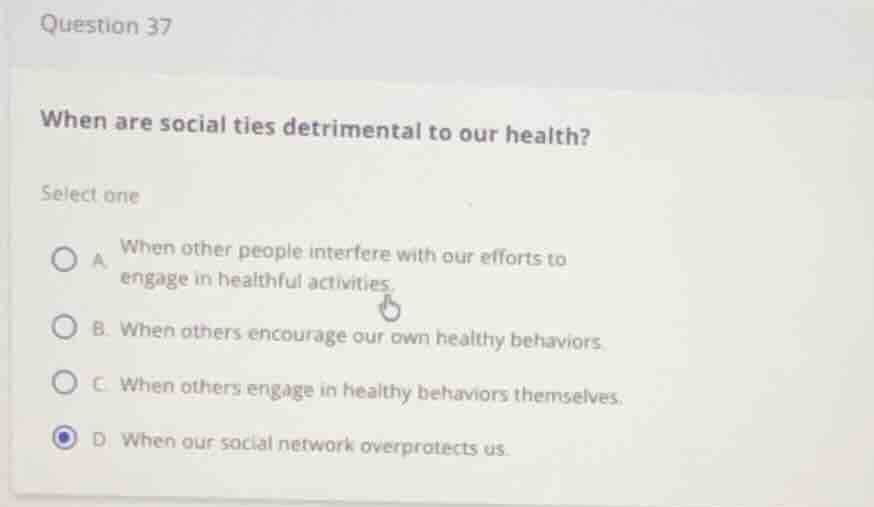
question 37
when are social ties detrimental to our health?
select one
a. when other people interfere with our efforts to engage in healthful activities.
b. when others encourage our own healthy behaviors.
c. when others engage in healthy behaviors themselves.
d. when our social network overprotects us.
Analyze the question prompt
The question asks when social ties can be detrimental (harmful) to our health. While social networks and Social Support are generally beneficial, certain dynamics can lead to negative health outcomes.
Evaluate option A
Option A states: "When other people interfere with our efforts to engage in healthful activities." This describes a direct negative influence or barrier to healthy behaviors, which is a well-documented way social ties can be detrimental.
Evaluate option B and C
Option B ("When others encourage our own healthy behaviors") and Option C ("When others engage in healthy behaviors themselves") describe positive social influences that promote wellness, making them beneficial rather than detrimental.
Evaluate option D
Option D states: "When our social network overprotects us." While overprotection (such as overprotective parenting or partner behavior) can sometimes limit autonomy, in general health psychology, direct interference with health-promoting behaviors (Option A) is the primary, most direct way social ties act detrimentally against health efforts. Let's re-verify standard health psychology curriculum definitions. Social ties are detrimental when they encourage unhealthy behaviors or directly interfere with positive health habits (Option A).
Formulate the final selection
Option A directly addresses the negative impact of social ties on health behaviors.

Snap & solve any problem in the app
Get step-by-step solutions on Sovi AI
Photo-based solutions with guided steps
Explore more problems and detailed explanations
- (A) When other people interfere with our efforts to engage in healthful activities. (Correct answer)
- (B) When others encourage our own healthy behaviors.
- (C) When others engage in healthy behaviors themselves.
- (D) When our social network overprotects us.