QUESTION IMAGE
Question
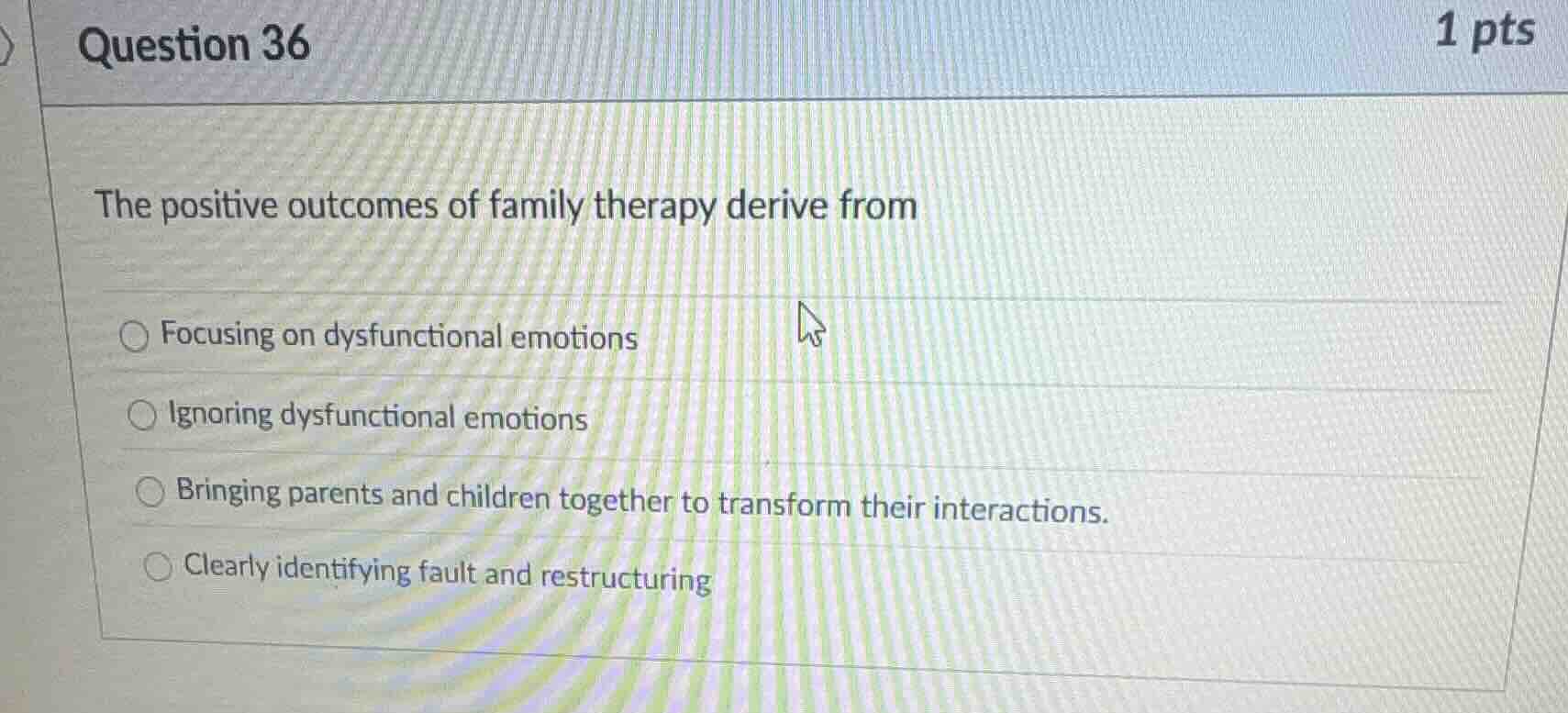
question 36
the positive outcomes of family therapy derive from
focusing on dysfunctional emotions
ignoring dysfunctional emotions
bringing parents and children together to transform their interactions.
clearly identifying fault and restructuring
🆕 New Concept Discovered: Family Systems Theory
Understanding how family dynamics and interactions shape individual behavior.
Step 1: Analyze the core objective of family therapy
Family therapy is built on the premise that individuals cannot be understood in isolation from one another, but rather as part of their family unit (a dynamic system). The primary goal is not to assign blame or focus solely on individual pathology, but to address and improve the patterns of communication and relationships among family members.
Step 2: Evaluate the given options
- Focusing on dysfunctional emotions: While emotions are discussed, simply focusing on dysfunctional emotions without changing the relational structure does not address the systemic root of the family's issues.
- Ignoring dysfunctional emotions: Ignoring emotions is counterproductive in almost all therapeutic modalities, including family therapy.
- Bringing parents and children together to transform their interactions: This aligns directly with systemic therapy. By bringing the family members together, the therapist can observe, intervene in, and help transform the dysfunctional communication patterns and behavioral interactions in real-time.
- Clearly identifying fault and restructuring: Family therapy explicitly avoids assigning "fault" or identifying a single "problem person" (often called the identified patient), as this damages the collaborative therapeutic alliance and misrepresents the systemic nature of family issues.

Snap & solve any problem in the app
Get step-by-step solutions on Sovi AI
Photo-based solutions with guided steps
Explore more problems and detailed explanations
Bringing parents and children together to transform their interactions.