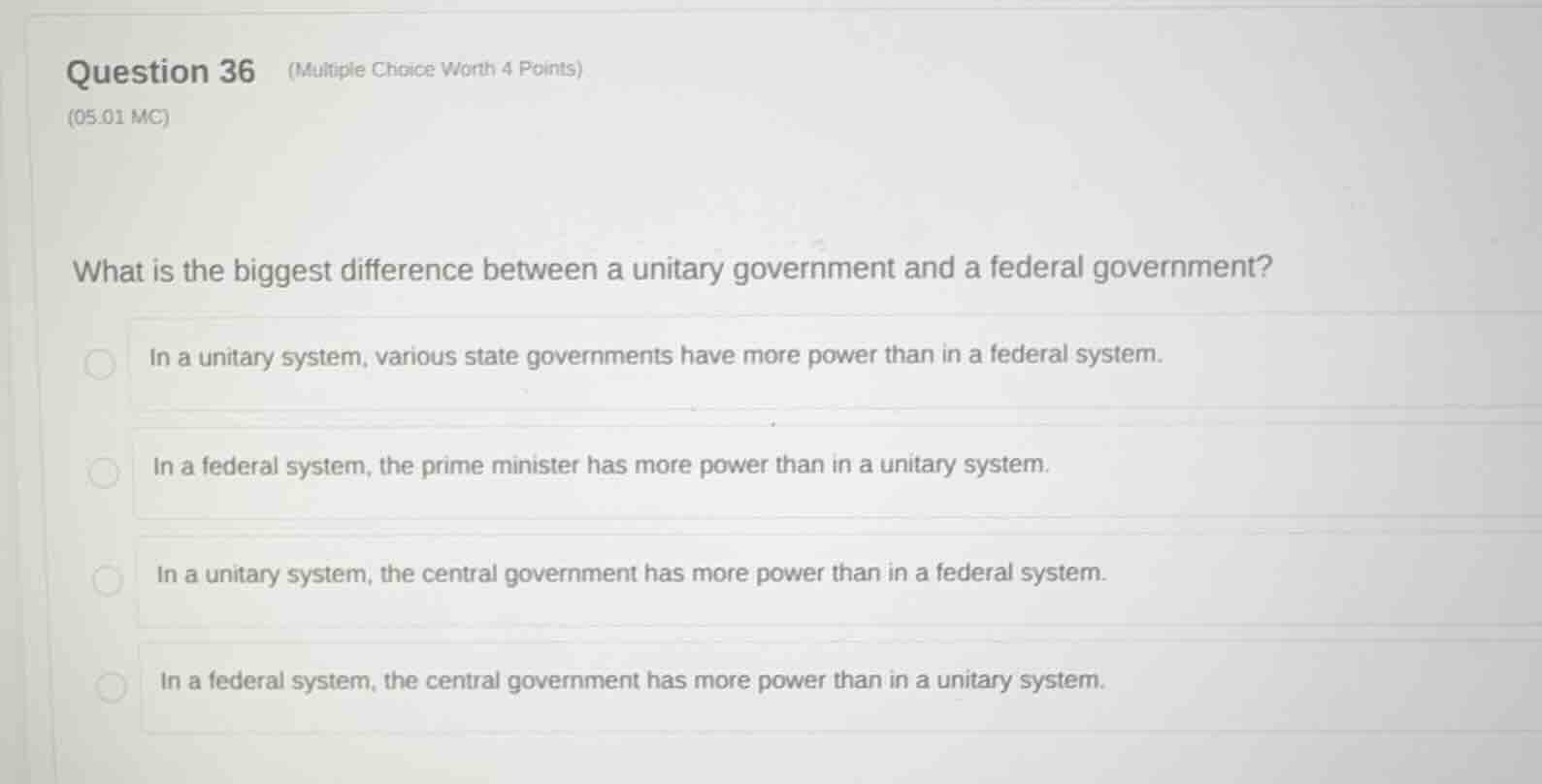
QUESTION IMAGE
Question
question 36 (multiple choice worth 4 points)
(05.01 mc)
what is the biggest difference between a unitary government and a federal government?
in a unitary system, various state governments have more power than in a federal system.
in a federal system, the prime minister has more power than in a unitary system.
in a unitary system, the central government has more power than in a federal system.
in a federal system, the central government has more power than in a unitary system.
<pre_analysis>
{
"quality": "clear",
"question_count": 1,
"skills_matched": [
"direct_cot",
"multiple_choice_formatter",
"explain_then_answer",
"tutor",
"mastery_adaptive_brevity"
],
"needs_drawing": false,
"concepts_used": [
"Federalism",
"Forms of Government"
],
"new_concepts": [
"Unitary Government"
],
"current_concepts": [
"Federalism",
"Forms of Government",
"Unitary Government"
]
}
</pre_analysis>
<reasoning>
Define unitary and federal systems
Using the Forms of Government and Federalism knowledge points
- In a unitary system, all governing power is concentrated in a single, central national government, which may delegate minor tasks to local offices.
- In a federal system, power is constitutionally divided and shared between a central national government and regional state governments.
Compare the power distribution
Using the Federalism knowledge point
- Because a unitary system concentrates all sovereign authority at the national level, its central government holds significantly more power than the central government in a federal system, where power must be shared with states.
- Therefore, the statement "In a unitary system, the central government has more power than in a federal system" accurately describes the primary difference.
</reasoning>
<answer>
<mcq-option>(A) In a unitary system, various state governments have more power than in a federal system.</mcq-option>
<mcq-option>(B) In a federal system, the prime minister has more power than in a unitary system.</mcq-option>
<mcq-correct>(C) In a unitary system, the central government has more power than in a federal system.</mcq-correct>
<mcq-option>(D) In a federal system, the central government has more power than in a unitary system.</mcq-option>
</answer>
<post_analysis>
{
"subject": "Social Science",
"question_type": "Multiple Choice",
"knowledge_point": [
"Social Science",
"Political Science",
"Forms of Government"
]
}
</post_analysis>
Snap & solve any problem in the app
Get step-by-step solutions on Sovi AI
Photo-based solutions with guided steps
Explore more problems and detailed explanations
<pre_analysis>
{
"quality": "clear",
"question_count": 1,
"skills_matched": [
"direct_cot",
"multiple_choice_formatter",
"explain_then_answer",
"tutor",
"mastery_adaptive_brevity"
],
"needs_drawing": false,
"concepts_used": [
"Federalism",
"Forms of Government"
],
"new_concepts": [
"Unitary Government"
],
"current_concepts": [
"Federalism",
"Forms of Government",
"Unitary Government"
]
}
</pre_analysis>
<reasoning>
Define unitary and federal systems
Using the Forms of Government and Federalism knowledge points
- In a unitary system, all governing power is concentrated in a single, central national government, which may delegate minor tasks to local offices.
- In a federal system, power is constitutionally divided and shared between a central national government and regional state governments.
Compare the power distribution
Using the Federalism knowledge point
- Because a unitary system concentrates all sovereign authority at the national level, its central government holds significantly more power than the central government in a federal system, where power must be shared with states.
- Therefore, the statement "In a unitary system, the central government has more power than in a federal system" accurately describes the primary difference.
</reasoning>
<answer>
<mcq-option>(A) In a unitary system, various state governments have more power than in a federal system.</mcq-option>
<mcq-option>(B) In a federal system, the prime minister has more power than in a unitary system.</mcq-option>
<mcq-correct>(C) In a unitary system, the central government has more power than in a federal system.</mcq-correct>
<mcq-option>(D) In a federal system, the central government has more power than in a unitary system.</mcq-option>
</answer>
<post_analysis>
{
"subject": "Social Science",
"question_type": "Multiple Choice",
"knowledge_point": [
"Social Science",
"Political Science",
"Forms of Government"
]
}
</post_analysis>