QUESTION IMAGE
Question
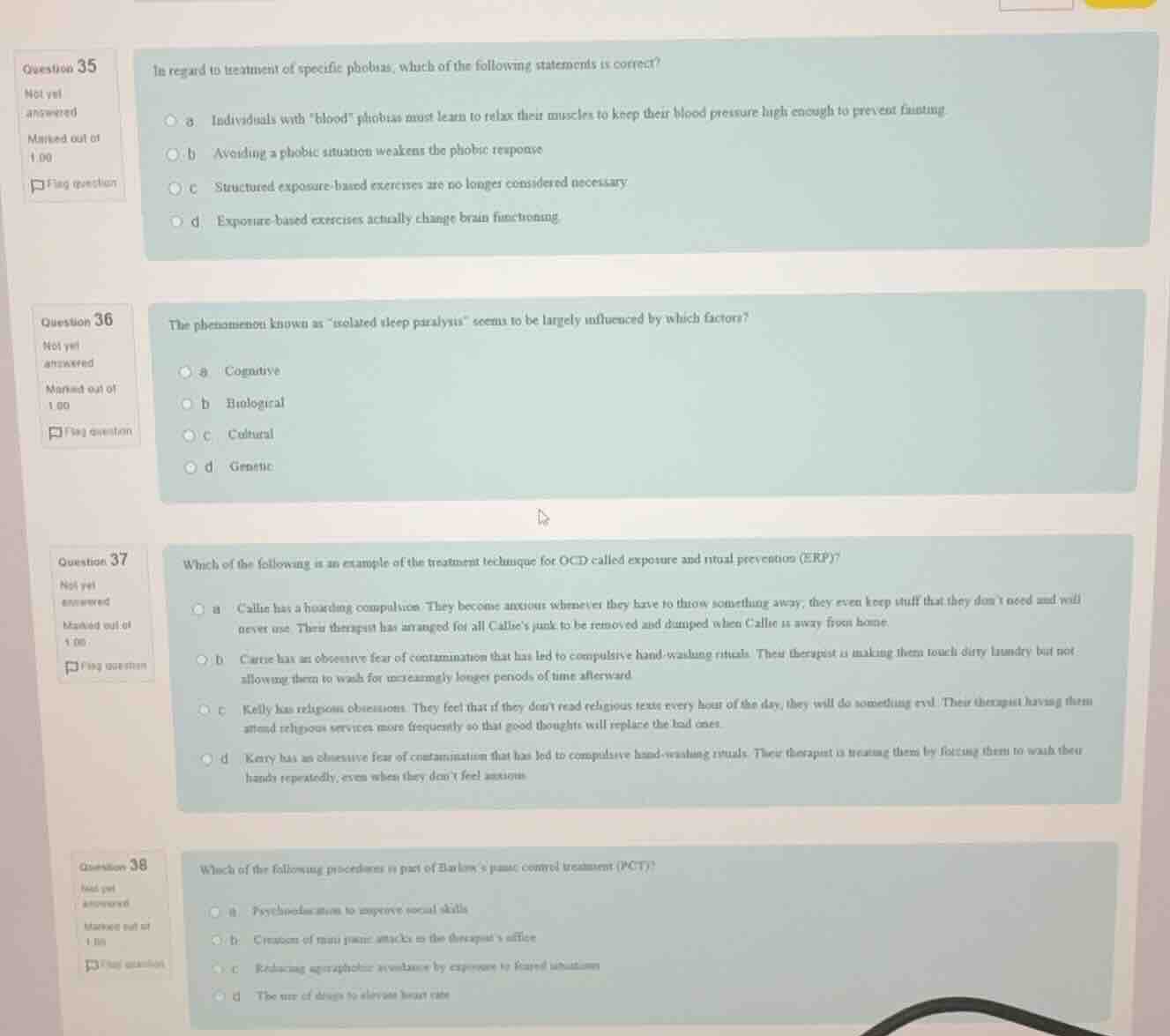
question 35
in regard to treatment of specific phobias, which of the following statements is correct?
a. individuals with \blood\ phobias must learn to relax their muscles to keep their blood pressure high enough to prevent fainting.
b. avoiding a phobic situation weakens the phobic response.
c. structured exposure-based exercises are no longer considered necessary.
d. exposure-based exercises actually change brain functioning.
question 36
the phenomenon known as \isolated sleep paralysis\ seems to be largely influenced by which factors?
a. cognitive
b. biological
c. cultural
d. genetic
question 37
which of the following is an example of the treatment technique for ocd called exposure and ritual prevention (erp)?
a. callie has a hoarding compulsion. they become anxious whenever they have to throw something away; they even keep stuff that they dont need and will never use. their therapist has arranged for all callies junk to be removed and dumped when callie is away from home.
b. carrie has an obsessive fear of contamination that has led to compulsive hand-washing rituals. their therapist is making them touch dirty laundry but not allowing them to wash for increasingly longer periods of time afterward.
c. kelly has religious obsessions. they feel that if they dont read religious texts every hour of the day, they will do something evil. their therapist having them attend religious services more frequently so that good thoughts will replace the bad ones.
d. kerry has an obsessive fear of contamination that has led to compulsive hand-washing rituals. their therapist is treating them by forcing them to wash their hands repeatedly, even when they dont feel anxious.
question 38
which of the following procedures is part of barlows panic control treatment (pct)?
a. psychoeducation to improve social skills
b. creation of mini panic attacks in the therapists office
c. reducing agoraphobic avoidance by exposure to feared situations
d. the use of drugs to elevate heart rate
Analyze Question 35 regarding specific phobias
- Option a is incorrect because individuals with blood-injury-injection phobia must tense their muscles (applied tension technique) to raise blood pressure and prevent fainting, not relax them.
- Option b is incorrect because avoidance strengthens the phobic response through negative reinforcement.
- Option c is incorrect because structured exposure-based exercises remain the gold standard treatment.
- Option d is correct because neuroimaging studies show that successful exposure therapy alters brain functioning in regions like the amygdala and prefrontal cortex.
Analyze Question 36 regarding isolated sleep paralysis
- Isolated sleep paralysis is highly associated with cultural interpretations and beliefs (such as "kanashibari" in Japan or "the witch riding you" in other cultures), which significantly influence its prevalence, reporting, and associated distress.
Analyze Question 37 regarding exposure and ritual prevention (ERP)
- ERP involves exposing the individual to the anxiety-provoking stimulus (exposure) and preventing the compulsive behavior (ritual prevention).
- Option b describes this perfectly: Carrie is exposed to dirty laundry (exposure) and is prevented from washing her hands (ritual prevention).
Analyze Question 38 regarding Barlow's panic control treatment (PCT)
- PCT targets panic attacks by exposing patients to interoceptive sensations (somatic cues) associated with panic.
- Option b is correct because it involves the deliberate creation of mini panic attacks (interoceptive exposure) in the therapist's office to habituate to the physical sensations.

Snap & solve any problem in the app
Get step-by-step solutions on Sovi AI
Photo-based solutions with guided steps
Explore more problems and detailed explanations
Question 35
- a. Individuals with "blood" phobias must learn to relax their muscles to keep their blood pressure high enough to prevent fainting
- b. Avoiding a phobic situation weakens the phobic response
- c. Structured exposure-based exercises are no longer considered necessary
- d. Exposure-based exercises actually change brain functioning (Correct answer)
Question 36
- a. Cognitive
- b. Biological</mcq-correct>
- c. Cultural (Correct answer)
<mcq-option>d. Genetic
Question 37
- a. Callie has a hoarding compulsion. They become anxious whenever they have to throw something away, they even keep stuff that they don't need and will never use. Their therapist has arranged for all Callie's junk to be removed and dumped when Callie is away from home.
- b. Carrie has an obsessive fear of contamination that has led to compulsive hand-washing rituals. Their therapist is making them touch dirty laundry but not allowing them to wash for increasingly longer periods of time afterward. (Correct answer)
- c. Kelly has religious obsessions. They feel that if they don't read religious texts every hour of the day, they will do something evil. Their therapist having them attend religious services more frequently so that good thoughts will replace the bad ones.
- d. Kerry has an obsessive fear of contamination that has led to compulsive hand-washing rituals. Their therapist is treating them by forcing them to wash their hands repeatedly, even when they don't feel anxious.
Question 38
- a. Psychoeducation to improve social skills
- b. Creation of mini panic attacks in the therapist's office (Correct answer)
- c. Reducing agoraphobic avoidance by exposure to feared situations
- d. The use of drugs to elevate heart rate