Sovi.AI - AI Math Tutor

Scan to solve math questions

QUESTION IMAGE

question 9 of 25 true or false: when approaching a railroad crossing, y…

Question

question 9 of 25

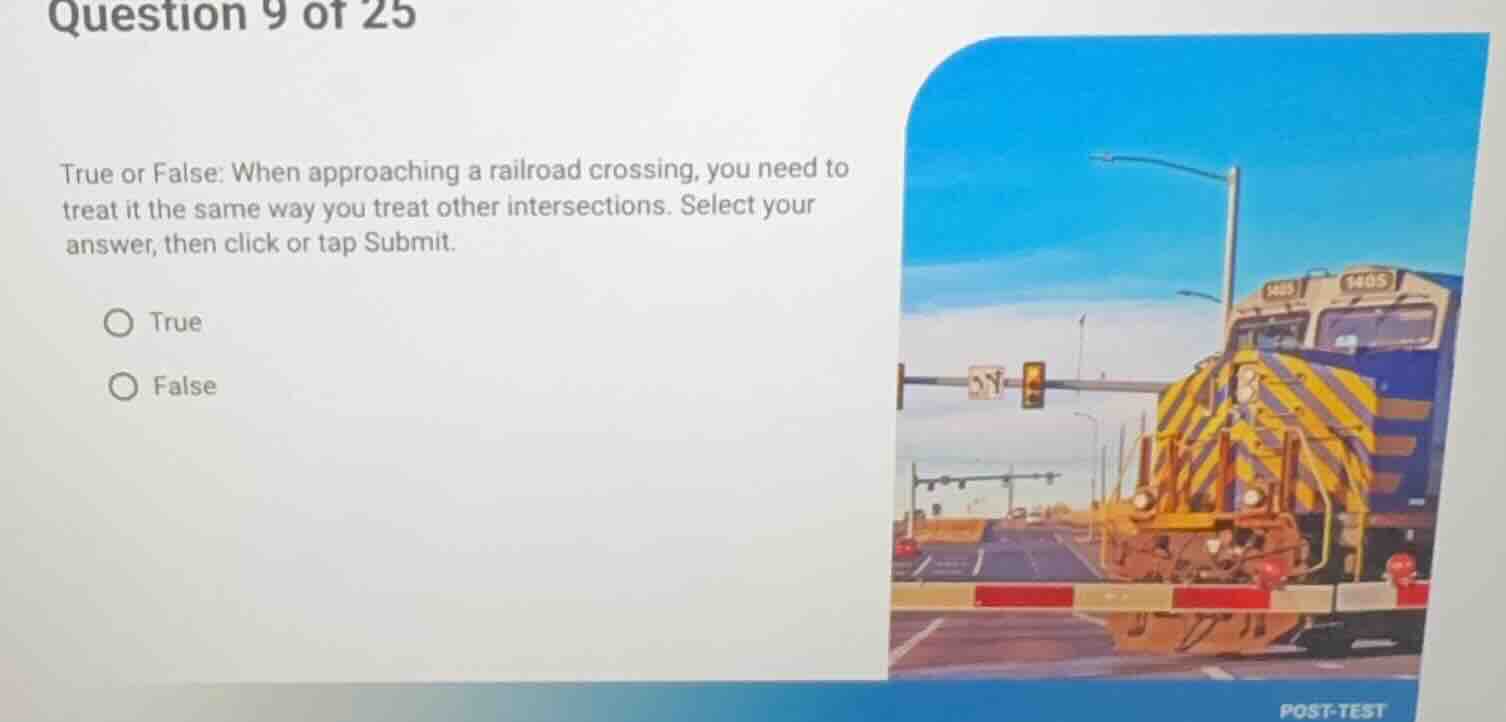
true or false: when approaching a railroad crossing, you need to treat it the same way you treat other intersections. select your answer, then click or tap submit.

true
false

Explanation:

Response

<pre_analysis>
{
"quality": "clear",
"question_count": 1,
"skills_matched": [
"direct_cot",
"multiple_choice_formatter",
"explain_then_answer",
"tutor"
],
"needs_drawing": false,
"concepts_used": [
"Intersection Safety"
],
"new_concepts": [
"Railroad Crossing Safety"
],
"current_concepts": [
"Intersection Safety",
"Railroad Crossing Safety"
]
}
</pre_analysis>

<reasoning>

Analyze the nature of railroad crossings

Railroad crossings are unique intersections where roadways meet train tracks. Unlike standard roadway intersections governed by traffic lights or stop signs where vehicles share similar stopping capabilities, trains have massive momentum and cannot stop quickly to avoid a collision.

Compare with standard intersections

Using your knowledge of Intersection Safety, standard intersections require scanning for cross traffic, pedestrians, and yielding the right-of-way. However, railroad crossings require specialized defensive driving behaviors:

  • You must always yield the absolute right-of-way to trains.
  • You must expect a train on any track at any time.
  • You must never stop on the tracks or pass near the crossing.

Therefore, treating them exactly the same way as standard intersections is incorrect and dangerous.
</reasoning>

<answer>
<mcq-option>True</mcq-option>
<mcq-correct>False</mcq-correct>
</answer>

<post_analysis>
{
"subject": "Others",
"question_type": "Multiple Choice",
"knowledge_point": [
"Others",
"Driver Education",
"Railroad Crossing Safety"
]
}
</post_analysis>

Answer:

<pre_analysis>
{
"quality": "clear",
"question_count": 1,
"skills_matched": [
"direct_cot",
"multiple_choice_formatter",
"explain_then_answer",
"tutor"
],
"needs_drawing": false,
"concepts_used": [
"Intersection Safety"
],
"new_concepts": [
"Railroad Crossing Safety"
],
"current_concepts": [
"Intersection Safety",
"Railroad Crossing Safety"
]
}
</pre_analysis>

<reasoning>

Analyze the nature of railroad crossings

Railroad crossings are unique intersections where roadways meet train tracks. Unlike standard roadway intersections governed by traffic lights or stop signs where vehicles share similar stopping capabilities, trains have massive momentum and cannot stop quickly to avoid a collision.

Compare with standard intersections

Using your knowledge of Intersection Safety, standard intersections require scanning for cross traffic, pedestrians, and yielding the right-of-way. However, railroad crossings require specialized defensive driving behaviors:

  • You must always yield the absolute right-of-way to trains.
  • You must expect a train on any track at any time.
  • You must never stop on the tracks or pass near the crossing.

Therefore, treating them exactly the same way as standard intersections is incorrect and dangerous.
</reasoning>

<answer>
<mcq-option>True</mcq-option>
<mcq-correct>False</mcq-correct>
</answer>

<post_analysis>
{
"subject": "Others",
"question_type": "Multiple Choice",
"knowledge_point": [
"Others",
"Driver Education",
"Railroad Crossing Safety"
]
}
</post_analysis>