QUESTION IMAGE
Question
question 23
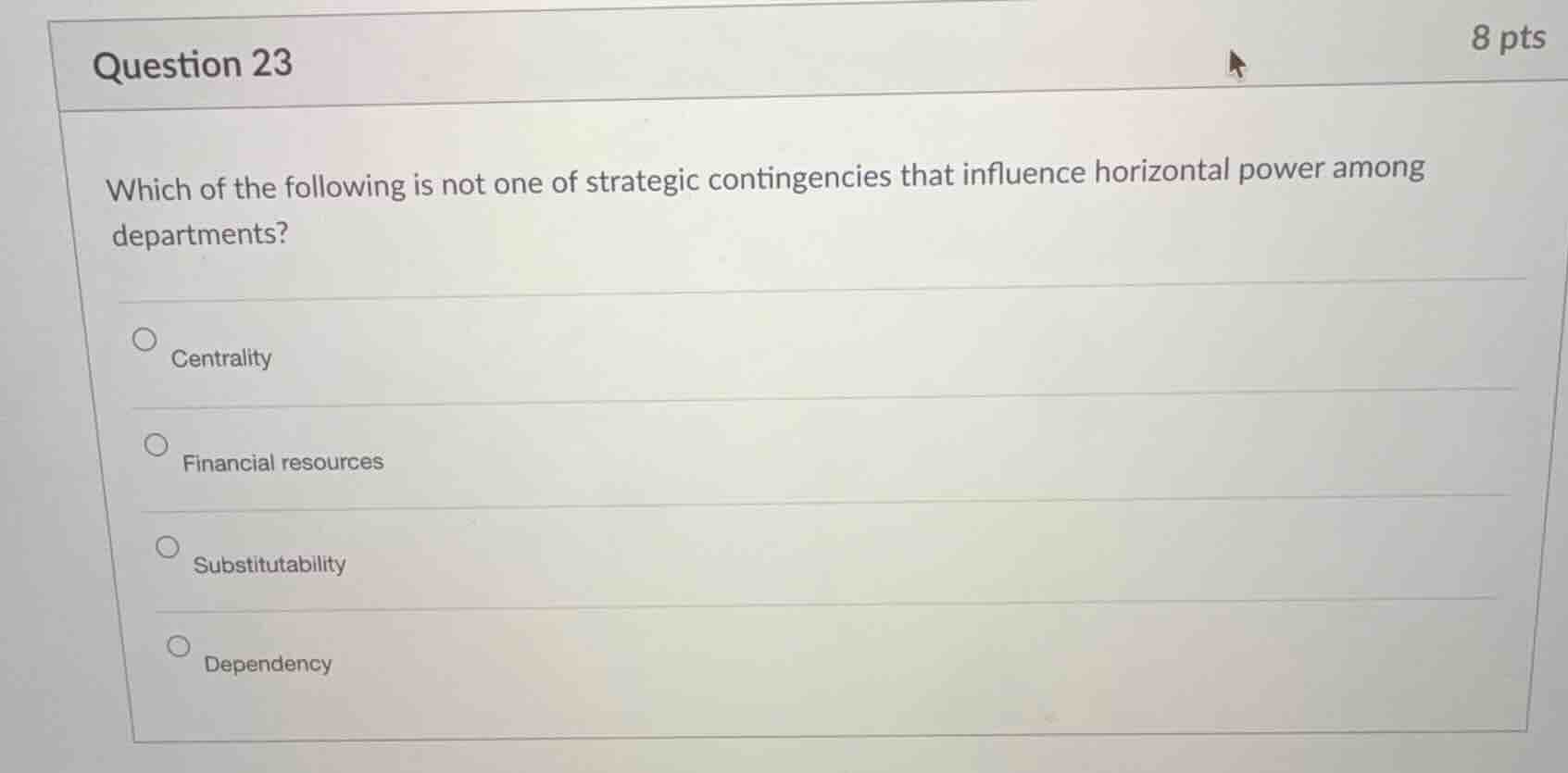
which of the following is not one of strategic contingencies that influence horizontal power among departments?
centrality
financial resources
substitutability
dependency
Define strategic contingencies theory
Using the Strategic Contingencies Theory and Horizontal Power knowledge points
- Strategic contingencies are activities or capabilities critical to an organization's success.
- Departments gain horizontal power by helping the organization resolve these key uncertainties.
- The model identifies specific factors that determine a department's power.
Analyze the core contingencies
Using the Strategic Contingencies Theory knowledge point
- Dependency: Power stems from other departments depending on yours.
- Financial resources: Controlling critical funds or resource allocation grants power.
- Centrality: Being central to the primary workflow of the organization increases power.
- Substitutability: If a department's functions cannot be easily replaced, its power increases.
Identify the non-contingency option
Using the Strategic Contingencies Theory knowledge point
- Dependency is a consequence of strategic contingencies rather than a distinct contingency itself.
- The primary contingencies are resource control, centrality, nonsubstitutability, and coping with uncertainty.
- Therefore, "Dependency" is the option that is not classified as one of the direct strategic contingencies.

Snap & solve any problem in the app
Get step-by-step solutions on Sovi AI
Photo-based solutions with guided steps
Explore more problems and detailed explanations
- Centrality
- Financial resources
- Substitutability
- Dependency (Correct answer)